

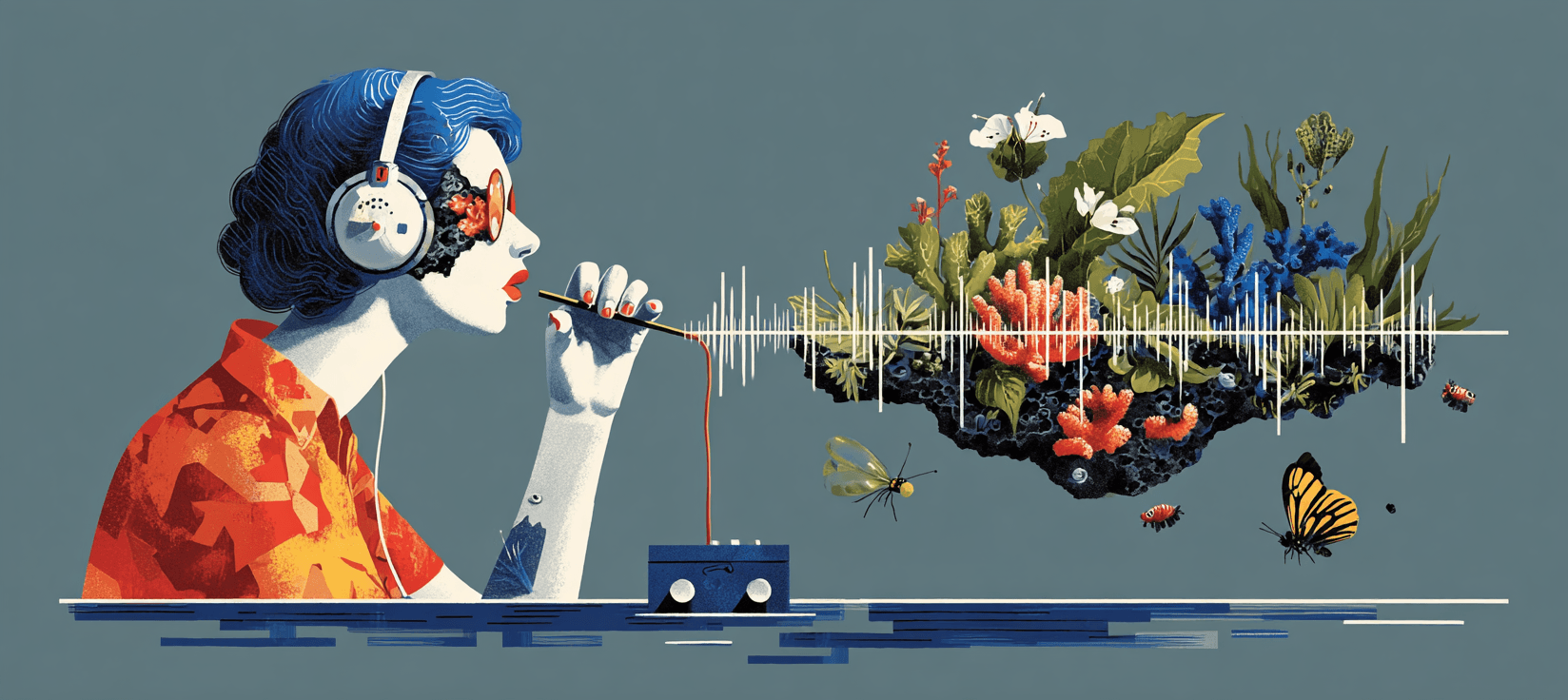
The patch reef was about two hundred yards off Elliott Key, in twelve feet of water. I anchored the skiff on the sand flat south of it and swam the hydrophone out.
An Aquarian H2a on thirty feet of cable, running back to the MixPre in a dry bag on the console. The H2a isn't my best hydrophone but it's the most forgiving in shallows. Less handling noise, and the midrange emphasis works for what's left of the biological band on these reefs. I clipped the housing to a cinder block I'd sunk the week before, positioned it a meter off the substrate facing down to cut surface noise. Swam back through water the color of weak tea, visibility maybe four feet, the cable paying out behind me. Waited for the sediment to settle.
Tuesday in October. The water was flat, which almost never happens during king tide season. I'd been watching the charts for two weeks. Eighty-nine degrees on the water. The console was too hot to rest a hand on by ten o'clock, and the salt dried white on my forearms as fast as I could wipe it.
I let the system run twenty minutes before I put the cans on.
What you hear standing on a skiff in Biscayne Bay is boat traffic and wind and water slapping fiberglass. What the hydrophone heard was quieter than that. Some snapping shrimp in the 2-to-20 kilohertz range, the crackle that on a healthy reef sounds like a frying pan, this dense static that used to be so loud it masked everything in the high frequencies. Here it sounded like a few pieces of cereal in a big bowl. Isolated pops with silence between them.
Below 1500 hertz, where the fish chorus lives, almost nothing. A faint pulse around 400 that might have been a toadfish. Might have been mechanical. I let it run.
Recording 32-bit float so I didn't have to ride the levels. Good, because there wasn't much to ride. Ninety minutes on the skiff. The dry bag radiated heat against my knee. I made notes on my phone: site BNP-PR-07, substrate approximately 80 percent algal turf, scattered Porites heads. I'd seen one parrotfish on the swim out. No scraping sounds on the recording.
The thing about a hydrophone is it holds steady. Your ears normalize. You stand on a boat for an hour and the wind and the slap become nothing, your brain files them away. The hydrophone sits at the sensitivity you set and it captures what's present in the frequency range, and it captures what isn't. The waveform looks like a line that should have more activity on it.
I pulled the hydrophone, coiled the cable slowly because any vibration on the connector travels straight to the file, and motored south.
The hammock was on the mainland side, off an access road south of Cutler Bay. It used to be hardwood. Gumbo limbo, mastic, wild tamarind. Canopy species that need fresh water in the root zone. Now it was mostly standing dead trunks and black needlerush, the salt-tolerant grass that moves in when the water table comes up. The ground was wet. It's usually wet now.
I set up a pair of Sennheiser MKH 8040s in ORTF on a low stand, deadcats on, positioned at the edge of where the canopy used to be. Here I was recording air. Even a two-knot breeze at that sensitivity sounds like someone breathing on the diaphragm. I waited for a lull and hit record.
Insects. Some. No painted buntings, which used to breed in these hammocks. No white-crowned pigeons. One Carolina wren at a distance that put it in the remaining live oaks further inland. The needlerush made a sound when the breeze came through, a dry whisper nothing like what used to be here. A hardwood canopy in wind is layered. Broad leaves and narrow leaves and bark and branch, each at different frequencies. Needlerush is one frequency. One texture.
I recorded for an hour. The water table was high enough that my boots were soaked through by the time I broke down the stand.
Back in the truck I transferred files to the SSD. Named them: BNP-PR-07_20311014_hydro_90min.wav and CUTLR-HH-03_20311014_amb_60min.wav. Embedded the metadata in the BWF header. Date, coordinates, gear chain, habitat notes. The habitat notes take the longest because I try to be specific. I wrote: Patch reef, degraded. Algal turf dominant. Minimal live coral cover. Shrimp activity sparse, fish chorus largely absent. For the hammock: Former coastal hardwood hammock, salt-intruded. Canopy 80–90% dead. Ground saturated. Avian activity minimal.
I labeled the drive and put it in the case with the others. Fourteen drives, each a terabyte. I have a shipping label for a facility in Culpeper, Virginia. I keep meaning to make copies first.
Things to follow up on...
-
Reefs sound their decline: Researchers have found that healthy and restored reef soundscapes exhibit significantly higher biotic sound diversity than degraded ones, and that the resulting silence actively discourages new marine life from settling, creating a feedback loop between acoustic emptiness and ecological collapse.
-
Florida's coral collapse accelerates: A NASA assessment found that live coral cover across Florida's Reef Tract has fallen to approximately 2 percent, with at least 97 percent of elkhorn and staghorn coral now dead or dying after the 2023 marine heatwave delivered nearly three times the cumulative heat stress of any previous event on record.
-
Ghost forests move inland: Rising sea levels are pushing saltwater into freshwater-dependent coastal hammocks across the Southeast, killing hardwood canopy species and replacing them with salt-tolerant marsh grass in a transformation visible as standing dead trunks silhouetted against open sky where dense forest used to be.
-
Biscayne Bay's quiet crisis: Over the past two decades, Biscayne Bay has lost 21 square miles of seagrass beds, with only one of twelve monitoring sites receiving a "good" rating in the most recent report card, as nutrient pollution and algal blooms continue to choke the ecosystem that once supported the reef's food web.