
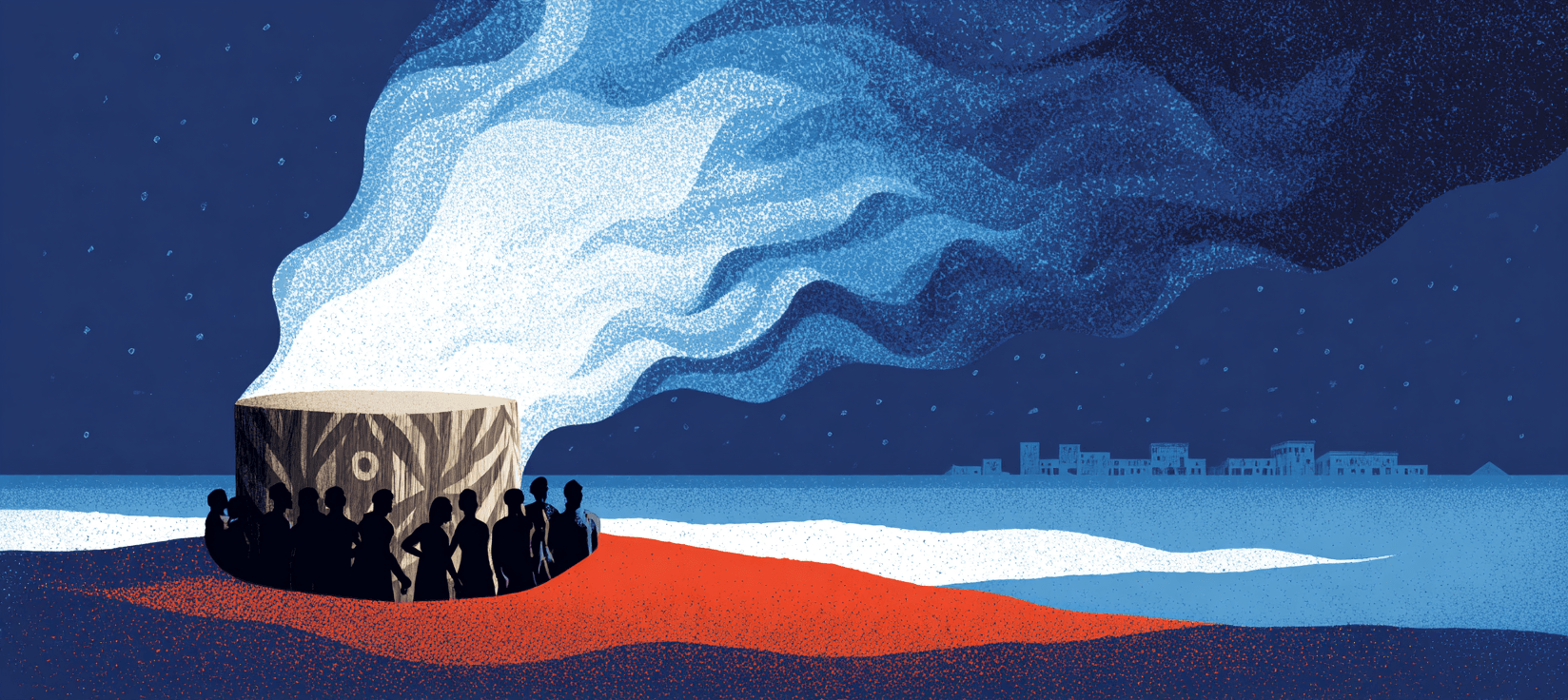
The percussion starts around 6 PM at El Batey Puerto Rican Center on Buffalo's Lower West Side, even with winter storm warnings blanketing Western New York. Darnel Davila, 18, leads the bomba drumming. The African-rooted Puerto Rican rhythm that his teacher Beatriz Flores calls "the encapsulated expression of Puerto Rican history and ethos." Outside, lake-effect snow is coming. Heavy bands, strong winds, temperatures that'll kill you if you're caught out too long. Inside, the drums keep going.
January 2026, and climate refuge looks like bomba classes continuing through winter storm warnings because the community that caught you when you arrived eight years ago is still here, still teaching, still holding space.
When Davila opened his door in Loiza, Puerto Rico, the morning after Hurricane Maria in September 2017, his neighborhood had disappeared. Streets flooded, trees uprooted, the gym where he'd spent his childhood shooting hoops reduced to rubble. His family came to Buffalo because, as he puts it, "we had somebody who would give us some place to stay. There was a very strong community in Buffalo." Around 10,000 people made similar moves in the weeks and months after Maria struck.
Buffalo's then-mayor declared the city would be "a climate refuge city for centuries to come." Economic development organizations launched campaigns pitching Buffalo's harsh winters as an asset. Stable, predictable, safe from coastal disasters. The "Be in Buffalo" talent attraction program specifically targeted climate migrants. Come north, the pitch said. Trade hurricanes for snow. Trade rising seas for lake effect.
Buffalo declared itself a climate refuge in 2017. The city adopted its first Climate Action Plan in 2025—eight years later, two years after a Christmas blizzard killed more than 40 people.
The pitch worked well enough to get people here. What it didn't mention: Buffalo's version of climate stability includes the occasional 200-inch snow season. Or that in December 2022, three years after the refuge declaration, a Christmas blizzard would kill more than 40 people, many of them in the neighborhoods where Puerto Rican families had settled.
Kelley St. John, Buffalo's first climate action manager, was snowed in at her North Buffalo home during that storm, agonizing about city residents weathering the blizzard without enough heat or food. She started her role in early 2023. Six years after Buffalo declared itself a climate refuge. The city adopted its inaugural Climate Action Plan in early 2025. Eight years between the marketing campaign and the actual planning. Two years after people froze to death.
Of those 10,000 people who came after Maria, many moved elsewhere or returned to the island. Census data shows Buffalo gained roughly 6,000 Puerto Ricans between 2015 and 2019. By 2022, New York State as a whole saw a net decline of nearly 2,000 Puerto Ricans. Employment, family, and social networks determined who stayed and who left.
The ones who stayed did so because of what Beatriz Flores built at El Batey, what the Hispanic Heritage Council is constructing in a $30 million cultural institute on Niagara Street, what informal networks of people helping people created before any city official wrote a climate vulnerability assessment. More than $2.4 million in building upgrades went to the Isaías González-Soto Branch Library on the Lower West Side, completed this past January. Refuge mechanisms that actually work.
Alberto Cappas, a writer who came to Buffalo from Puerto Rico via New York City in the 1960s, watched the post-Maria response unfold. "After Hurricane Maria, the local Latino community raised money to bring people affected here," he told Great Lakes Now. People got help with housing, employment, counseling. "It helped a great deal," he said. Then he added something that cuts deeper:
"They feed the stomach, but not the mind."
At El Batey, Flores teaches bomba and plena to kids and adults. Cultural dance and percussion that connects participants to their African and Indigenous descent. The classes ran through the December 2022 blizzard. They ran through last week's storm. They'll run through this weekend's warnings. Preservation of culture as a form of survival, community infrastructure that functions when municipal infrastructure fails.
Assemblymember Jonathan Rivera, whose family migrated from Puerto Rico and who now represents parts of Buffalo where large numbers of Puerto Ricans live, knows what determines whether refuge works:
"Your public school system has to be prepared and well-positioned to handle that because that's where a lot of folks fall through the cracks."
More than 500 students from Puerto Rico enrolled in Buffalo K-12 schools immediately after Maria. That's 500 kids who needed bilingual education, who needed teachers who understood what they'd been through, who needed a school system ready to catch them.
Buffalo's climate planning documents now talk about "vulnerabilities." Areas where climate may disrupt services or threaten at-risk communities. Phase 2 of the Climate Resiliency Planning Initiative commenced last spring. There's a curbside composting pilot program, LED streetlights, porous pavement. A Climate Vulnerability Assessment that will be "expanded upon with resident insights." All of it matters. All of it came years after the people who needed it arrived.
The winter storm that hit this past weekend dumped another foot or more of snow on Western New York. Mayor Sean Ryan coordinated 40 pieces of equipment, 2,000 tons of salt, 20-plus DPW crews. The Buffalo Skyway closed. Some residents criticized the response. The mayor insisted it was the strongest storm response in five years. Life continued the way it does in places where winter is a fact rather than an event.
Davila credits his success to the support he received from Buffalo's Puerto Rican community. The people who helped people, who caught him when he arrived. He now leads bomba drumming at El Batey, part of the same community infrastructure that made refuge possible. He's fluent in English. He's building a life here. Community made refuge work for Davila. Official declarations had nothing to do with it.
This past Monday was Martin Luther King Jr. Day. El Batey was closed for the holiday. The winter storm warnings were still in effect. The drums would start up again Tuesday evening, same time, same place. That continuity. The weekly rhythm of cultural preservation through whatever weather comes. Refuge when you strip away the marketing.
Buffalo will be here for centuries to come, probably. Whether it's a refuge depends on what you're fleeing, what you find when you arrive, and whether the drums are still playing when the next storm warning goes out.
Things to follow up on...
-
Hispanic Heritage Cultural Institute: Governor Hochul's administration provided $5 million for Phase 2 of the $30 million facility that broke ground in September 2023 on Niagara Street.
-
Buffalo's Climate Action Plan: The city's Phase 2 Climate Resiliency Planning Initiative commenced in Spring 2025 and promises to expand the Climate Vulnerability Assessment with resident insights from Buffalo's diverse neighborhoods.
-
University of Buffalo climate refuge research: Students in undergraduate and graduate courses presented recommendations at Buffalo City Hall in May 2025 exploring how land use policies can support climate resilience and strategic relocation in Western New York.
-
Regional climate planning: The Greater Buffalo Niagara Regional Transportation Council released a draft Comprehensive Climate Action Plan in September 2025 laying out strategic moves to reduce greenhouse gas emissions across Erie and Niagara Counties over the next 25 years.