

The paramedic had been sitting in his rig outside HCA Houston Healthcare Southeast for two hours and forty minutes on Tuesday morning, July 9, 2024. His patient, a Pasadena woman with congestive heart failure, had run out of oxygen the night before when Hurricane Beryl knocked out her power. She'd managed to call 911 with 1% battery left on her phone, gave them her address before it died. Now she sat in his rig, stable, breathing, alive—and he couldn't get her inside.
Through the glass doors he could see the lobby packed wall-to-wall. Oxygen patients mostly, people whose home equipment had died when the grid went down. Every chair full. Every stretcher full. The triage nurse kept coming to the door, looking out at the line of ambulances, shaking her head. No beds. No rooms. No space.
His radio crackled. Chest pain in Channelview. No units available.
Possible stroke in Deer Park. No units available.
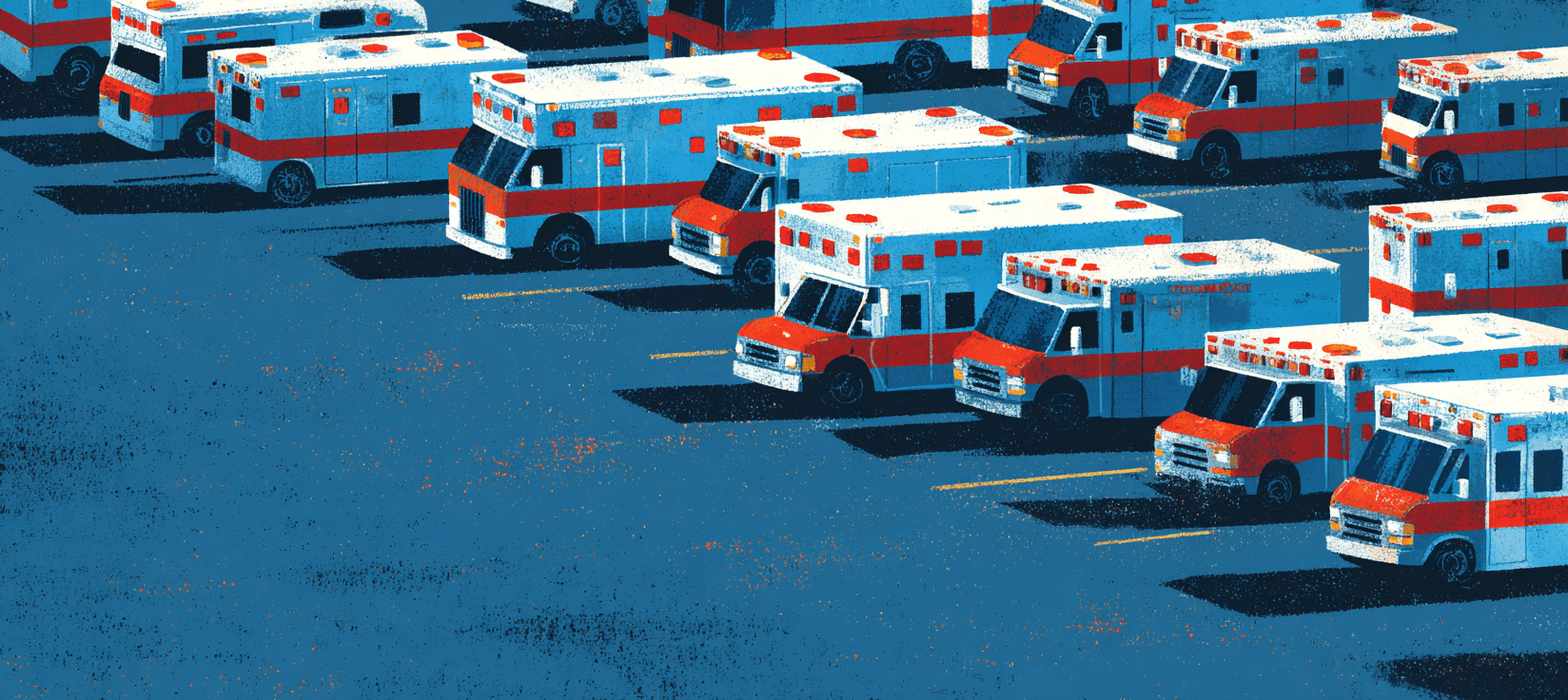
At that moment, only 4% of Houston's ambulances were free to respond to calls. The other 96% sat in parking lots like this one across the city, crews waiting to offload patients they'd already rescued. Some had been waiting three hours. While they waited, people were calling 911 and getting nothing.
When a city's power grid fails during summer heat and hospitals become the only buildings with air conditioning and electricity, the healthcare system doesn't surge to meet demand. It gridlocks.
The discharge problem had started before the ambulance problem. On Monday, as Beryl made landfall, hospital administrators across Houston faced a question with no good answer: Do we send elderly patients home to houses without power in July heat?
"It's difficult to send a 90-year-old to a 90-degree house."
Brad Lembcke, president of Baylor St. Luke's Medical Center, later explained that his system delayed discharges for about 45 patients until they got power back or other arrangements could be made.
The paramedic watched another nursing home van pull up. Three more patients being transferred because their facility had lost power. The lobby was already standing room only. Where were they going to put them?
Take that decision and repeat it at every hospital in Houston. Every patient on oxygen, every dialysis patient, every person with COPD or congestive heart failure who manages at home with electricity-dependent equipment. Suddenly hundreds of people who should have been discharged days ago were still occupying beds. Then 2.2 million CenterPoint customers lost power and the medically fragile started showing up at emergency rooms because their houses had become uninhabitable.
Harris Health's Ben Taub Hospital saw a 34% increase over typical volume highs. Houston Methodist reported its second-highest emergency room visits ever.
"As the days progressed, without power, patients present with more heat illness."
Dr. Benjamin Saldana, Houston Methodist's assistant director, was describing a cascade—cancer patients, transplant patients, people who needed refrigerated medications, seniors transferred from nursing homes that had lost power.
The paramedic's radio crackled again. Structure fire in Galena Park. No units available. He knew what that meant. Somebody else was sitting in their rig somewhere, stuck, unable to respond. The whole system was gridlocked.
That same day, a Houston police officer got shot in the leg while working. He was taken to a hospital and ended up being treated in a hallway because there wasn't a room for him. Mayor John Whitmire later said they were shocked to learn about it—a cop shot in the line of duty, and the best the hospital could do was a hallway. Not because the hospital didn't care. Because there was literally nowhere else to put him. Every bed was full. Every room was full.
The officer had been shot. He got a hallway.
David Persse, who runs Houston's emergency medical services, eventually had to tell people publicly not to go to hospitals just for power and air conditioning. Then he admitted he didn't criticize those who did, "because it was at that point that there were very few options for them." The hospitals were full of people seeking shelter while simultaneously full of people who needed emergency care. Nobody had planned for both at once.
By Wednesday, Houston had converted NRG Arena into a 250-bed medical facility for hospital patients who'd been discharged but couldn't return to homes without power. The city turned a sports arena into overflow hospital space not because of storm injuries, but because the infrastructure failed and people couldn't go home.
Hospitals prepare for surge capacity. They've got protocols for mass casualties, for operating on generator power, for bringing in extra staff. St. Luke's invited 100 staff members to sleep at facilities before the storm. They activated command centers. They did everything the disaster playbook requires.
But the disaster playbook assumes that after a few days, the grid comes back and patients can go home. When that assumption fails, there's no protocol. Just ambulances in parking lots and paramedics who can't answer calls.
At least 17 Texas hospitals ran on generator power, though the state wouldn't say which ones. At St. Luke's Health–Patients Medical Center in Pasadena—not far from where the paramedic sat waiting—the generators kept the lights on but couldn't keep up with the cooling load. Temperatures rose until the hospital had to evacuate. Even the backup systems weren't built for this climate.
Houston has now received $314 million in federal disaster recovery funding, with more than half earmarked for power infrastructure—backup generators for cooling centers and public safety sites. The vast majority goes to city infrastructure, not healthcare facilities. The assumption remains that hospitals will handle their own resilience. That ambulances will be able to offload patients. That people will have homes to return to.
The paramedic eventually got his patient inside. She got a bed. Her oxygen tanks got refilled. She went home when the power came back. But she's got congestive heart failure and an enlarged heart, living in a city where the power grid fails during hurricanes. Next summer, when another storm comes, she'll make the same call to 911. And some paramedic will sit in a parking lot with her, watching the clock, unable to answer other calls.
The ambulances that can't move. The calls that can't be answered. The people who can't go home. The workers trying to make a broken system work while it breaks further. Next hurricane season, he'll be back in that parking lot. How long he waits depends on how long the power stays out, and nobody's fixed that problem yet.
Things to follow up on...
-
Generator cooling limits: At St. Luke's Health–Patients Medical Center in Pasadena, generators kept lights on but couldn't maintain cooling, forcing evacuation as temperatures rose—revealing that backup power systems weren't designed for summer heat loads.
-
Recovery funding allocation: Houston's $314 million federal disaster recovery plan dedicates more than $151 million to backup generators for cooling centers and public safety sites, but most funding goes to city infrastructure rather than healthcare facilities.
-
Ongoing displacement patterns: A Rice University survey found that one in eight Houston residents still reported disruption from Beryl months after the storm, with around 40% of Greater Houston residents expressing desire to leave due to 2024 weather disasters.
-
Separate IV shortage: Hurricane Helene damaged Baxter International's North Carolina facility in late September 2024, creating a nationwide IV fluid shortage months after Beryl that forced Houston hospitals to give patients Gatorade instead of IV hydration.