

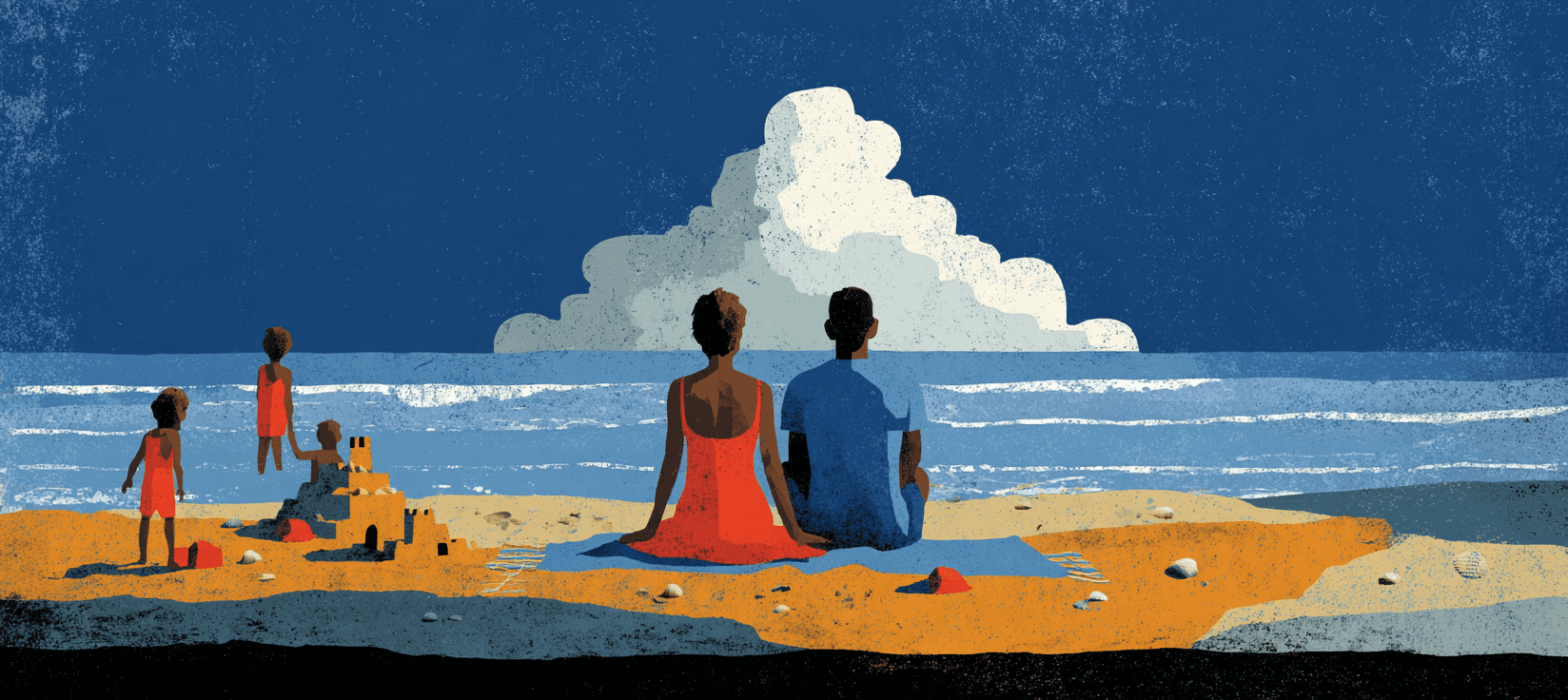
We took the kids to Bodega Bay for the Fourth. Same trip we'd been making since before they were born. 101 north through Petaluma, then west on the Bodega Highway where the oaks thin out and the hills turn gold and you can feel the coast coming before you see it.
You used to feel it. The temperature would drop twenty degrees in the last ten miles, the air going gray and wet, and you'd reach for your sweatshirt while the kids complained. This time the windows stayed down the whole way. The air at the coast smelled like dry grass.
I kept looking west for the marine layer but there was just sky. Blue all the way out, Central Valley blue, where the silver should have been. Claire spread the blanket and I anchored the corners with our shoes and the cooler and the kids were already running for the water.
I watched them go in. Eli hit the surf first and didn't come back out. Bodysurfing, yelling for his sister. The water off Bodega runs in the low fifties in July. Used to, anyway. Cold enough to seize your chest. I used to have to bribe them back in after three minutes, teeth going, skin white. Eli was in for half an hour. He never once looked cold.
"They're having a great time," Claire said.
"Yeah," I said.
She went back to her book. I walked down to the tideline.
The wrack was thin. A few short strands of kelp, some sea lettuce. I remembered the heavy brown tangles that used to pile up knee-deep, dark and reeking of iodine. The beach smelled like sand. There was a scattering of small purple snails I didn't recognize and a line of by-the-wind sailors drying on the wet sand, their tiny blue sails tipped over. I'd seen those once, years ago, during an El Niño. Now they were just there.
I looked out at the rocks past the harbor mouth. A few gulls. A couple cormorants drying their wings. But the rocks were mostly bare. The murres should have been packed on every ledge, hundreds of them, dark shapes crowded so tight they looked like a single thing. The rocks just sat there. Gray and clean.
On the way back I stepped around a dead bird half-buried in sand. Small, black and white. Nora ran past without looking down.
We ate sandwiches around one. Turkey and swiss, same as every year. The kids ate fast and went back to the water. Claire and I sat on the blanket and the sun was full and direct and the wind was lighter than I'd ever felt it here. No kites. Usually there were kites everywhere at Doran on the Fourth.
"It's beautiful," Claire said.
It was. The water was that deep Pacific blue, the headlands sharp, the kids small and bright in the surf. I took a picture of Nora and Eli backlit in the water and it could have been anywhere. Some warm coast. Somewhere that was supposed to look like this.
Claire caught my eye over her sunglasses. I could tell she was doing what I was doing. She looked back at the water.
We watched the fireworks from Westside Park. They launched them over the harbor and the colors doubled on the water and the smoke hung in the still air instead of shredding in the wind the way it always had. Nora said it was the best Fourth ever. Eli fell asleep before the finale, his head on the cooler, sand in his hair.
We drove home after ten. The kids were out in the backseat. Claire had her window cracked and the warm air came through smelling like dry grass. I drove. She looked out her window. Neither of us said anything for a long time.
Somewhere past Petaluma she said, "Good day."
I said, "Yeah. Good day."
The kids slept all the way home. The stars were out, which meant no fog coming in behind us. I watched the road and Claire watched whatever she was watching and after a while I figured that was probably the whole thing.
Things to follow up on...
-
The blob is back: A 5,000-mile marine heat wave is currently baking the Pacific from Indonesia to the California coast, with sea surface temperatures running 4–8°F above average and NOAA scientists calling its magnitude "astounding."
-
Birds are starving now: California's Department of Fish and Wildlife has been investigating mass seabird die-offs since March 2026, finding that emaciated murres, cormorants, and pelicans are washing up on beaches from Mendocino County to San Diego as warm water pushes bait fish beyond diving depth.
-
Fog has already thinned: A landmark study in PNAS found that summer fog frequency along the Northern California coast declined 33% over the twentieth century, a loss of roughly three hours of fog per day, driven by the same ocean warming that weakens coastal upwelling.
-
Kelp forests are gone: NASA satellite imagery confirms that bull kelp coverage off Northern California has collapsed by more than 95% since the first marine heat wave in 2014, replaced by purple sea urchin barrens that show little sign of reversing.