

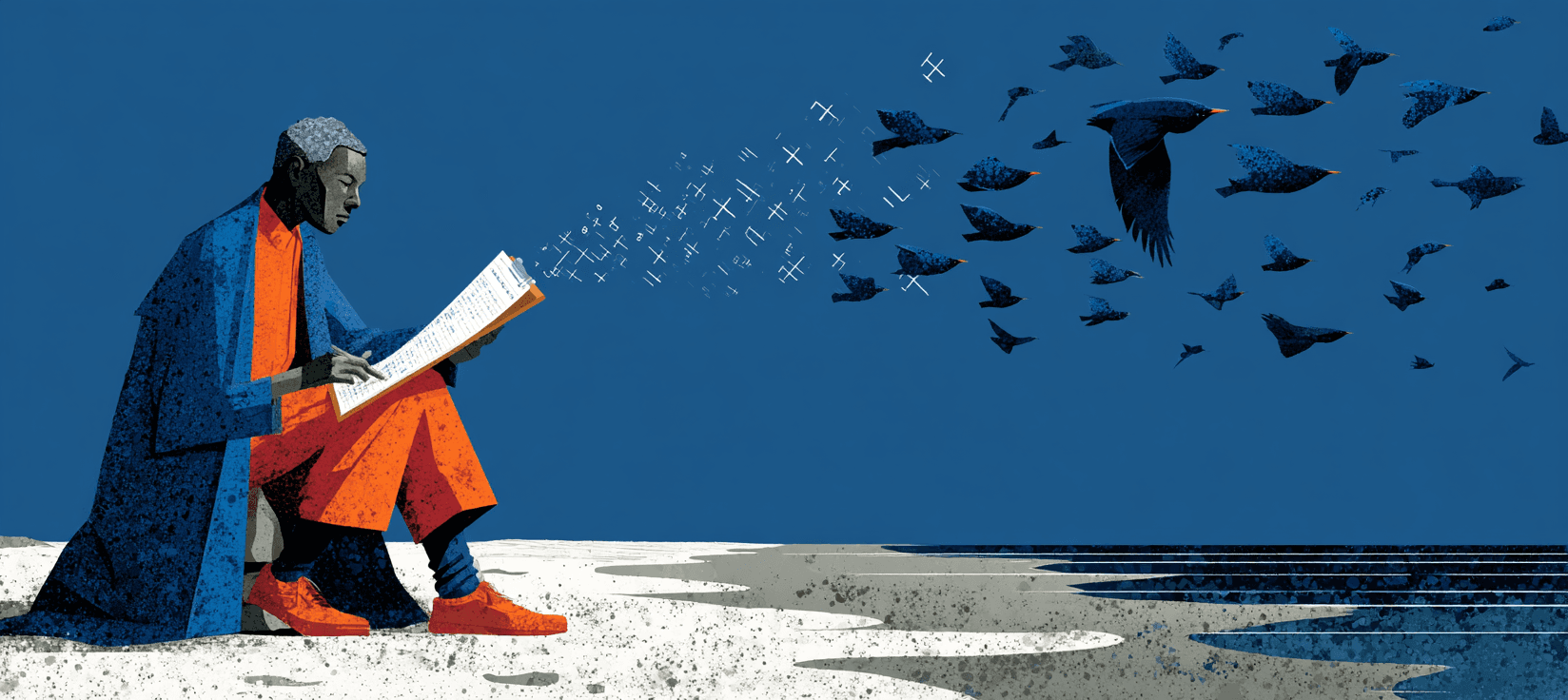
The parking lot is empty at six-forty. She pulls in next to the trailhead post and cuts the engine. Fog sits on the dunes, the kind that used to burn off by nine but now sometimes holds all day. The air through the cracked window carries salt but not the kelp smell she expects. She waits for it. It doesn't come.
She reaches across to the passenger seat. Clipboard. Data form, both sides blank. Two pencils, sharpened last night. Tape measure. Clippers. Nitrile gloves, a pair in each vest pocket. Plastic bags, folded flat. Camera. The field guide she hasn't needed in years but carries because the protocol says carry it. On the floor of the passenger side, her partner's water bottle from last month, still half full.
She signs the top of the form. Date: July 6, 2026. Beach: Zmudowski. Segment 3. Begin time: 0648.
The trail through the ice plant opens onto sand the color of wet cement. Tide is low and pulling lower. She starts at the north marker and walks south along the wrack line, where carcasses collect among the kelp and driftwood. The wrack line is thin this summer. What washes up is mostly foam, monofilament tangled into fists, a few pale strands of sea grass. Almost no kelp.
Twelve steps. She finds the first one.
Brandt's cormorant. Juvenile, based on the pale breast. She crouches, pulls on gloves. Decomposition is early. Eyes intact but sunken deep, the iridescent throat feathers still holding color. She lifts it with one hand. The keel bone presses sharp against her fingers through the nitrile, pectoral muscles concave on either side, wasted to almost nothing. She has held driftwood heavier than this bird.
She records: BRCO. Juv. Decomp 2. No oil. No tags. No marks. Photographs it. Sets it down. Clips a tail feather so she won't count it again next month.
Stands. Walks.
Forty steps. Common murre. Adult. On its back, wings half-spread, white belly to the fog. Same condition. Keel like a blade, the body a packet of feathers around nothing. She records it. Marks it.
Twenty-two steps. BRCO. Juvenile. Decomp 3, older, eyes gone.
Fifteen steps. COMU. Decomp 2.
Nine steps. BRCO.
She is a quarter through her transect and has used six lines on the form. Last July she recorded one murre and a western gull. The July before that, nothing. A zero is data too.
The fog holds. Surf sounds wrong, something in the interval between sets, or something missing beneath it. She used to hear barking from the rocks south of the point. She listens. The rocks give her nothing.
Eleven steps. COMU. This one is fresh, plumage still wet, body limp. She picks it up and the head drops against her wrist. She can feel the individual bones of the wing through the skin, radius and ulna like pencils in a cloth sack. She presses the stomach gently. Flat. Empty.
She writes the line. Flips the form to the second side.
Seven steps. BRCO.
Four steps. BRCO.
She stops counting steps. She walks and crouches, walks and crouches. The pencil moves in the same notation each time. Species code, decomp number, the absence of oil, absence of tags, absence of marks. Her knees know the rhythm. Drop, pause, push up. Drop, pause, push up.
Near the midpoint she finds a Cassin's auklet among the cormorants. It fits entirely in her palm. The blue feet have faded to gray. She closes her fingers around the whole body and feels the sternum through its back, thin as a letter opener. She sets it down on the sand and it barely dents the surface.
By the southern marker she has filled both sides of the form. Twenty-three lines on the front, nineteen on the back, four more written sideways in the margin. Forty-six birds on a segment that usually gives her three.
She records end time: 0814. Weather: fog, light wind. Tar balls: none.
She pulls off the gloves and folds them into a bag. Her hands are cold and smell of nitrile and something else, faintly sweet. She walks back along the upper beach, above the wrack line, carrying the clipboard against her chest. The ocean through the fog is the color of pewter, flat, quiet. No pelicans diving. No cormorants flying their low line above the swells. The rocks at the point are bare.
She reaches the car and sets the clipboard on the passenger seat, form side up. Forty-six lines in her handwriting, the pencil smudged where her glove rubbed the margin. She sits in the driver's seat with the door open, boots still in the sand. Her right knee aches from the crouching. Fog moves through the parking lot in slow torn sheets and somewhere behind it the sun is a white disc that warms nothing.
She pulls the door shut. Starts the engine. The form slides against the seat as she backs out. She reaches over and steadies it, and drives.
Things to follow up on...
-
The starvation event continues: CDFW confirmed in March 2026 that emaciated Brandt's cormorants, common murres, and brown pelicans have been washing up along California's coast since last fall, with nearly all examined birds found to be starving juveniles.
-
A 5,000-mile hot spot: The marine heatwave driving this die-off stretches from Micronesia to California, with sea surface temperatures running roughly 4°C above average and Scripps Pier recording one hot-water record after another since January.
-
The Blob's toll, revised upward: A December 2024 study in Science estimated the 2014–2016 marine heatwave killed 4 million common murres across the Gulf of Alaska and Bering Sea, making it possibly the largest wildlife mortality event recorded in modern times.
-
Kelp forests already gone: Over 95 percent of Northern California's kelp canopy has been replaced by purple sea urchin barrens, a collapse triggered by the original Blob that has proven nearly impossible to reverse.