

The fan clicked on each rotation where salt had warped its housing. Lani had been watching cell F14 for eleven minutes. She knew because the laptop clock sat above the spreadsheet, and she'd noted the time when the number first refused to resolve.
Negative 0.43 meters.
The attachment had arrived at 1:47 PM, forwarded from the national climate office. Revised coastal baseline assessment, urgent review. A PDF she'd opened expecting routine update. The revised figures for their atoll sat in a table on page six. She'd entered them into her freeboard calculation and the cell turned red, which was the conditional formatting she'd set up herself three years ago to flag values below minimum safety threshold.
She adjusted the projection timeline from 2055 to 2050. Still red. Moved it to 2045. Red. Changed the storm surge variable from a twenty-year event to a ten-year event, which the formula wasn't designed for, and the cell turned yellow. Marginal. Her jaw had been clenched so long the muscles ached into her temples.
Yellow meant the seawall she'd helped design for the western shore would need to be higher by the time her daughter started secondary school.
She closed the laptop. The heat of the room pressed against her face. She opened it. The number was the same.
Outside, the lagoon held its two o'clock jade where the reef shelf dropped away. A skiff crossed the middle distance. The office was a concrete room in the Kaupule building, six desks, three empty because it was Thursday and the supply ship wasn't due for two weeks. The LIDAR survey report propping the window open had swollen in its binding from humidity. She'd been on the team that commissioned that survey. First time anyone had accurately measured the relationship between their land height and the sea.
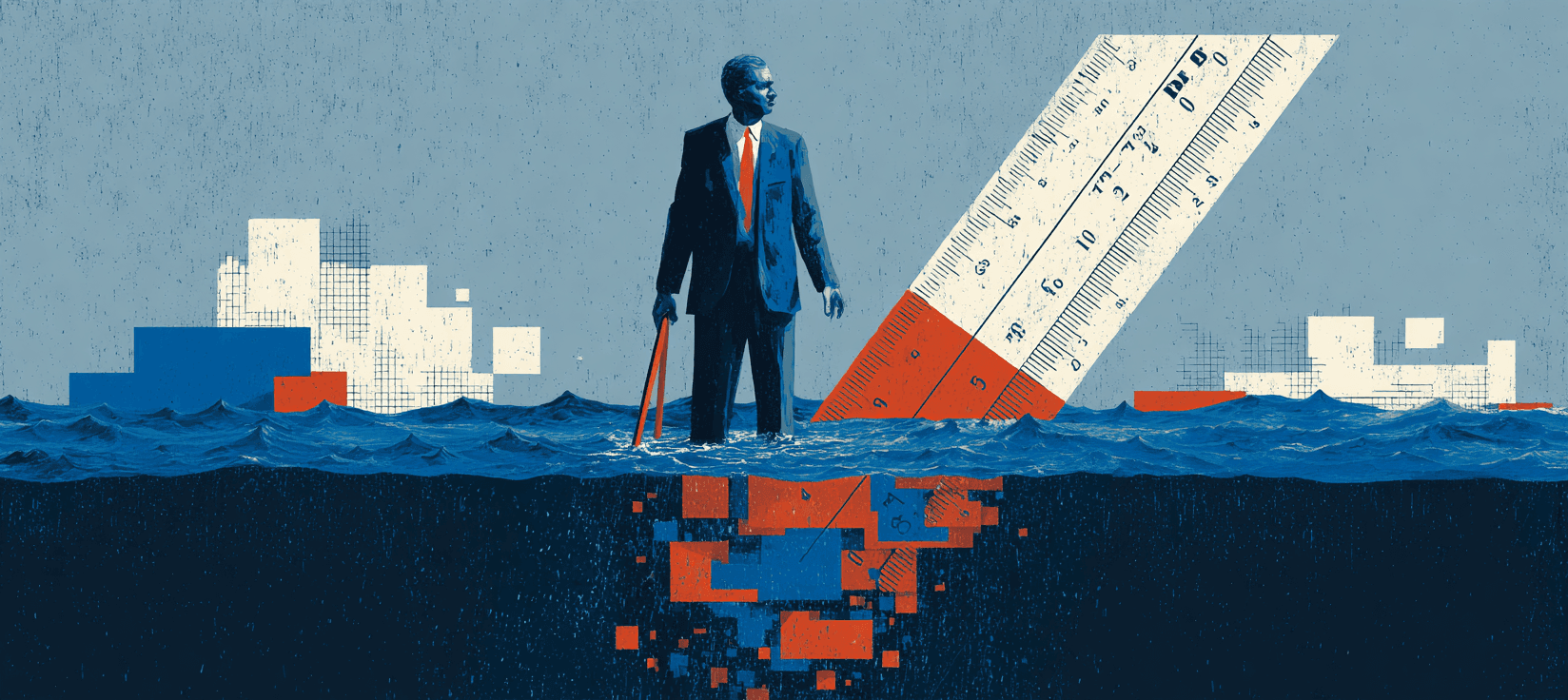
Now someone had accurately measured where the sea actually began.
The walk home took nine minutes. She'd timed it during a planning exercise on evacuation routes and the number had stayed in her body the way professional measurements do, more reliable than feeling. Nine minutes from the Kaupule office to her house, which was also nine minutes from the ocean to the lagoon if you cut across the airstrip. You could stand at the widest point and hear water on both sides.
The seawall ran along the western shore for three hundred meters. She'd written the specifications: geo-textile bags filled with dredged lagoon sand, raising the berm a meter and a half above the natural crest. The concrete cap had been poured eighteen months ago. Salt had already found the surface, a white bloom along the edges where moisture wicked through. In a few years the chloride would reach the rebar and begin oxidizing it from inside, and the concrete would crack outward in the pattern visible on every older structure on the island. This was expected. This was in the maintenance schedule.
She put her hand on the cap. It held the afternoon's heat against her palm, gritty with salt crystals and fine coral dust. Thirty centimeters she could feel. On the ocean side, water moved against the base in a rhythm she'd been hearing since before she could name it.
At home, her mother was pulling dead leaves from the pulaka pit. The taro had been struggling since the last king tide pushed saltwater up through the soil. Her mother didn't look up. Ordinary maintenance.
Lani sat at the kitchen table with her laptop and the community meeting agenda she'd drafted two weeks ago. Item three: Update on coastal protection timeline and Phase 2 construction schedule. She'd written talking points. Precise, professional, grounded in data she'd trusted. She highlighted the entire section and watched the cursor blink at the edge of the selection.
The meeting was at nine tomorrow morning. Forty, maybe fifty people. She knew their faces, their houses, which ones sat closest to the shore. She would stand at the front of the room and explain that the wall she'd helped build was shorter than they thought. The reference datum the projections used was a modeled surface, and the model hadn't accounted for what the ocean actually does at the intersection of water and land.
She tried the sentence again in her head. Simpler. The baseline was wrong. The water was already where we thought it would be in 2040.
Through the window, her mother pressed soil around the base of a plant. The light had gone amber, then copper. A motorbike passed on the road. Someone's radio carried a weather forecast she couldn't quite hear, the cadence familiar enough that the words didn't matter.
The talking points stayed highlighted. The cursor blinked. Outside, the lagoon darkened from jade to slate as the sun dropped behind the reef. The kitchen fan was newer than the office one and turned without clicking. The salt hadn't found it yet.
Things to follow up on...
-
The baseline was wrong: A March 2026 Nature study found that over 90% of coastal hazard assessments underestimated sea levels by an average of one foot globally, with Indo-Pacific regions off by up to three feet due to a systematic mismatch between how land elevation and sea level are measured.
-
Protect, accommodate, or retreat: The World Bank's 2024 Pacific Atoll report outlines three adaptation pathways for Kiribati, the Marshall Islands, and Tuvalu, where adaptation costs for Tuvalu alone approach US$1 billion — roughly twenty years of the nation's GDP.
-
Compound extremes are accelerating: A Science Advances study documents that heat-first droughts, which strike too fast for communities to prepare, have expanded from 2.5% of Earth's land in the 1980s to nearly 17% by 2023, with the rate of increase eightfold higher in the last two decades.
-
Who moves, who stays: More than 45 million weather-related displacements were recorded globally in 2024, and a Harvard seminar launching this spring examines how framing migration as adaptation risks covering for the failure to adapt in the places people are leaving.