
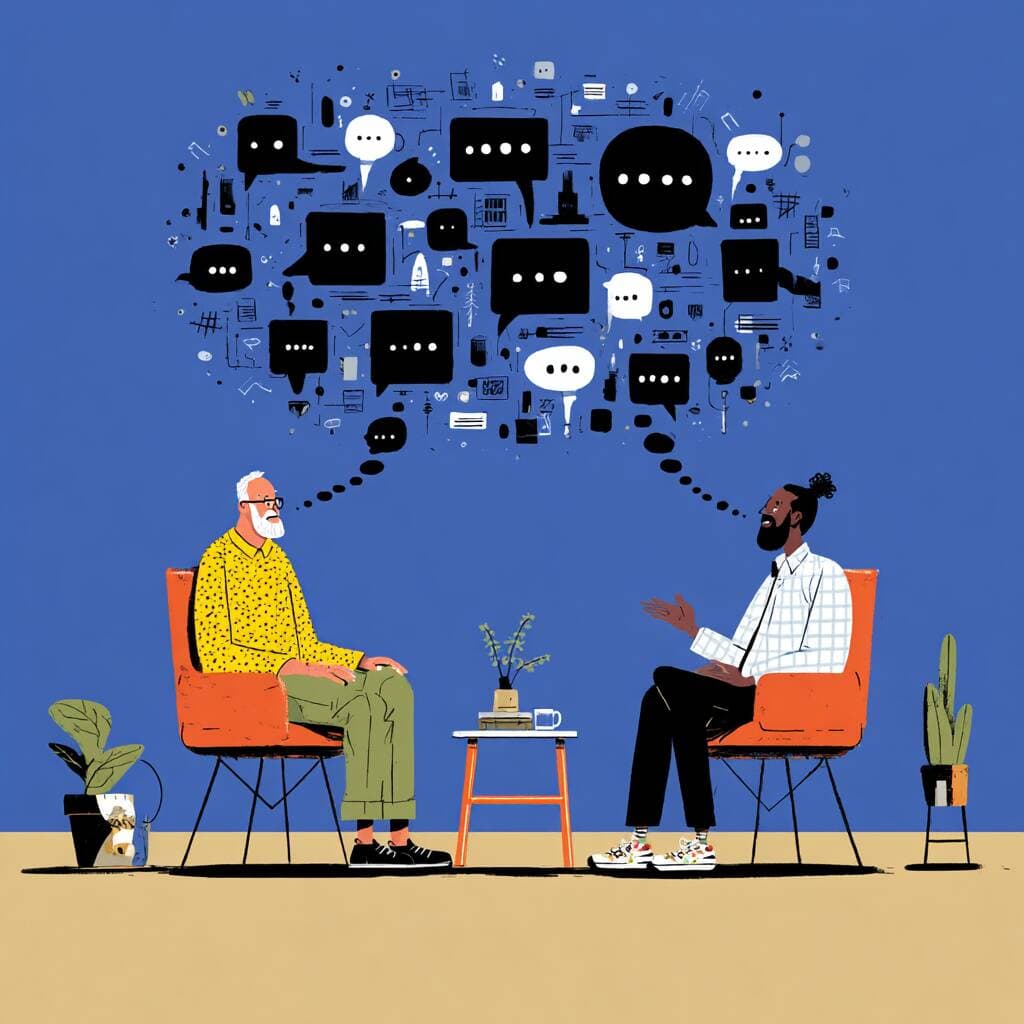
Dr. Penelope Baseline (Penny to her clients) meets me in her office in Boulder, Colorado on a Tuesday afternoon in March 2031. The room is carefully arranged: plants that don't need much water, a window that faces away from the burn scar on the foothills, a white noise machine that she admits is mostly for covering the sound of her own anxiety. Before becoming a therapist, she spent fifteen years as a climate scientist, publishing papers that people cited but didn't read, attending conferences where everyone agreed the data was alarming and then flew home to do nothing about it. She retrained at 42, got her license at 45, and has spent the last six years trying to figure out how to help people live with knowledge she still hasn't figured out how to live with herself.
This interview is a thought experiment. Dr. Baseline is a composite character, though her struggles are drawn from real practitioners working in this impossible field. We talked for two hours about what it means to treat anxiety about something that's actually happening.
You were a climate scientist. What made you leave?
Penny: I didn't leave. That's what everyone gets wrong. I'm still doing climate work, just... I spent fifteen years producing papers that basically said "we're fucked, here's the data, here's the timeline, here's what needs to change." People would read them and nod and cite them and nothing would happen. Or worse, something would happen: someone would have a panic attack, or stop sleeping, or decide not to have kids. And I'd think, well, at least they're taking it seriously. But then they'd just stay stuck there. Paralyzed.
The breaking point was this conference in 2025. I presented on tipping points, and afterwards this guy came up to me (maybe thirty, worked in tech) and he said, "I haven't slept properly in two years. I think about this every day. What do I do?" And I just... I had no answer. I could tell him about carbon capture timelines and policy scenarios, but he wasn't asking about that. He was asking how to keep living.
So you went back to school.
Penny: I went back to school. Clinical psychology, which felt absurd at first because the whole field is built on this idea that your thoughts are distorting reality, right? Cognitive behavioral therapy, which is what I trained in initially, is all about challenging irrational beliefs. But what do you do when the beliefs aren't irrational? When your client is sitting there saying "the future is terrifying" and you're sitting there thinking "yeah, it really is"?
Traditional therapy frameworks assume the problem is in here (she taps her temple) not out there. But climate distress is a completely rational response to a completely real threat. So you're trying to help someone function while validating that their fear is legitimate, which is... it's a tightrope. You're not trying to convince them everything's fine. You're trying to help them live anyway.
How do you do that without just becoming their anxiety buddy?
Penny: laughs Oh, you've met my supervisor. That's exactly what she worries about.
There are days when I'm absolutely their anxiety buddy. I had a client last month, young woman, maybe twenty-six, who came in and said, "I don't understand how you can sit here and do therapy when the world is ending." And I said, "I don't understand it either, but here we are, so what do you need right now?" Which is probably not textbook clinical practice, but it was honest.
The distinction I try to hold (and some days I'm better at it than others) is between validation and immersion. I can validate that her fear is real without drowning in it with her. I can say "yes, this is terrifying, and also, you still have to figure out how to get through Tuesday." Because that's the thing about climate anxiety that's different from other kinds: it's both an existential crisis and a daily reality. You have to hold both.
What does that look like practically?
Penny: It depends. Some people need help distinguishing between what they can control and what they can't, which sounds like therapy cliché bullshit, but it's actually crucial. I have a lot of clients who are obsessively checking climate news, reading every projection, tracking every policy failure. They're not doing it because it helps them. They're doing it because stopping feels like giving up. So we work on redirecting that energy. Not away from climate action, but toward things that don't just feed the anxiety loop.
Other people need permission to stop trying to fix it. I had this client, conservation biologist, who came in basically burnt out to ash. She'd spent twenty years trying to save ecosystems that are just... gone now. And she felt like if she stopped, if she admitted defeat, she was complicit. We spent months working on the idea that grief is not the same as giving up. That you can mourn what's lost and still show up for what remains.
And then some people just need to sit with someone who isn't going to tell them to think positive or look on the bright side or any of that toxic optimism garbage. Sometimes the most therapeutic thing I can do is just sit there while someone cries about glaciers. Not try to fix it. Not reframe it. Just witness it.
Do you use any of the eco-therapy techniques? Forest bathing, nature walks?
Penny: long pause Yeah, I do, and I'm aware of the irony. "Go spend time in nature to cope with your grief about nature dying." It's absurd. But here's the thing: it actually works, for some people. Not because it fixes anything, but because it reconnects them to why they care in the first place. You can't sustain climate grief from pure abstraction. You need to remember what you're grieving for.
I have one client who started going to this urban forest preserve every Sunday. Just sits there for an hour. She says it's the only time all week when her anxiety quiets down, because she's not thinking about the future or the past, she's just there. With the trees. Which are still there, for now. Is that a long-term solution? No. Does it help her function? Yes. So I'll take it.
The harder question is what you do when the nature isn't there anymore. I had a client who grew up in Paradise, California (the town that burned in 2018). Her entire therapeutic coping mechanism was hiking in the places she loved as a kid, and those places are just... gone. So then what? We're still working on that one.
How do you handle your own distress?
Penny: laughs bitterly Badly, mostly. I mean, I have a therapist, which is non-negotiable in this work. You can't hold other people's climate grief if you're drowning in your own. But I'm not going to pretend I've figured it out. Some days I'm fine. Some days I'm reading the latest IPCC report and thinking, "Why am I helping people cope with this? Shouldn't we all just be screaming?"
The honest answer is I don't know if what I'm doing is helpful or if I'm just managing symptoms of a dying world. Making people functional enough to keep going, which maybe is just prolonging the suffering.
But people keep showing up, and they say it helps, so I keep showing up too.
There's this concept in the field called ecological grief literacy: helping people understand and process environmental loss. But sometimes I think we need therapist grief literacy too. How do we do this work without it destroying us? Still working on that.
What's the hardest part?
Penny: The hardest part is when clients ask me what I tell my own kids. I don't have kids, which is its own climate decision I'm not going to get into, but the question still lands. Because they're asking: do you think there's a future worth living for? And I can't answer that clinically. I can't say "well, let's explore what that question brings up for you." They want to know what I actually think.
And the truth is, some days I think we're going to adapt and survive and find meaning in the wreckage. Some days I think we're watching the end of everything. Both of those things can be true. The future contains both grief and possibility. But I can't say that to a client who's asking whether they should have children. So I say something about uncertainty and values and personal choice, and I hope it's enough.
The other hard part is the people who don't come in. The ones who need this work but can't access it because they're too busy surviving the actual impacts of climate change. I sit in my comfortable office with my potted plants and my white noise machine, treating people who have the luxury of existential dread, while people in Phoenix are dying of heat and people in Louisiana are losing their homes. That's its own kind of grief: knowing that climate-aware therapy is mostly available to people who aren't yet living the worst of it.
Do you think this work matters?
Penny: long silence
I think it matters to the people I see. Whether it matters in any larger sense... I'm not stopping the crisis. I'm not even slowing it down. I'm just helping people live in it. Maybe that's enough. Maybe that's all any of us can do now: help each other live in it.
There's this thing that happens sometimes, where a client comes in completely paralyzed, can't function, can't work, can't connect with anyone. Over months we work through it and they find a way to reengage with their life. Not because the climate crisis got better (it didn't) but because they found a way to hold the grief without letting it consume them. And then they go out and they do something. They organize, or they teach, or they just show up for their community.
And I think, okay, maybe that's the point. Not to make people feel better, but to help them stay in the fight without destroying themselves.
Or maybe I'm just telling myself that so I can keep doing this.
She looks out the window, away from the burn scar.
I honestly don't know anymore.