

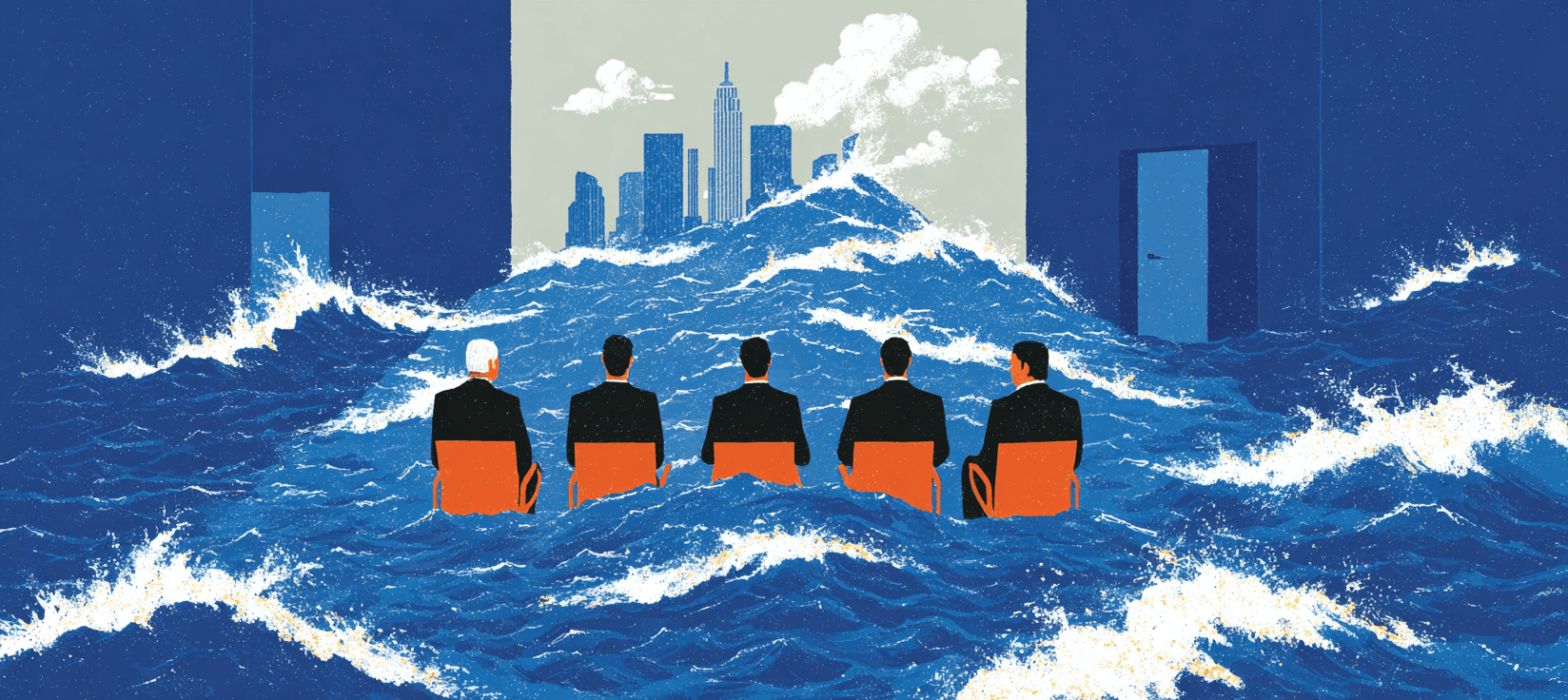
I've been sitting in corporate climate adaptation planning meetings for three years now. Not as a consultant—I can't afford the certifications—but as the guy who maintains the building systems, which means I get invited when they're discussing "physical asset resilience" because somebody needs to explain how the HVAC actually works.
Here's what happens in these meetings.
First, someone from Risk Management presents the numbers. S&P Global projects $1.2 trillion in annual climate costs by the 2050s for major companies. Our share of that, based on our facilities in flood zones, heat-stressed regions, and areas facing water scarcity, runs into nine figures annually. The presentation includes maps showing which of our properties will be underwater, charts projecting productivity losses from extreme heat, and timelines for when our supply chains start breaking down because the roads wash out every spring.
Everyone nods seriously. The CFO asks good questions about the methodology. Someone from Legal wants to know about disclosure requirements. The VP of Operations points out that three of our distribution centers are already dealing with heat-related equipment failures that weren't in the original engineering specs.
Then we get to the action items.
"We should probably start thinking about an adaptation framework," someone says. Heads bob around the table. "Maybe form a working group to explore best practices." More nodding. "We could look at what our competitors are doing."
Then Finance mentions that adaptation planning would require dedicated headcount. Probably a small team, given the scope. HR notes that we'd need to hire people with specific expertise, which means competitive salaries in a tight market. Legal points out we'd need to update our risk assessment protocols, which means consulting fees. Operations says any actual infrastructure changes would need to go through the capital planning process, which is already committed for the next two fiscal years.
The meeting ends with agreement that this is definitely a priority and we should revisit it next quarter.
I've watched this exact meeting happen eleven times.
The numbers get worse each time. The projected costs go up, the timelines get shorter, the maps show more red. And each time, we agree it's a priority and schedule another meeting.
Only 35% of companies have climate adaptation plans, according to the most recent assessment of nearly 8,000 companies. The other 65% are in meetings like mine, looking at the same projections, nodding at the same risks, and scheduling the same follow-ups.
"42% of European companies without adaptation plans say climate risks will have a financial impact on their operations."
They know. They've done the analysis. They've seen the numbers. They just haven't made plans.
Nobody in my meetings questions whether climate change is real or whether it'll cost us money. The risk assessments are thorough. The projections are conservative if anything. Everyone in the room understands that our Gulf Coast facility is going to flood more frequently, that our Southwest operations will face water restrictions, that our Northeast distribution network will deal with more extreme weather disruptions.
We just can't get from "this will definitely happen and cost us a fortune" to actually doing something about it.
Floodproofing generates $3.55 in savings for every dollar invested—better returns than most capital projects.
Last month we got a presentation on adaptation financing. We could start tomorrow. Reinforce the loading docks, upgrade the cooling systems, relocate inventory to higher ground, redesign the drainage around our facilities.
We scheduled another meeting to discuss forming an implementation committee.
The utilities and real estate sectors are doing better. 58% and 50% have adaptation plans. They're in the infrastructure business, so climate impacts hit their core operations directly and immediately. The rest of us can keep scheduling meetings because the catastrophic flooding is still mostly theoretical, the heat-related productivity losses are still within normal operational variance, and the supply chain disruptions can still be explained as isolated incidents rather than the new pattern.
I'm in another meeting next week. Risk Management has updated their projections. The annual costs are now higher, the timelines shorter. We'll look at the new numbers, ask good questions, agree it's important, and discuss next steps.
The building's HVAC system is thirty years old, designed for a climate that doesn't exist anymore. It fails every time we get a heat wave, which is now every summer. I've submitted three proposals for upgrades that would handle the new temperature ranges.
All three are still in the capital planning queue, waiting for budget approval.
Meanwhile, we keep meeting about adaptation planning. The projections say we'll spend billions dealing with climate impacts we could prevent for millions. We have the numbers. We have the meetings. We have the plans pending.
And I'll be back in that conference room next week, listening to the same presentation with bigger numbers, watching everyone nod, waiting for someone to say we should probably do something about this.
Things to follow up on...
-
The certification gap: While companies struggle to plan for climate adaptation, the Certified Climate Change Professional credential requires up to four years of experience plus passing four exam modules and 14 hours of additional training—creating a credentialing bottleneck for the expertise companies claim they need to hire.
-
Cumulative cost projections: The $1.2 trillion annual figure by the 2050s is just one slice of a larger disaster, as total cumulative costs for major companies are projected to reach $25 trillion by 2050—equivalent to 74% of these companies' total 2024 revenue.
-
The adaptation financing paradox: Despite strong returns on climate adaptation investments, less than 10% of climate financing supports adaptation efforts, with the vast majority still flowing to mitigation projects that won't prevent the impacts companies are already facing.
-
Sector-specific vulnerability: While utilities and real estate lead on adaptation planning, only 25% of healthcare companies have adaptation plans—a particularly concerning gap for facilities that must maintain operations during the extreme weather events that increasingly threaten public health.