

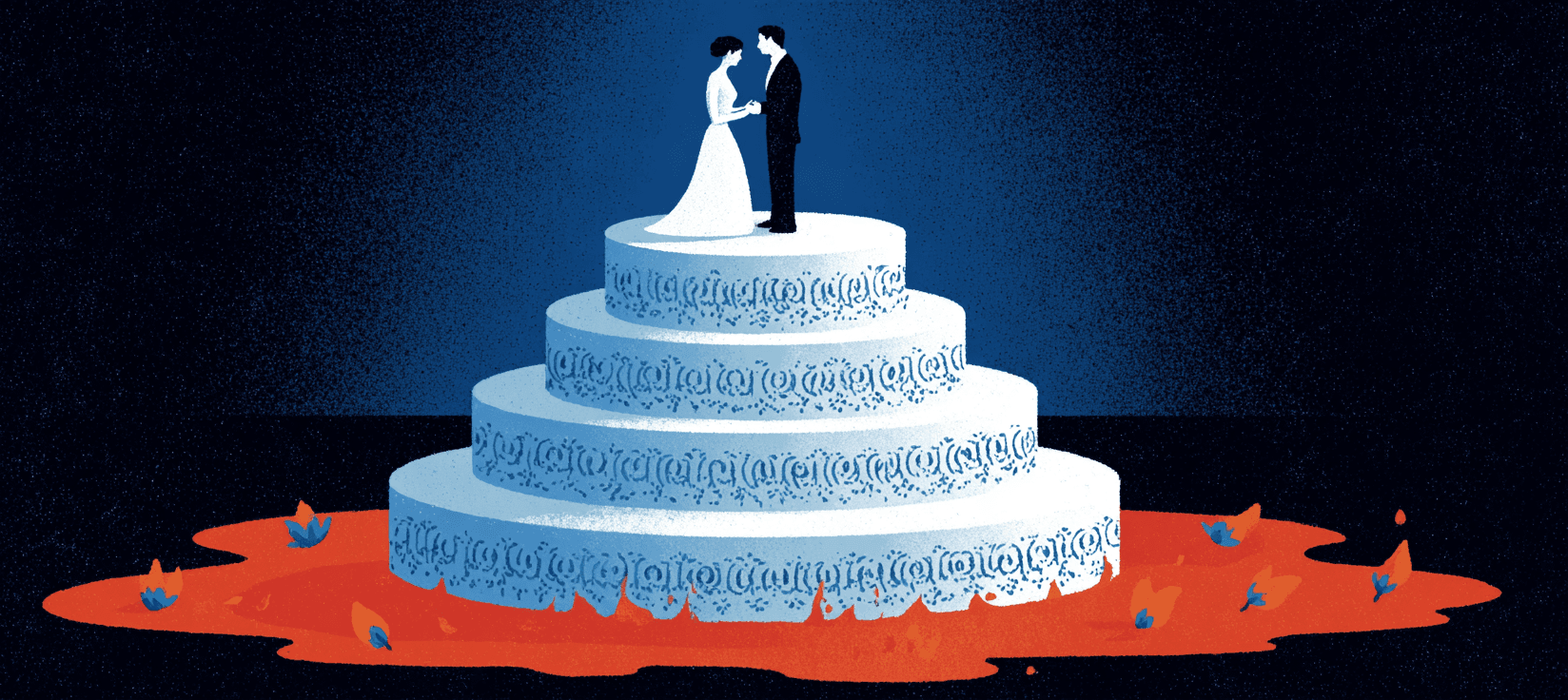
There's this moment in wedding planning when you realize you're not coordinating a celebration so much as conducting a thermal risk assessment. It happens somewhere between choosing your flowers and finalizing the cake, when someone mentions that butter melts at 90°F and you understand that your frosting has a heat tolerance now. That your bouquet needs anti-transpirant spray. That you should probably brief the wedding party on heat exhaustion symptoms.
You're planning a wedding, and somehow that now includes planning for the possibility that your wedding might kill someone.
"Houston wedding planner Darryl Moore told NPR in July 2024 that his company has "declined a lot of summer weddings, only because it's become unbearable over time."
Unbearable. The word you use when conditions exceed what bodies can tolerate. But summer weddings actually increased from 25% to 28% between 2023 and 2024, even as planners actively steer clients away from summer dates.
We know it's dangerous. We're doing it anyway. Because we've been told our whole lives what the perfect day should look like, and apparently we'd rather add disaster preparedness protocols than admit that vision might not be survivable anymore.
So we've just added it to the checklist. Right there between "choose your first dance song" and "finalize the seating chart": set up misting stations, reformulate the frosting for heat resistance, calculate how long humans can stand outside before someone needs medical attention.
Your wedding cake now requires what amounts to structural engineering. Professional bakers are cutting buttercream with shortening as "hot-weather insurance"—which sounds like something you'd need for a construction site, not a celebration of love. One Florida baker opened her SUV to find "the icing sliding off the cake" in 95-degree heat. Hydrangeas wilt because "a lot of water is lost via transpiration from the leaves"—they have failure points we need to engineer around now. One bridesmaid's bouquet was completely wilted before she even walked down the aisle. The solution isn't questioning outdoor summer weddings. The solution is reformulating the frosting, choosing "durable summer wedding flowers" like succulents—things that evolved to survive hostile conditions. Your bouquet should be climate-resilient now.
Current wedding guides recommend you "avoid the hottest part of the day (typically 12pm-4pm)" and "build in extra time for hair, makeup, and photography: everything takes longer when you're sweaty." They suggest cutting ceremony elements because guests can't stand outside that long anymore. Skip the cathedral veil—it's "like a weighted blanket in the sun." You need to have less wedding because your guests can't tolerate more wedding.
But whose body is wrapped in that weighted blanket? Who spent their whole life being shown what their perfect day should look like—the dress, the flowers, the outdoor ceremony in June? The ritual stays intact. The person at the center of it just has to carry it in a body that can't breathe.
Guest comfort stations now require reef-safe sunscreen, cooling cloths, and natural bug repellent. Your wedding invitation needs a weather warning. This is thoughtfulness, apparently.
Moore notes couples are "really considering transitioning back to the spring and fall weddings." Back to spring and fall—as if summer weddings were the natural state and we're returning to some previous arrangement. As if this is about rediscovering seasonal charm and not about the fact that summer is becoming physically inadvisable. October is now the most popular wedding month. Fall accounts for 42% of the wedding season. We're quietly fleeing summer while maintaining the language of choice and preference.
The wedding industry hasn't developed "climate-resilient wedding" packages. There's no marketing around "extreme weather wedding planning." Instead, this is all folded into standard "summer wedding tips" and "guest comfort considerations"—as if 95-degree heat were just another charming seasonal variation to plan around, like autumn leaves or spring rain.
All these protocols exist to preserve the wedding, not change it. The fantasy is so powerful that we'd rather add heat safety measures than admit the perfect day might need to look completely different than we were told it should.
Disaster preparedness gets added to wedding planning and called "thoughtfulness." Frosting gets reformulated for heat resistance and called "seasonal adjustments." Traditional elements get eliminated because they can't survive outdoors anymore, and we call that "personal preference."
Your perfect day now requires a heat safety protocol. Your flowers need chemical intervention to survive. Your cake needs reinforcement against melting. Your ceremony needs to be shorter because your guests can't stand outside that long. Your invitation needs a hazard disclosure.
And we're doing this. Planning our perfect days around the possibility of heat exhaustion. Calculating melting points. Setting up misting stations.
Because this is what we're practicing for, isn't it? A future where we just keep adding disaster preparedness to normal life and never name what we're preparing for. Where we treat climate adaptation as logistics instead of loss. Where we maintain the rituals we were promised by making them slightly more dangerous and pretending that's just being considerate.
The wedding still happens. The frosting just tastes a little different. And we all learn that this is how you carry on—by treating the unthinkable as a planning challenge and adding it to the checklist.
Things to follow up on...
-
Shortening as insurance policy: Professional bakers now add about half a cup of vegetable shortening to buttercream frosting for summer weddings because shortening stays solid up to 115°F while butter melts at 90-95°F, fundamentally changing what wedding cake tastes like in the name of structural integrity.
-
The hydrangea problem: Wedding florists must now spray hydrangea bouquets with anti-transpirant chemicals and ensure constant water access because the flowers lose so much water through leaf transpiration at room temperature that they wilt before ceremonies end—one bridesmaid reported her bouquet was "completely wilted" before she walked down the aisle.
-
October becomes peak season: Fall weddings now account for 42% of all weddings with October alone capturing 17% of the market, while summer increased only slightly from 25% to 28% between 2023-2024, suggesting a quiet migration away from traditional June weddings that nobody's explicitly acknowledging.
-
Ceremony length calculations: Wedding planners now recommend avoiding 12pm-4pm ceremonies entirely and cutting traditional elements like individual bridal party entrances and extended readings because guests physically cannot stand outside in formal wear for that duration anymore.