

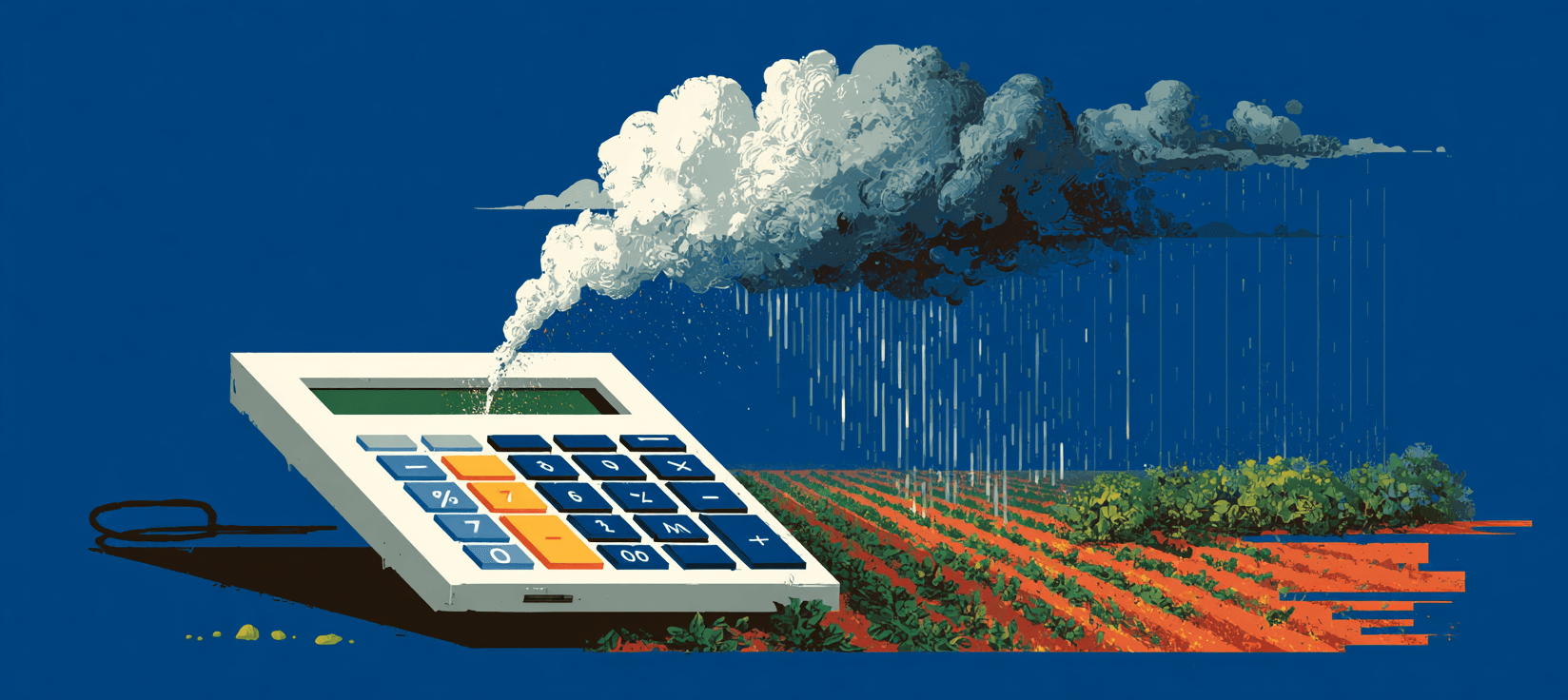
Ranchers call their prime breeding cows "factories." Everything else on the operation can be adjusted, delayed, sold off. The factories are what you protect. A cow sold today means no calf to sell next year, and a heifer born today won't drop her own first calf for two years. That's the math. It doesn't care about commodity prices or weather forecasts or what some model in Reading, England, says about atmospheric oscillation patterns in the tropical Pacific.
Benton England, a South Texas cattleman, put it on RFD-TV this week with the plainness you get from people who work outdoors for a living:
"I realize prices are high now, but that's only been for really a short amount of time. In reality, before, we were losing money on cattle. That's why the cattle numbers have kind of really gone off, because for a long time, people weren't making money."
Behind that understatement sits a national beef herd at its lowest in fifty years. Texas alone dropped from 13.1 million head to 12 million between 2020 and 2024. January through March 2026 was the driest on record for the contiguous United States since measurement began in 1895. By the end of March, 89% of Texas and 99% of Oklahoma sat in drought. Six consecutive years of it. In February, the Ranger Road Fire exploded across 283,000 acres of Oklahoma and Kansas grassland on 65-mph winds, killing hundreds of head of livestock and burning through pasture that was already bare. From 2020 through 2024 alone, the drought cost Kansas, Oklahoma, and Texas agriculture an estimated $23.6 billion, and the sixth year is still burning.
NOAA places a 61% probability on El Niño developing this spring. For the Southern Plains, that means continued heat and dying grass. For the Corn Belt, eight hundred miles north, it means potential relief rain. Same atmosphere, same oscillation.
The European Centre's forecast suggests it could rival the super El Niños of 1982 and 1997, with a one-in-four chance of a very strong event by year's end. The weather pattern burning England's pasture could, in theory, deliver cheaper feed grain from Iowa come fall.
Theory requires time, which is exactly what drought doesn't give you. By the time a good Corn Belt harvest might push corn prices down, herds already culled are gone. You cannot un-sell a factory.
The Corn Belt forecast isn't unanimous anyway. The North American Multi-Model Ensemble shows a drier bias for much of the corn-growing region, and meteorologist Matt Makens has warned that a rapid El Niño transition could worsen Corn Belt drought by shoving moisture west too quickly. The relief narrative is plausible enough, which in agriculture means almost nothing.
And even if the rain comes, the Corn Belt has its own ledger to settle. David Iserman, a fifth-generation farmer in Streator, Illinois, told CME Group's OpenMarkets in March that he's "definitely either breaking even, if we're lucky, or losing money." His number one cost is fertilizer, and fertilizer is where the Iran war meets the planting season. Roughly a third of the world's seaborne fertilizer trade normally passes through the Strait of Hormuz. Urea hit $838 per ton the last week of March, up 46% year-over-year. Anhydrous ammonia crossed $1,060. USDA's March 31 Prospective Plantings report showed corn acreage down 3% from last year. Rain is only useful if you can afford to plant something in it.
Meanwhile the same signal hammers tropical commodity regions. During the 2015–16 super El Niño, 10.2 million Ethiopians needed food assistance while Indonesian wildfires devastated crops and global sugar production dropped by 7 million tons. In the more recent 2023 El Niño, Indonesian coffee production fell 20% and rice prices climbed 25% above government-recommended levels as farmers watched their third planting simply fail for lack of water. A strong 2026 event threatens the same regions again. The EU warned this month that El Niño could bring dry conditions to northwestern Ethiopia, South Sudan, and Sudan during the main agricultural season, and Vietnam's meteorological services project heat waves exceeding last year's intensity across Southeast Asian coffee and rice country.
All of which lands on a system already buckling. The World Food Programme counts 318 million people facing crisis-level hunger. WFP projects 45 million more could fall into acute food insecurity if the Iran conflict continues and oil stays above $100 a barrel.
"In the worst case, this means lower yields and crop failures next season. In the best case, higher input costs will be included in food prices next year."
— Carl Skau, WFP Deputy Executive Director
The food system in April 2026: a Texas rancher watching scorched pasture while the same oscillation promises rain eight hundred miles north. An Illinois farmer whose fertilizer bill ate whatever that rain might earn him. A global supply chain where the war and the weather are working both ends against a middle that ran out of give two years ago. The people doing the actual work of feeding everybody are the ones doing the arithmetic. Nobody is helping them with it.
Things to follow up on...
-
Wheat acreage hits bottom: USDA's March 31 Prospective Plantings report put all-wheat planted area at 43.8 million acres, the lowest since 1919, as rising input costs and drought compound to push farmers away from the crop.
-
Fertilizer trickle through Hormuz: DTN reported in early April that Iran appears to be allowing some ships through the Strait of Hormuz, potentially easing the nitrogen price spike, though analysts caution the ceasefire offers no clear path to sustained reopening.
-
Southern rust complication: Corteva Agriscience's 2026 planting outlook warns that a wet spring across the South and Corn Belt could set up another severe year for southern rust disease, an underreported threat to the very corn crop El Niño is supposed to help.
-
May WASDE as next marker: The USDA's May World Agricultural Supply and Demand Estimates report will incorporate Prospective Plantings data into the first official 2026-27 production forecast, offering the clearest picture yet of whether planting intentions held up against the fertilizer shock.