

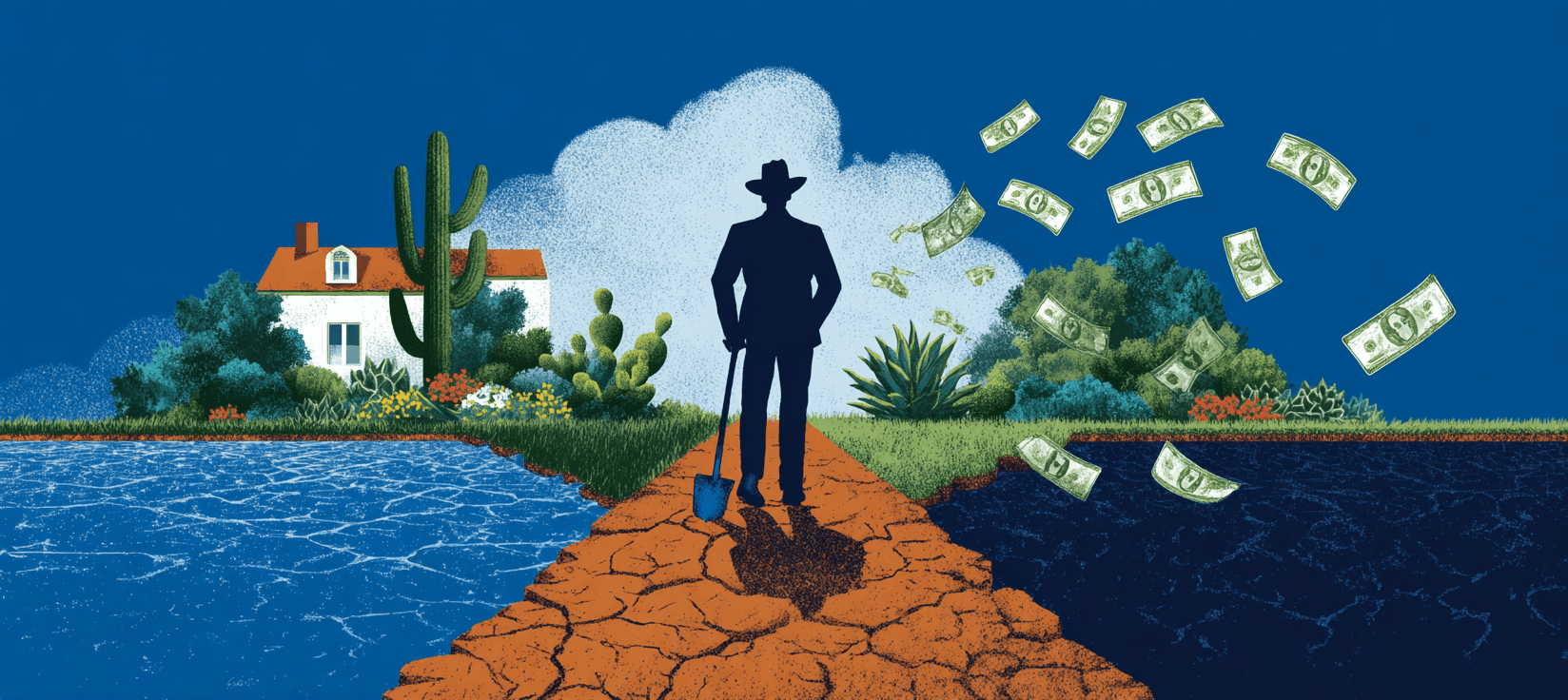
The contractor walks the perimeter of the backyard in mid-December, gravel crunching under his boots. It's 72 degrees at 10am, the kind of winter morning that sold the house two years ago. Native agave here, maybe some desert marigold there, a small flagstone patio where the kids could actually sit without burning their feet come June. He's done six of these this month in the neighborhood. The bid comes to $14,800, good for thirty days.
The homeowner—who moved to Tempe in May 2023 with a new job and a mortgage that made sense on paper—says he'll think about it. What he means is: he'll spend another week trying to figure out if investing fifteen grand in this property is smart or stupid given everything he's reading about water.
The backyard has been gravel and struggling oleander since the previous owners ripped out the grass years ago. For two years, it's been fine to leave it alone. But the seven-year-old wants a space for her art projects, and the space feels unfinished. The city offers rebates for desert landscaping. The contractor says it adds value.
Whether "value" means anything when water headlines keep escalating but home prices in the neighborhood have climbed $40,000 since 2023—that's the calculation keeping him up at night.
The Kitchen Table at Midnight
After the kids are in bed, there's the laptop and the stack of printouts. The Phoenix Water Services website says "reliable 100-year water supply." The Bureau of Reclamation's June data shows Colorado River system contents at 23.29 million acre-feet, down 1.47 million from a year ago. Arizona is taking an 18% cut in Colorado River water for 2025—the biggest of any state.
Phoenix promises a 100-year supply while Arizona takes 18% cuts. The city gets 60% from Salt/Verde Rivers, but groundwater models show 4% shortfalls and water rates are projected to climb 5-13% annually through 2029.
The city gets 60% of its water from the Salt and Verde Rivers, not the Colorado. That matters, apparently. But then there's the June 2023 news that Governor Hobbs restricted new construction in parts of metro Phoenix because groundwater modeling showed a 4% shortfall. And the projection that Phoenix water rates will increase 5% to 13% annually through 2029.
The monthly water bill—currently $75, $110 in August—doesn't explain any of this. It just shows the number going up.
Two Doors Down
Two doors down, they just put in a pool. That seemed insane when the excavation started in October—putting in a pool during a water crisis? But talking to them at the mailbox, their water bill apparently isn't much different. The city's Stage 1 Water Alert triggers "intensive public education" but zero mandatory residential restrictions.
Three houses the other direction, they did the desert landscaping two years ago before the rebate program existed. It looks good. They say it cut their summer water bill by about $30 a month, which means the $12,000 they spent pays back in maybe thirty years—unless water rates climb faster than projected, which the city says they will.
The houses with desert landscaping cluster on the west side of the neighborhood, installed before 2023 when only early adopters could afford the upfront cost. The recent construction on the east side—where the pool went in—came with HOA covenants requiring "water-wise" features, which apparently includes pools if they're part of the original build.
Meanwhile, the development restrictions that stopped new construction apply to outer suburbs like Buckeye and Queen Creek, not established neighborhoods like this one where home prices jumped 65% between 2019 and 2025.
The research required to make a $15,000 landscaping decision has become research about who the water restrictions actually affect and who they don't.
What the Projections Don't Resolve
The new 2025 state water law requires a 20% reduction in urban water use, but that's municipalities setting targets, not homeowners facing rationing. Phoenix municipal users will see "very small reductions" in 2026, if any, despite Arizona's massive state-level cuts. The city is spending up to $300 million reopening a treatment plant to increase reclaimed water use.
Then you read that seven states blew past their deadline to negotiate new water-sharing rules, with no resolution as current agreements expire end of 2026. Or that when home builders sued the state over stopped development certificates, they hired consultants who produced "far more optimistic" groundwater projections than the state's model.
Whose projections get believed and whose interests get protected—that's where the uncertainty lives. The city's hundred-year planning assumes conservation measures that haven't been implemented. The state's groundwater model shows shortfalls that developers' consultants say don't exist. The Colorado River negotiations that determine 40% of Phoenix's supply have no deadline and no consensus.
The contractor's bid expires in thirty days.
Which version of the future do you bet on?
The Expiration Date
The bid sits on the kitchen counter next to the water bill and the printouts. The rebate application is bookmarked. The seven-year-old asks when they're getting the patio.
Investing $15,000 in a property when the gap between official reassurance and actual conditions keeps widening. The city added 80,000 new residents in 2024 while taking the biggest Colorado River cuts of any state. Investors bought 47% of Phoenix's inventory in the first half of 2025. Home prices keep climbing, which suggests either confidence or information that hasn't reached everyone yet.
In three weeks, the bid expires. By then, maybe the research will reveal something definitive. Or maybe it won't, and the choice will come down to whether the rebate program and the climbing property values matter more than the snowpack at 45% of the 30-year median and the negotiations with no resolution.
How climate decisions actually happen in Phoenix: not through dramatic evacuations or collective action, but through individual families trying to interpret contradictory information while the people with resources keep building pools and the people without them try to figure out if desert landscaping is an investment or a hedge.
The gravel backyard doesn't care. But the calculation of who gets to make confident decisions and who has to do the research at the kitchen table—the neighborhood is already showing you how that works.
Things to follow up on...
-
Large water user regulations: Phoenix's March 2024 ordinance requires businesses using 250,000+ gallons daily to submit conservation plans, with 500,000+ gallon users facing 30% reduction requirements through conservation or recycling.
-
Colorado River negotiations stalled: The seven states that rely on the Colorado River missed their deadline to reach a new water-sharing agreement after more than two and a half years of negotiations, with current operating criteria expiring at the end of 2026.
-
Developer groundwater modeling dispute: When the state stopped issuing development certificates, home builders hired consultants who produced far more optimistic groundwater projections than the state's model, leading to two lawsuits challenging the Arizona Department of Water Resources decision.
-
Phoenix reclaimed water investment: The city is spending up to $300 million to reopen the Cave Creek Water Treatment Plant with new technology by the end of 2026, significantly increasing the use of reclaimed water for drinking as part of long-term water security planning.