

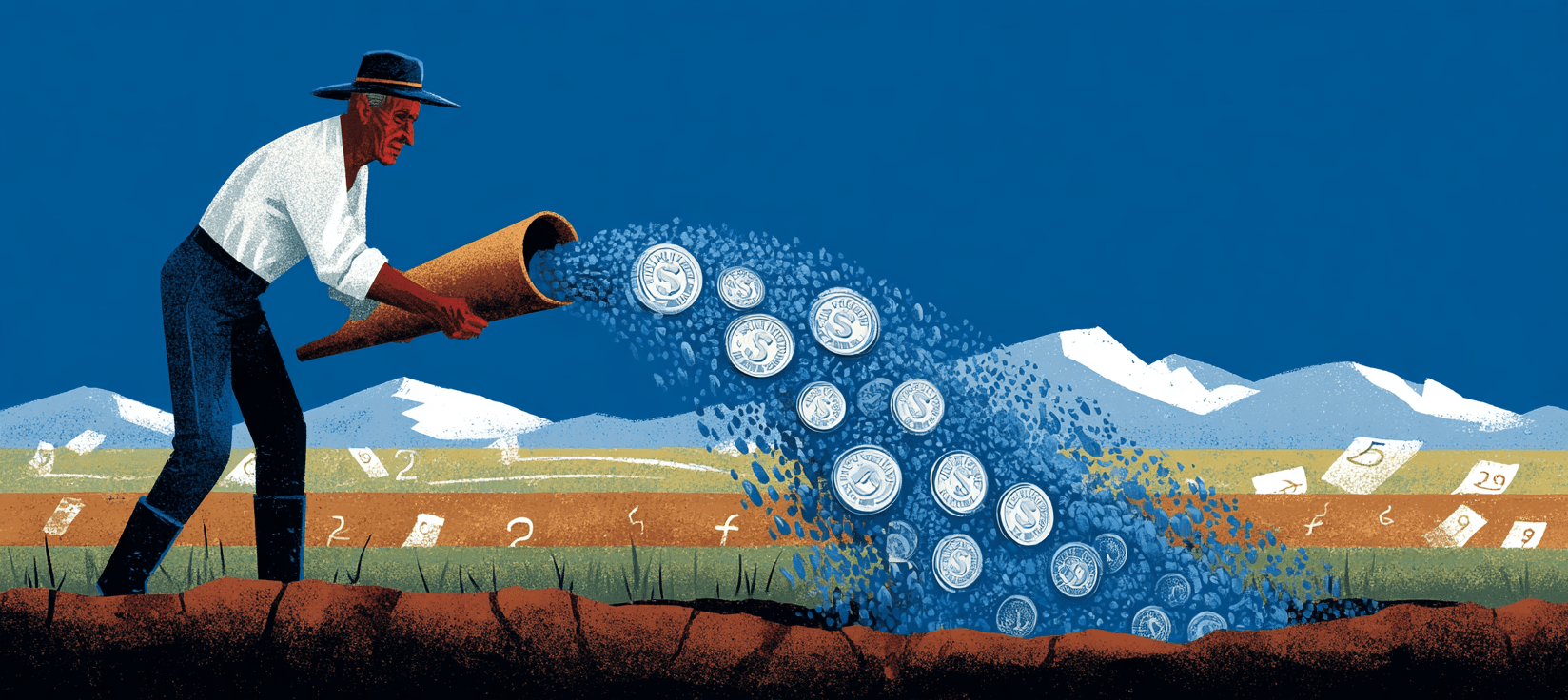
Root cuttings go into the ground in early spring. Equipment gets serviced. Contracts with processors get signed or deferred based on what a farmer believes the water will be. In the Klamath Basin, straddling the Oregon-California border at 4,000 feet of elevation, these decisions happen on a schedule that has nothing to do with the Bureau of Reclamation's timeline for announcing how much water 1,200 farming families will actually receive. The agricultural calendar runs ahead. It has to. By the time the number arrives, the money is already spent.
On April 1, the Klamath Water Users Association sent a letter to basin families. It arrived without an allocation number. What it carried was a sentence that named the condition precisely:
"This will be yet another year when you, your family, and other farmers and ranchers will be required to make tough decisions to ensure the survival, rather than the prosperity, of generational family operations."
Survival. Scott Seus, a third-generation horseradish and peppermint farmer who serves as KWUA board president, had been making those decisions for weeks already. On April 2, he told the Bend Bulletin the fallowing could reach 50,000 acres. "It was almost surreal," he said, "because we've been struggling with this for 25 years."
Five days later, the Bureau released the number: 221,000 acre-feet. Roughly half of what the basin needs. Snowpack on April 1, the date it should peak, stood at around 4 to 6 percent of average. The Cascades peaks that should still be white in early April are bare. The mountain reservoir that fills all winter and releases all summer, the entire premise the Klamath Project was built on, is nearly empty before irrigation season begins.
KWUA executive director Elizabeth Nielsen put it plainly: "It's much less than what we want to hear, although realistically not less than what we expected at this time."
The reason 2026 cuts the way it does is 2025. Last year, for the first time in six seasons, Klamath Basin farmers received enough water to meet their needs. One full allocation after a drought that began in 2020, bottomed out in 2021 with a historic near-total shutoff of just 33,000 acre-feet, and ground through 2022, 2023, and 2024 at various degrees of shortage. One year of relief. Enough time to reinvest, recommit, take on debt to restart what had been scaled back. Enough time to believe the calendar might hold again. The commitments families made during that good year do not reverse when the water disappears.
The agricultural calendar demands you act as if you know the answer months before it arrives. Switching crops, as basin potato farmers described in 2021, requires major investments in equipment, infrastructure, and years-long customer relationships. When the answer arrives wrong, the seed is purchased, the fields are prepped, the contracts are signed.
The Klamath Project Drought Response Agency will administer a seasonal idling program funded from $19.1 million in federal drought resilience money, paying farmers to leave fields unirrigated for the full season.
In prior years, the No Irrigation Program paid $450 per acre. The 2026 rate hasn't been announced. The math on $450 is straightforward and insufficient. Potato ground produces several thousand dollars per acre in gross income. Grain crops, a couple hundred. The payment covers something. But costs are fixed. The bank doesn't fallow. In 2021, Seus grew only about 40 percent of his land but still paid water fees to maintain the other 60 percent. You concentrate whatever water you have on the highest-value crops. Let the lower-value acreage go. Accept the idling payment on what you can't reach. Hope the partial crop covers the gap between what the program provides and what the bank requires.
Gene Souza, executive director of the Klamath Irrigation District, said in late March what the allocation number later confirmed: "I'm not seeing the water availability to meet all my legal and contractual obligations." Districts that normally wait for spring runoff will pull from reservoir storage earlier than usual. The system is borrowing from itself.
KWUA has called 2026 a "bridge year," noting that the Bureau has begun an Endangered Species Act re-consultation that could change the regulatory framework in future seasons. The regulatory process operates on its own calendar. The snowpack operates on another. The farmer stands between them, holding seed, having already committed money and labor to a season that may not arrive.
Seus farms horseradish and peppermint on ground his family has worked for three generations. At 50,000 acres fallowed across the basin, nearly 30 percent of the Project's irrigated land goes dry. Some of those fields are his. The letter his own organization sent on April 1 named the condition honestly. Survival. The seasonal cycle that once organized everything here, snow in winter becoming water in summer becoming food in fall, has come apart. Nobody in the basin can say what replaces it. The families who work this volcanic soil are making irreversible spring decisions in the gap.
Things to follow up on...
-
The basin isn't alone: Upper Colorado River Basin snowpack stands at just 24 percent of normal, and every western state is experiencing snow drought simultaneously, according to a CBS News synthesis of NIDIS data.
-
Groundwater as false bridge: During the 2020-2021 drought, a federal land-idling program tripled the Klamath Basin's historical groundwater pumping average, eventually drying out hundreds of residential wells and raising the question of whether this year's shortage will push farmers back underground.
-
The crop mix keeps shifting: OPB's 2021 reporting documented basin farmers permanently moving away from high-value potatoes toward drought-tolerant alfalfa, a shift that lowers per-acre revenue and compounds the economic damage of each successive short-water year.
-
Who pays for adaptation: Vermont's Climate Superfund Act, the first law attempting to make fossil fuel companies reimburse communities for climate adaptation costs, went to federal court on March 30 with implications for whether farming communities like the Klamath Basin could ever recover losses from the industries driving the drought.