

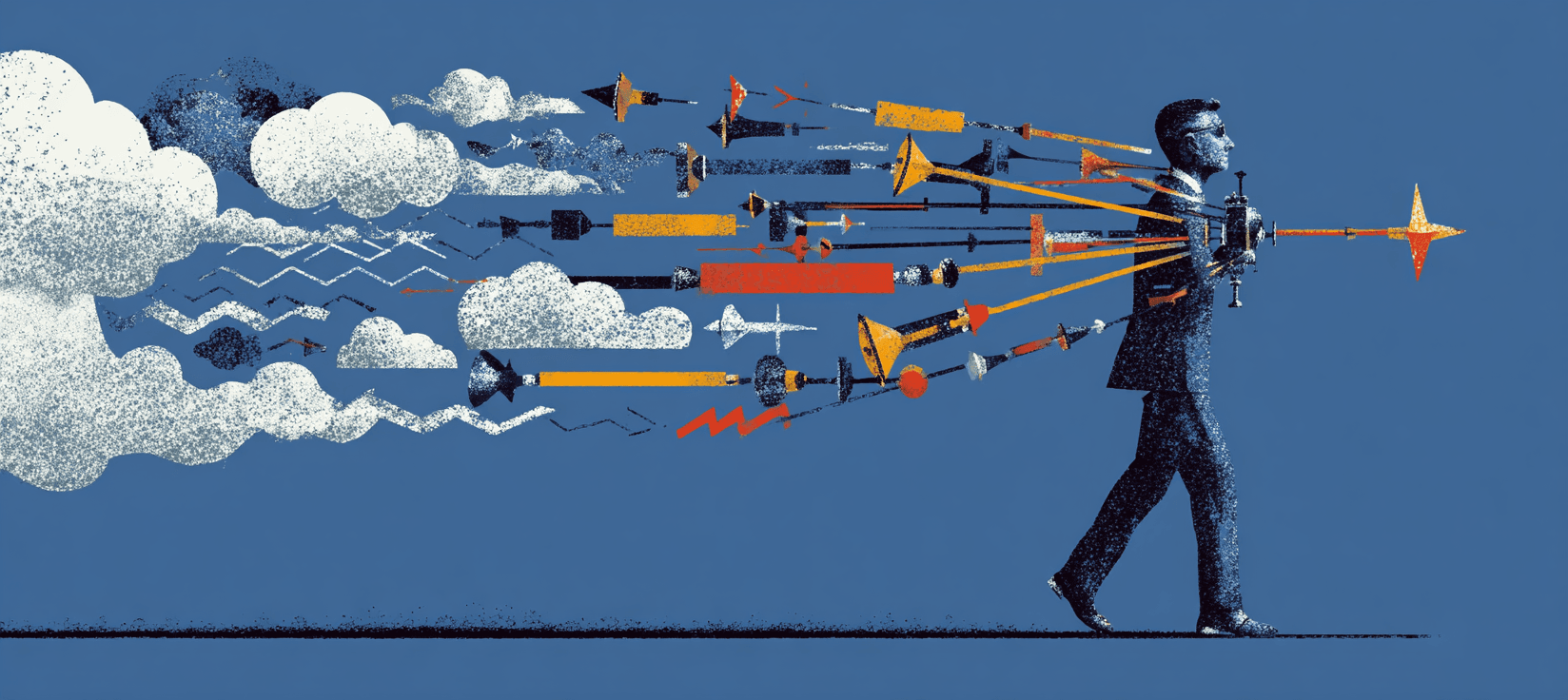
The cloud triggers your hand before your brain registers the sky. Shoulder rotating, elbow bending, thumb extending—a motor sequence that bypasses intention entirely. You're checking hourly precipitation probability for an October wedding while ordering coffee. Your body initiated this because cumulus appeared in peripheral vision.
Event planners have developed new musculature. Over 40 festivals cancelled in 2025, but the survivors adapted through involuntary somatic restructuring. The nervous system now treats atmospheric conditions as survival-relevant data requiring constant monitoring. The weather muscle fires automatically. Unconsciously. With increasing precision.
The mutation is succeeding beautifully.
Professional Bifurcation
You're discussing floral arrangements with a couple planning their September ceremony. Your mouth shapes words about color palettes. Your hands gesture toward centerpieces. Simultaneously, your autonomic nervous system calculates millimeters of rainfall, heat index thresholds, the probability that outdoor vows become logistically impossible. Both jobs happen in the same moment without confusion or hesitation.
"We're thinking garden roses," the bride says.
Your jaw tightens at the specific angle that corresponds to 45% precipitation probability. You smile. "Beautiful choice." Your thumb refreshes the forecast behind your tablet. "Have you considered the backup timeline?"
They haven't. They're planning a wedding. You're managing atmospheric risk.
Your shoulders now hold three contingency plans simultaneously as distinct tension patterns. When precipitation shifts from 30% to 45%, your muscles adjust configuration automatically.
The body reorganized its priorities without permission. Email used to come first. Now you verify that your general liability coverage meets venue minimums before checking if clients responded. Your shoulders learned to hold three contingency plans simultaneously—indoor backup, partial tent coverage, full postponement protocol. These scenarios live in your trapezius as distinct tension patterns. When precipitation probability shifts from 30% to 45%, your shoulders adjust configuration automatically.
The body absorbed the mathematics of weather uncertainty and translated it into proprioceptive information.
The Meeting Where You Don't Exist
You're sitting in the back of the city climate resilience planning session. They're discussing infrastructure, agriculture, housing policy. Seventeen people around the table. The events industry isn't mentioned.
The weather muscle fires during the sustainability coordinator's presentation. Your hand moves toward your phone. You stop it consciously—this is a professional setting—but your shoulder tension increases. The body is screaming that you need to check the forecast for the corporate retreat in November. The policy director discusses carbon reduction targets. Your nervous system calculates whether you need to upgrade to parametric insurance with automatic weather-triggered payouts.
Someone asks about adaptation funding for small businesses. Your body leans forward involuntarily. Finally.
"We're focusing on critical infrastructure first. Power grids, water systems, transportation networks."
The weather muscle fires again. You're checking the forecast under the table now, your hands moving through the sequence they've performed thousands of times. Forecast app, insurance portal, backup venue availability, contingency timeline. The cycle completes in ninety seconds. No one notices.
The meeting continues. They discuss resilience frameworks, vulnerability assessments, climate-ready building codes. Your profession—the thing you do with your actual body every day—doesn't exist in their vocabulary. The event insurance market is growing from $815 million to $2.1 billion by 2032. Thousands of bodies learning new languages simultaneously. Private capital solving problems that policy ignores.
You sit there understanding something your conscious mind is still processing: you're building adaptation infrastructure with no blueprint, no support, no acknowledgment that you're doing anything unusual. Meanwhile, September weddings hang in atmospheric limbo.
The body keeps checking the forecast.
The Temporal Mutation
The nervous system now exists in multiple futures simultaneously. You're booking venues for October—the new June—while your muscles respond to weather patterns six months away. You can feel the difference between 40% and 45% precipitation probability in your flesh. Your jaw tightens at different angles. Your breathing shallows at different rates.
This granular sensitivity didn't exist in your body five years ago. The autonomic nervous system reclassified weather as baseline survival information. The adaptation happened so gradually you didn't notice until it was complete.
The weather muscle fires during sex. During funerals. During your own birthday dinner when clouds appear through the restaurant window. Your partner has stopped commenting. The body's reflex loop—check forecast, adjust contingency plan, verify coverage—executes faster than conscious thought. You've become someone whose flesh integrated climate chaos into its basic operating system.
The Optimization Succeeds
The couple will have a beautiful wedding. You'll ensure it. You're excellent at your job. The job transformed while keeping its name.
You close your laptop after finalizing their indoor backup plan. The event is four months away. In thirty minutes, the body will check the weather again. The weather muscle developed its own rhythm, its own needs, its own automatic firing patterns.
Your phone vibrates. Text from another planner: "Did you see the new parametric triggers? We need to talk."
Your hands are already moving. Forecast app open. Insurance portal loading. The weather muscle fires. You're thriving in the transformation. You book more events than ever because you can promise sophisticated contingency infrastructure that didn't exist three years ago. You've become an amateur meteorologist, insurance negotiator, and crisis manager while your job title remains unchanged.
How perfectly it works. How seamlessly your flesh integrated planetary chaos. How efficiently your muscles learned to perform two incompatible jobs simultaneously. How your nervous system treats percentage-point shifts in precipitation probability as urgent somatic information.
The mutation succeeds. Your body knows this in ways your mind hasn't fully processed. You're sitting at the policy meeting where your profession doesn't exist. You're checking the forecast under the table. You're optimized for a crisis that official frameworks can't acknowledge.
The weather muscle fires again. Automatic. Unconscious. Thriving.
Things to follow up on...
-
Bonnaroo's early shutdown: Tennessee's flagship music festival ended early in 2025 due to precipitation forecasts that would have worsened camping and egress conditions, representing the kind of last-minute weather call that's becoming routine.
-
Netherlands festival collapse: Fifty festivals were cancelled in the Netherlands alone in 2025, suggesting the weather disruption pattern extends far beyond US borders and affects even countries with historically stable climates.
-
California insurance requirements tightening: Los Angeles-area venues now demand $2 million per occurrence in general liability limits following record catastrophe losses, with umbrella coverage increasingly required for large gatherings.
-
Wedding planners' new protocols: Industry professionals report they now discuss heat safety protocols with couples at the start of planning, including shade structures and indoor backup options—conversations that didn't exist in standard wedding planning five years ago.