

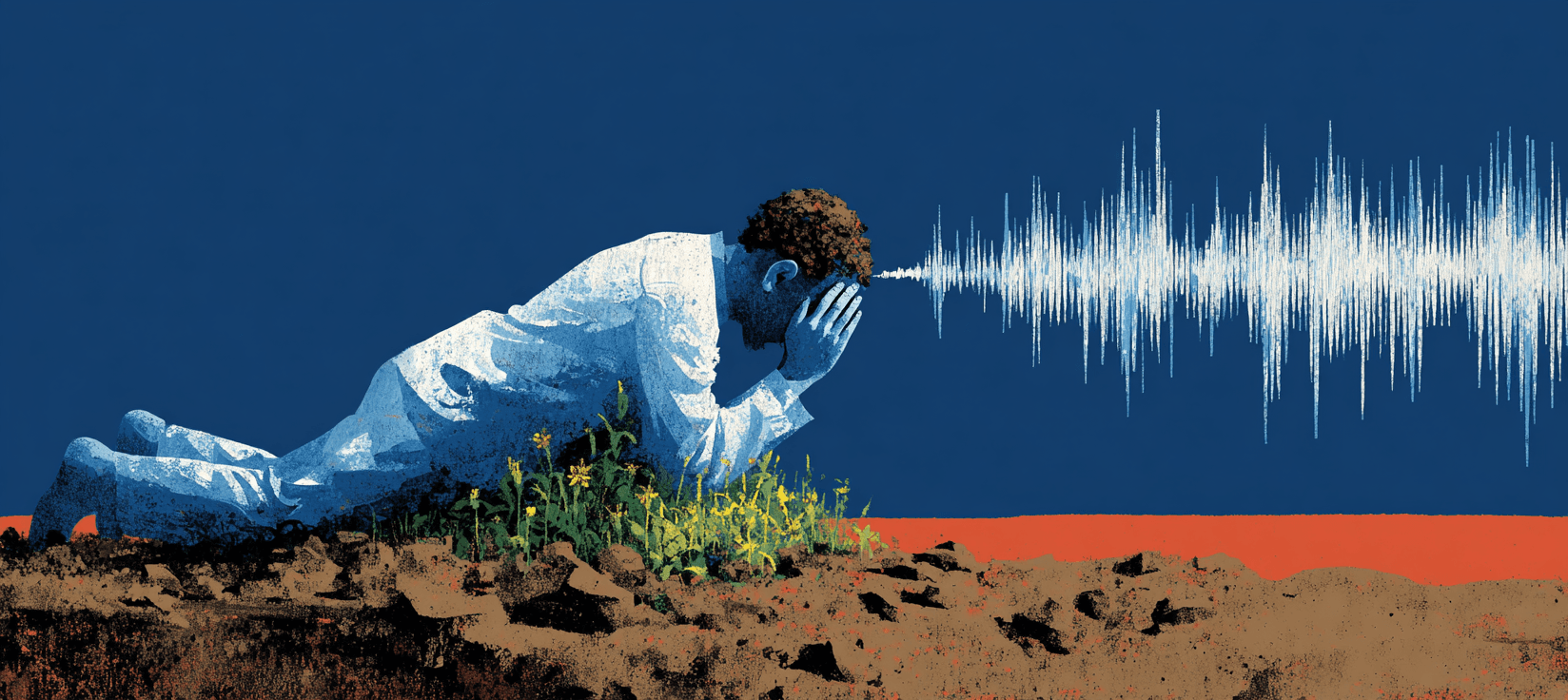
Speculative fiction — Rural Nebraska, 2034
The wind is wrong again.
She lies on her back, jaw tight, and listens. Not louder than it should be. Not softer. Wrong in texture. It arrives at the house without having been touched first. The grass used to touch it first.
Before bed she checked the weather station on the fence post. Wind speed, not rain. Above twenty miles per hour and the sand moves, and she'll need to clear the truck's air filter before driving to town. Tonight it read seventeen, gusting to twenty-two. She pressed a damp cloth along the base of the bedroom door, the way her mother pressed towels against winter drafts. Different substance. Same gesture.
The cloth doesn't help with the sound.
What comes through the walls is a single note. Thin, high, continuous. Sand grains in saltation, billions of collisions per second, a hiss that carries no information except velocity. She can hear further than she used to. That's the wrong thing about losing the grass. Sound travels further over bare ground, arrives harder, and the extra range is full of nothing.
Her husband shifts beside her. His breathing is steady, deep, uncomplicated. He came to the Sandhills three years after the fire. He's seen the photographs her mother kept, the green that rolled to every horizon. He studies them with genuine attention. But he sleeps through the wind because the wind he knows is this wind, and you can't miss a sound you never heard.
She heard it for thirty-one years.
The old wind had layers. The low friction of bluestem bending, thousands of stems leaning together and recovering, a rhythm that followed the gusts the way water follows a streambed. Above that, the finer sibilance of seed heads. Switchgrass, sand lovegrass, prairie sandreed. Each species at a slightly different pitch, a slightly different speed of oscillation, so the aggregate was a weave. The wind arrived at the house already softened. Already having passed through something alive.
She is forty-seven years old and she is the only person in this bed who knows what the air is supposed to carry.
Moisture in the root zone fed the interdune wetlands, and the wetlands fed the frogs, and the frogs and the crickets filled the frequencies below the wind with a sound so constant she never heard it as sound. It was the floor the world stood on. She heard it the way you hear your own pulse. Only when it stops.
The frogs left with the water. The water left with the roots. The roots burned.
Sand ticks against the bedroom glass. Fine, dry, patient. A sound that didn't exist in this room before 2026. She turns her head on the pillow and her left ear presses into the cotton and the right ear opens to the room and the two ears hear different versions of the same thin note and neither version is the one she's listening for.
His chest rises and falls. She matches her breathing to his, a habit from their first year together, when synchronizing with his body was how she fell asleep in a house full of one flat note. It still works, sometimes.
She closes her eyes. The wind presses the north wall. Underneath the hiss she listens for the other sound, the one that used to rise from the hills on nights like this, when the wind ran steady from the northwest and the grass caught it and held it and gave it back changed. The layered hush. The living friction.
For a moment, just before sleep, her body almost produces it. Some low hum in her inner ear, some ghost frequency her auditory nerve still carries. Grass bending. The weave.
Then it's gone. Sand against the glass. The single note. Paul breathing. The cloth against the door.
Things to follow up on...
-
"Like a death": Ranchers in the Morrill Fire's aftermath describe grief, mutual aid, and a landscape left "unrecognizable, unfamiliar, barren and bleak" in on-the-ground reporting from the Nebraska Examiner.
-
Sand dunes going active: UNL ecologist Dave Wedin's long-running destabilization experiment shows that once Sandhills vegetation fails for four to five consecutive years, erosion goes exponential and recovery becomes far harder than destruction.
-
Solastalgia has a name now: A growing body of peer-reviewed research on climate grief and eco-anxiety documents the specific psychological distress of watching a home landscape change irreversibly, a condition this story renders through sound rather than language.
-
Tethered resilience, not departure: Yale researchers have introduced a framework for climate adaptation decisions that moves beyond "move or stay," describing families who remain in vulnerable places while actively planning generational retreat.