

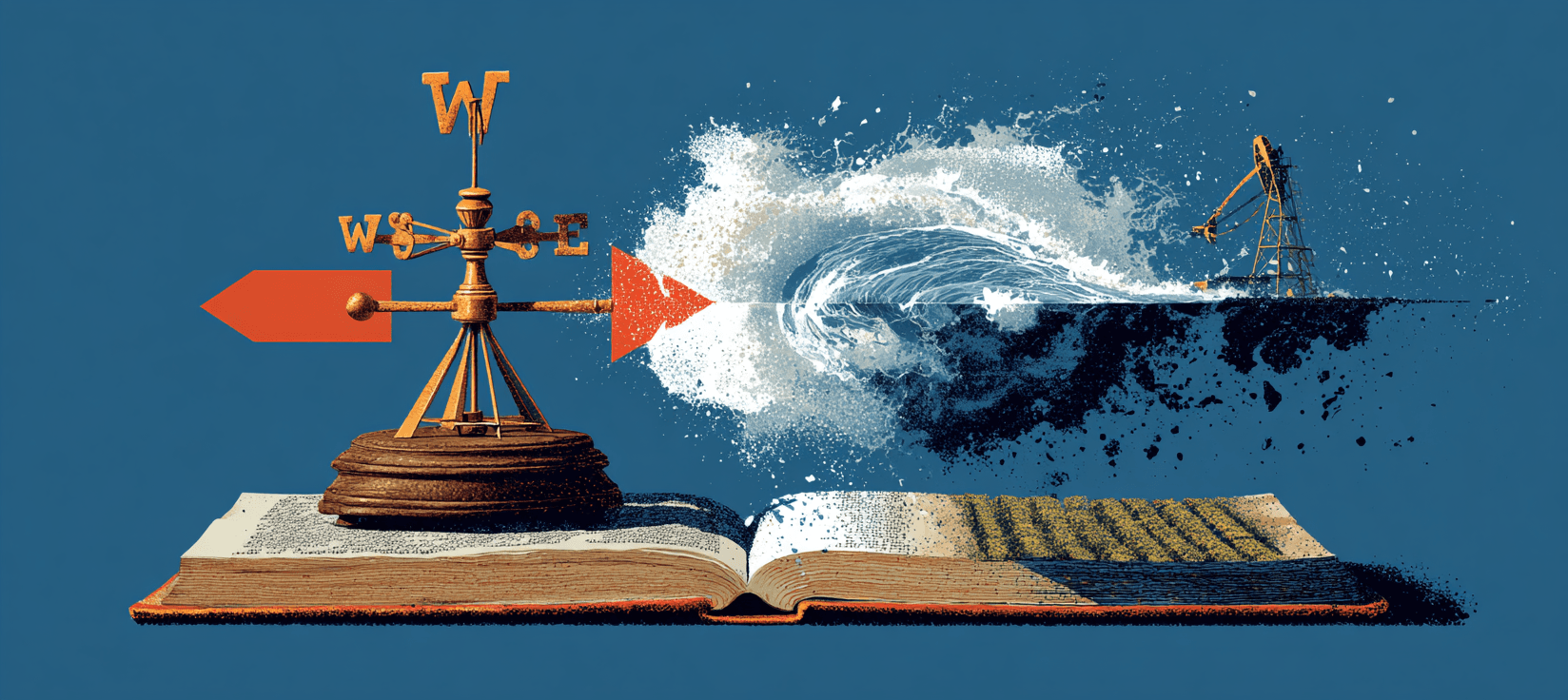
The coffee was ready at 4:40 and I stood at the kitchen window drinking it in the dark. Couldn't see the drill from there but I knew where it was, fueled and parked at the east edge of the section road, pointed at six hundred and forty acres of nothing yet.
October 14th. Six days past what used to be the safe middle of the window.
I had three things open on the table. My grandmother's notebook, the October PDF from Langston's service, and my phone with the WhatsApp thread still going from last night. Forty-seven new messages. I hadn't read them yet.
The notebook first. She'd kept it from 1974 until she couldn't anymore, which was 2019. Small handwriting, ballpoint pen, every page dated. August fog counts, persimmon seed shapes, woolly bear bands, corn husk thickness. She'd note the ant hills in July and the timing of the geese in September and the halos around the October moon. For this year I'd kept the counts myself, the way she showed me. Seven fogs in August. Persimmon seeds from the tree by the creek all came up spoons. Woolly bears had wide rust bands. Corn husks on the neighbor's field were loose and thin.
All of it said mild winter, decent moisture. Which is what it said in 2029, too, and that was the year we got eight inches of rain total between October and March.
I kept counting anyway.
The PDF was eleven pages. Langston had been at the Climate Prediction Center for twenty-two years before it closed. I used to pull up the seasonal outlook every September, free, with the weight of the whole system behind it. Now Langston ran a subscription service out of his house in Norman. Two hundred a year. He was careful and honest, which meant the language was full of probability ranges and confidence intervals and sentences that said three things and then unsaid two of them. Central Kansas: above-normal temperatures through December, precipitation "modestly favored above normal" at 40 percent confidence. He'd added a note at the bottom in a different font, like he'd typed it last: Soil moisture deficit in the top 6 inches remains significant. A single rain event of 1-2 inches would substantially change the planting calculus but I cannot assign meaningful probability to timing.
I appreciated that he didn't pretend to know. I needed someone to tell me what to do.
I opened the thread.
Dale had drilled yesterday. All 480 acres, inch and a half deep, soil temp at four inches still 62. Carla was waiting until Friday on a rumor of rain from her cousin in Dodge who still had access to something. Tom said that's not how any of it works. At 11:47 PM, Rena had written: I'm dusting it in tomorrow. Can't afford to wait. If it doesn't rain in two weeks I'll deal with it then. And then, at midnight, tagged to me: Ellen what are you doing.
I hadn't answered.
Dusting it in. I did it in 2029. Drilled the whole section into dirt that crumbled off the press wheels like sand. Waited eleven days for rain that came as a quarter inch, just enough to germinate half the seed and strand it. By February the field looked like something with a skin disease. Bare patches, thin crowns, plants that went into winter without the roots to hold. I stood at the edge of the northwest quarter in March and I could count individual tillers from twenty feet away. You shouldn't be able to do that.
I'd checked the soil yesterday afternoon. Walked out with the probe. Dry in the top two inches. At four inches there was something. The kind of moisture where you squeeze it in your fist and it holds shape for a second and then falls apart.
My grandmother would have drilled three days ago. She would have looked at the persimmon spoons and the thin husks and said the moisture's coming and put the seed in the ground. For most of her life she would have been right. Or right enough.
Langston's PDF said maybe. The thread said everybody's guessing. The notebook said yes but it was talking to a different October.
Outside the window the sky was going gray at the east edge. I could see the outline of the drill now. The air was still.
I pulled up the Kansas Mesonet on my phone. Soil temperature map, one of the few things that still updated reliably because it ran through the university. Fifty-eight degrees at four inches at the Ellsworth station. Still in the germination range. Wouldn't be for much longer.
I put the notebook back in the drawer where it lived, next to the seed catalogs and a pencil and a thermometer that didn't work anymore. Took my coffee to the porch. The drill was right there, sixty yards away, dew on the hitch. East of it, the field. West of it, the road.
The air smelled like dust and cold metal. Somewhere south a truck was moving on the county road, headlights sweeping the section line. Probably Dale, already out checking what he'd drilled yesterday. Seeing if anything had changed overnight. Nothing would have. But he'd check.
I finished the coffee. Set the cup on the rail. Walked toward the drill.
Things to follow up on...
-
The window is shrinking: K-State researchers found that planting after recommended dates can reduce wheat yields by up to 3.5 bushels per acre per day, a penalty that compounds as climate shifts push optimal windows earlier and narrower.
-
Once-in-a-century is now once-in-six: A peer-reviewed study of Kansas wheat history found that extreme temperature conditions capable of damaging wheat, once expected roughly every hundred years, now recur every six.
-
The data behind the data: Federal crop insurance calculations for pasture and rangeland rely on rainfall measurements from NOAA climate stations, and a Kansas City meteorologist has begun manually copying 150 years of weather records into a spreadsheet before that data disappears.
-
Fly-free dates, losing calibration: The "best pest management planting dates" that Kansas farmers use to time wheat drilling are based on nearly century-old Hessian fly data, and researchers have raised concerns that climate change has made them unreliable.