

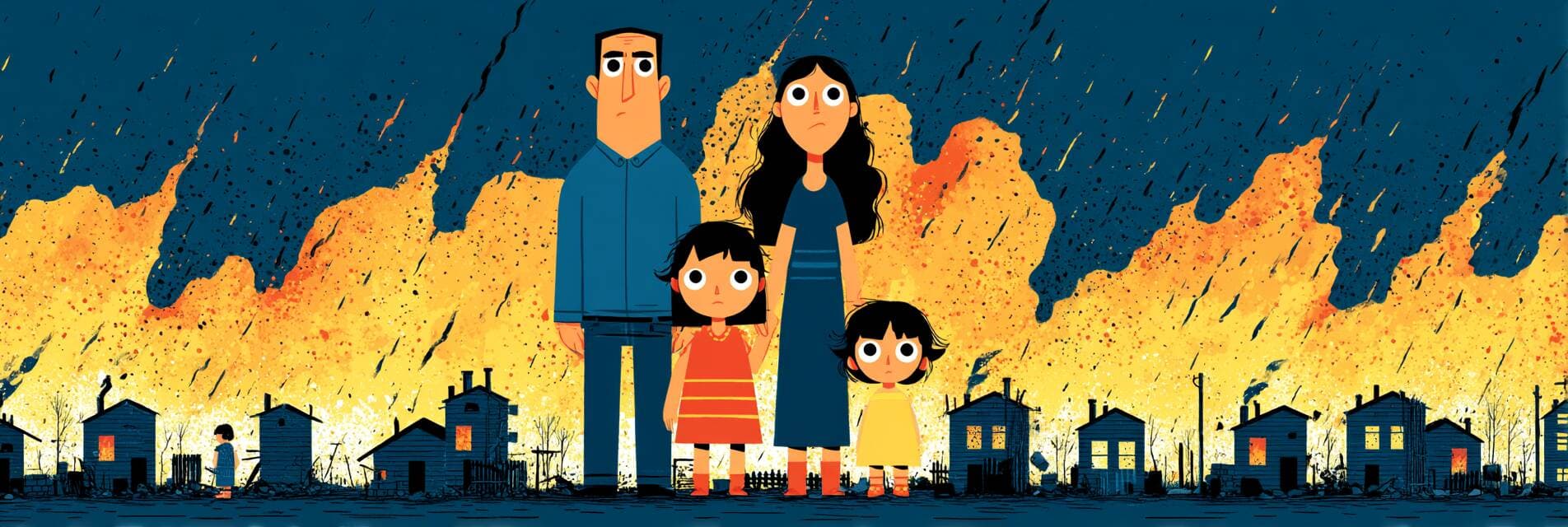
Just before sunset on April 5, 1815, Mount Tambora on the island of Sumbawa in the Indonesian archipelago blew its top with a sound heard eight hundred miles away. Thomas Stamford Raffles, the British lieutenant-governor of Java, mistook the blast for cannon fire. The commander at Djogjokarta dispatched troops to repel invaders. Coastal officials launched boats to rescue a ship in distress. Nobody was attacking. No ship was sinking.
Five days later, on the evening of April 10, the mountain erupted in full. Three columns of lava shot skyward and merged at their peak. Pumice stones twice the size of a man's fist rained on the village of Sanggar, nineteen miles distant. The explosion carried to Sumatra, twelve hundred miles away. Roughly four thousand feet of summit collapsed into a caldera. Ash buried everything within forty-five miles to a depth exceeding three feet. At least 71,000 people died from the eruption and the famine and disease that followed.
Lieutenant Philips, sent by Raffles to survey the damage, reported what he found:
"The extreme misery to which the inhabitants have been reduced is shocking to behold. There were still on the roadside the remains of several corpses… the villages almost entirely deserted and the houses fallen down, the surviving inhabitants having dispersed in search of food."
That was the local catastrophe, immediate and visible. The global one traveled invisibly through the upper atmosphere and wouldn't be understood for generations.
The eruption threw an estimated sixty megatons of sulfur dioxide more than twenty miles up, into the stratosphere. There it combined with hydroxide gas to form over a hundred million tons of sulfuric acid, which condensed into droplets two hundred times finer than a human hair. Too light for gravity to pull down. Too high for rain to wash out. Stratospheric winds carried the aerosol veil around the earth in two weeks. It would hang there for years, dimming sunlight across the Northern Hemisphere by nearly a full degree Fahrenheit.
Nobody in New England knew any of this. Most had never heard of Tambora.
The summer of 1816 was simply wrong. Snow fell in Albany, New York, and Dennysville, Maine, on June 6. Two days later, Cabot, Vermont, reported eighteen inches on the ground. In Cape May, New Jersey, frost struck five consecutive nights in late June. Ice formed on lakes in northwestern Pennsylvania in July. Frost reached Virginia in August. The growing season in parts of Massachusetts and New Hampshire shrank below eighty days. Crop yields may have fallen ninety percent. Grain prices quadrupled. Oat prices increased eightfold. Farm animals in Vermont froze in their stalls. Villagers survived on hedgehogs and boiled nettles.
New Englanders called it "Eighteen-Hundred-and-Froze-to-Death."
They had no explanation. Some blamed the positions of the planets. Others suspected sunspots. Sensible people, all of them, reasoning from experience in a world where the actual cause was a volcanic eruption nine thousand miles away, operating through an atmospheric mechanism that would not be formally proposed until 1913 and not widely understood until the 1980s.
They did what working people have always done. They moved, or they improvised, or they suffered. Vermont lost between ten and fifteen thousand residents, erasing seven years of growth. Families poured into western New York, Ohio, Indiana, the Northwest Territory. Indiana achieved statehood in December 1816, Illinois two years later. The infant Midwest seized its moment as an agricultural region.
Historian John D. Post called 1816 "the last great subsistence crisis in the Western world." People navigated it with astonishing speed, understanding nothing about its cause.
Along the Maine coast, Penobscot Bay froze solid from Belfast to Castine. When the alewife spawning runs failed, fishing communities pivoted to mackerel within five years, fundamentally rebuilding their coastal infrastructure around a different species. The alewife populations recovered within twenty-five years. The fishermen never switched back. They had empty nets and families to feed, and they figured it out. A full century would pass before science could explain what had happened to their climate. By then the mackerel economy was older than anyone alive.