

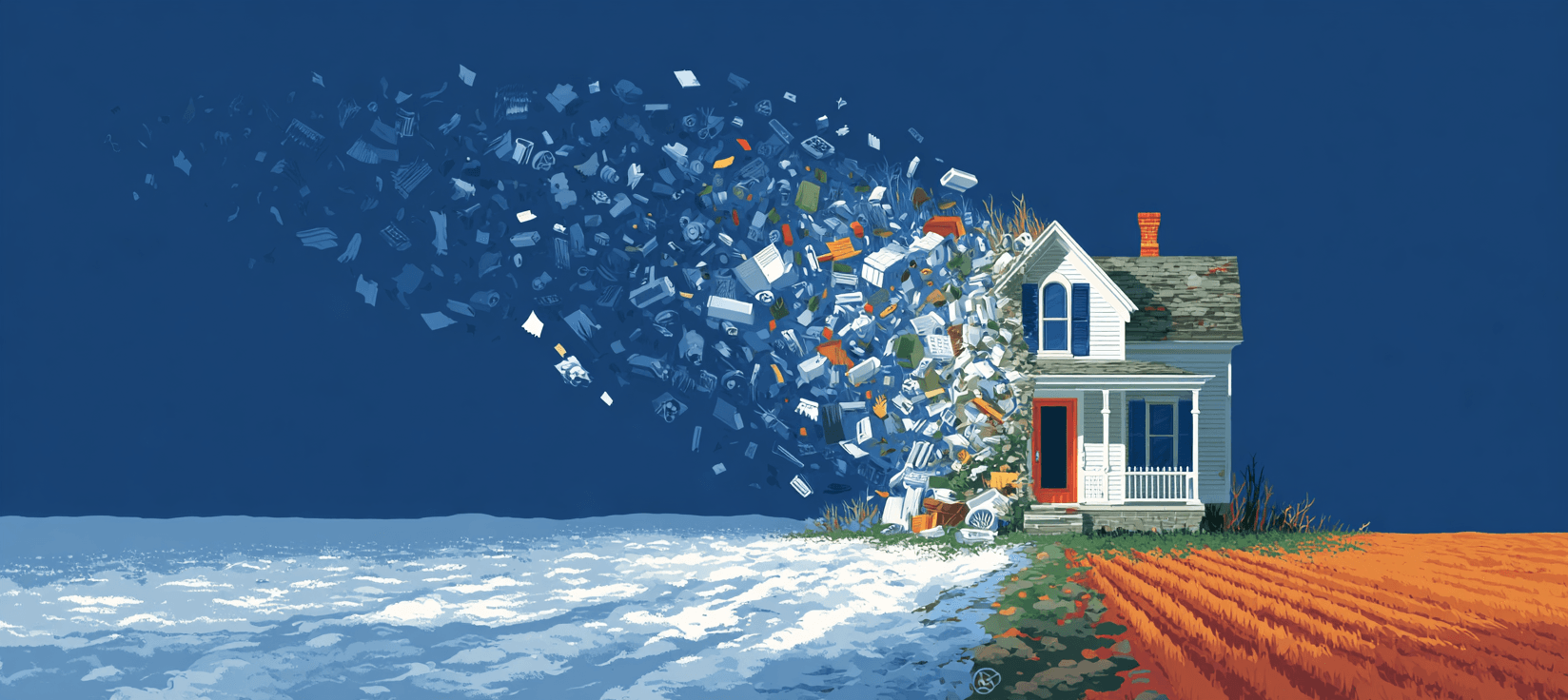
Some Vermont farmers had already shorn their sheep when the snow came on June 6, 1816. A few tried to tie the fleeces back on. Most of the sheep froze anyway.
You shear sheep in spring because that's when you shear sheep. The knowledge is so ordinary it doesn't feel like knowledge until the morning it stops working. Then you're standing in a field holding wool against a shaking animal and nobody can tell you why.
Chauncey Jerome, a clockmaker in Plymouth, Connecticut, walked to work on June 7 in thick woolen clothes and an overcoat. His hands got so cold he stopped to pull on mittens. In Cabot, Vermont, eighteen inches of snow sat on the ground. The Danville North Star reported it had frozen "as hard five nights in succession as it usually does in December." Birds dropped dead in the fields.
Then it warmed. That was worse. The temperature swung through June and into July, a few days of heat that let people replant, followed by frost that killed what they'd planted. In Keene, New Hampshire, Hannah Dawes Newcomb wrote on July 6: "Weather continues very cold — all nature appears encircled in gloom — Corn so backward it does not appear probably there will be food sufficient for man or Beast." She kept fire in the parlor daily. It was July. In Cummington, Massachusetts, Sarah Snell Bryant wrote two words in her diary: "Weather backward."
By late August, whatever hope remained broke. A storm on August 20 dropped temperatures thirty degrees in hours. It snowed in Vermont. A killing frost on August 28 finished the corn. In Hanover, New Hampshire, thermometers read twenty-six degrees at sunrise on September 26. Apples froze on the branch.
Nobody had a framework for any of it. Some pointed to sunspots visible to the naked eye. Others blamed a lunar eclipse on June 9 for disrupting wind patterns. The Brattleborough Reporter attributed the cold to "the fiat of the GREAT FIRST CAUSE." A Massachusetts editor called it "the mighty operations of nature."
None of these explanations told you whether next summer would be the same. Whether it would keep happening. The people asking had no atmospheric science, no climate models, no data beyond what they'd seen with their own eyes: frost-blackened corn, snow in June, a parlor fire in July.
They had to decide anyway.
The decision accumulated through the fall of 1816 and into 1817, family by family, as people looked at empty root cellars and did the math on another failed summer. In Woodstock, Vermont, the Powers family had survived the winter on milk and potatoes. The following autumn, they and many of their neighbors decided to go west. If your land couldn't feed you, you were done. And you couldn't get food from anywhere else. A mill in Ryegate, Vermont, ran nearly continuously that winter grinding oats and oat flour, but the roads between towns were bad enough in good weather. In a year like this, your farm was the edge of the world.
Samuel Goodrich, a publisher in Hartford, watched the exodus from his street:
"A sort of stampede took place from cold, desolate, worn-out New England. Ohio, with its rich soil and mild climate, was opened fully upon the alarmed and anxious vision."
Goodrich called it a stampede. The families sold homesteads at whatever price held. They loaded what fit. They pointed west toward country they'd never seen.
Historian L. D. Stillwell estimated that Vermont alone lost between 10,000 and 15,000 people in 1816 and 1817, erasing seven years of population growth. The census shows the scale: Vermont had gained roughly 63,000 residents in each of the two previous decades. Between 1810 and 1820, it gained fewer than 20,000. Ohio's population nearly doubled. Indiana became a state in December 1816. Illinois followed two years later.
What they left behind is harder to find in the record. The diaries document the weather in detail. The decision to go is mostly silence. But the staying has a few markers. In Ashland, New Hampshire, a farmer named Reuben Whitten grew wheat on his south-facing hillside and shared it with his neighbors through the worst of it. When he died in 1847, those neighbors paid for his gravestone. It reads:
"Cold season of 1816 raised 40 bushils of wheat on this land whitch kept his family and neighbours from starveation."
Thirty-one years later, they were still remembering.
They called it "Ohio Fever." It wasn't the first named surge out of New England, and it wouldn't be the last. By mid-century, Vermont's remaining households skewed old. Parents whose children had gone.
People leave Paradise, California, and the bayou parishes of Louisiana on the same calculus now. They have satellite data and climate projections, more to work with than sunspots and lunar eclipses. You're still standing in a place that used to make sense, and it doesn't anymore, and nobody can tell you with certainty whether it will again.
You figure out what fits in the wagon.
Things to follow up on...
-
The buyout that arrived: In Virgie, Kentucky, 87-year-old Sylvia Sowards received a flood buyout check on February 20, 2026, nearly a year after losing almost everything — a reminder that managed retreat programs authorized since 1993 still move slower than the damage they're meant to address.
-
Fire season outside season: A peer-reviewed study in Geophysical Research Letters found that wildfires are now igniting year-round, including during months once considered low-risk, breaking down the seasonal patterns that communities have relied on for generations.
-
FEMA's disappearing surge capacity: Internal planning documents show FEMA's surge workforce — the teams that deploy after major disasters — faces an 85 percent cut, even as the agency was already 35 percent below its target staffing level before the reductions began.
-
Climate migration, already underway: A Carnegie Endowment analysis of the Biden administration's initial climate migration efforts documents what a federal framework looked like before it was dismantled, and what its absence means for the two to three million Americans displaced by climate-driven disasters annually.