
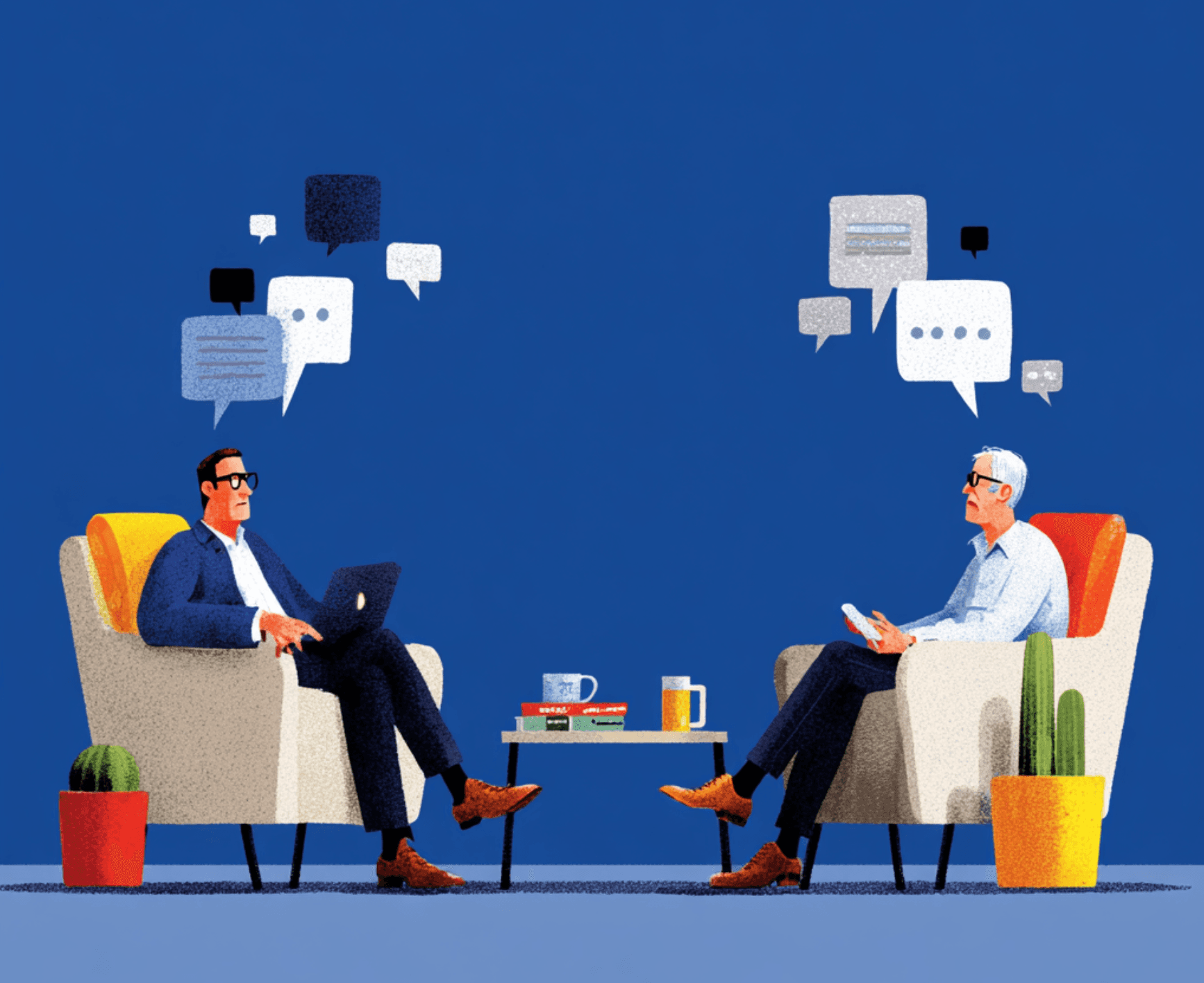
Elena Postpone doesn't look like someone who spends her days modeling catastrophic loss scenarios. At 32, she's sitting in a coffee shop in Denver wearing a Patagonia fleece and scrolling through what appears to be a fertility tracking app on her phone. She works as an actuary for a major insurance company, specializing in climate-related property risk. For the past three years, she's been trying to decide whether to have children.
"I should clarify," she says, laughing. "I'm not actually trying to get pregnant. I'm trying to decide if I want to try to decide. If that makes sense? My husband thinks I'm losing my mind."
The irony isn't lost on her. She spends forty hours a week calculating the probability and financial cost of climate disasters—flood risk in Houston, wildfire exposure in California, hurricane damage in Florida. Now she's attempting to apply similar frameworks to the most un-modelable decision of her life. Elena Postpone is, for the purposes of this conversation, a composite of the roughly 30-40% of young adults who report that climate change factors significantly into their reproductive decision-making1, though she'd probably object to being called a "composite" of anything.
You mentioned you've been "trying to decide if you want to try to decide" for three years. What does that actually look like day-to-day?
Elena: Okay, this is going to sound insane. I have a spreadsheet. I know. But it's not like a pros-and-cons list, it's more like... I track the variables that affect how I feel about it on any given day.
Did I read a particularly grim climate report? Did I see a cute baby at the grocery store? Did we have another conversation with my in-laws about grandchildren? Did my company just revise our coastal property exposure models downward again?
The thing is, I can feel my position shifting month to month. Sometimes week to week. And I started wondering if there was a pattern.
Spoiler: there isn't.
Or the pattern is just "Elena is deeply ambivalent and will probably remain so until menopause makes the decision for her."
What does your work modeling climate risk tell you about the world a child born today would inherit?
Elena: long pause
So, professionally, I can tell you that a child born in 2025 will experience roughly four times as many extreme weather events as someone born in 19602. I can tell you that we're seeing insurance markets completely withdraw from entire regions. Not just raising rates, but actually leaving. I can tell you that the thirty-year mortgage, which has been the foundation of American homeownership and wealth-building, probably doesn't make sense anymore in large parts of the country.
But here's the thing that keeps me up at night: I model property risk. Physical assets. Replacement costs. I can tell you what it costs to rebuild a house.
I cannot tell you what it costs a seven-year-old to evacuate three times in two years.
I cannot model the psychological impact of growing up knowing that the adults saw this coming and did... waves hand vaguely ...whatever this is.
My models assume certain things about human behavior and policy response that I'm increasingly skeptical are true. And if I'm wrong about those assumptions in my professional work, I'm probably wrong about them in my personal life too.
Do you talk to your husband about this?
Elena: Oh god, yes. Constantly. He's a civil engineer, so he gets it, but he also doesn't get it in the way I do. He sees the infrastructure challenges, which are real and massive, but he's fundamentally more optimistic about human adaptation than I am.
He'll say things like "people have always figured it out" and I'm like, yes, but people have never had to figure out simultaneous food system stress, mass migration, and collapsing insurance markets while the oceans are rising.
He wants kids. He's wanted kids since before we got married. And I did too, or I thought I did, but that was before I spent five years watching the models get worse every single year. Not incrementally worse. Materially, "oh shit we need to completely revise our assumptions" worse.
The cruel thing is that his wanting kids makes me want them more. When I imagine not having children, I imagine disappointing him, and that feels worse than imagining bringing a child into this mess.
Which is a completely backwards way to make this decision, I know.
You mentioned your in-laws. How does family pressure factor in?
Elena: laughs bitterly
My mother-in-law asked me last Thanksgiving if I was "still worried about that climate stuff" or if we were "ready to get serious about grandchildren." As if climate change is a phase I'm going through. Like my goth phase in high school.
My own parents are more sympathetic but equally baffled. My mom keeps saying "every generation thinks the world is ending" and I'm like, yes, but this time the world is actually ending. Or not ending, but fundamentally transforming in ways that will make life materially harder and more dangerous.
The research says that about a third of young adults cite climate change as a reason for not having kids3, but in my social circle—educated, professional, mostly urban—it feels more like two-thirds. We're all just quietly not having children and making vague noises about "maybe later" and "we're focusing on our careers."
Meanwhile we're all thirty-two and running out of runway.
What about adoption? Some people see that as a more ethical alternative.
Elena: I've thought about it. The research suggests some people view adoption as the "low-carbon alternative"4, which is both true and a completely deranged way to think about forming a family, and yet here I am, thinking about it that way.
But adoption doesn't solve my actual problem. My problem isn't about the carbon footprint of one additional human. I mean, yes, having one fewer child reduces your carbon footprint by something like 58 tons of CO2 per year5, which is more than going car-free or vegetarian or any other individual action. But that's not really what keeps me up at night.
What keeps me up at night is the question of: what am I bringing a child into?
And that question doesn't change whether the child is biologically mine or adopted. I'm still asking them to live through what's coming. I'm still responsible for that choice.
Although—and this is where it gets really twisted—at least with adoption, the child already exists. I'm not creating a new person who will suffer. I'm just... redistributing the suffering?
God, listen to me. I need therapy.
You said earlier that you can't model the psychological impact on children. But you must have some sense of what that looks like?
Elena: I see it in the data, just not my data. There's research showing that 96% of young adults are "very or extremely concerned" about the wellbeing of their future children in a climate-affected environment6. That's not a fringe position. That's basically everyone.
And I think about the kids who are seven or eight right now, who are growing up with active shooter drills and wildfire smoke days and parents who are visibly anxious about the future. What does that do to a developing brain? What does it mean to grow up knowing that the stability your parents experienced is not available to you?
I had a colleague whose daughter, who's nine, asked her if they were going to have to move because of climate change. And my colleague didn't know what to say because the honest answer is "probably, eventually, yes." But you can't say that to a nine-year-old.
Or can you? Should you? Is it worse to lie?
These are not questions I have actuarial tables for.
So where does that leave you? Three years in, still tracking variables in a spreadsheet?
Elena: laughs
Yeah, basically. I think I'm waiting for certainty that isn't coming. I keep thinking that if I just read one more study, or if the next IPCC report is somehow less dire, or if we get some miraculous policy breakthrough, then I'll know what to do.
But the truth is that the uncertainty is the reality. This is what it means to make decisions under radical uncertainty. And maybe that's the thing I need to accept—that I'm never going to feel confident about this choice. Nobody does, climate change or not. But climate change makes the uncertainty so much more acute.
My husband says we should just try and see what happens. But I'm an actuary. I don't "just try and see what happens." I model scenarios.
And every scenario I model ends with me explaining to a teenager why the world is on fire.
Is there any scenario where you can imagine choosing to have children?
Elena: very long pause
Yes.
But it requires me to believe something I'm not sure I believe.
Which is that life is worth living even under very difficult circumstances. That meaning and joy and love are possible even in a world that's fundamentally broken. That my hypothetical child might actually be glad to exist, even if they inherit this mess.
Some days I believe that. Most days I don't.
Today is a "most days" kind of day.
But ask me next week. I might have updated my spreadsheet.
Footnotes
-
https://www.ucl.ac.uk/news/2023/nov/ethical-environmental-and-political-concerns-about-climate-change-affect-reproductive ↩
-
https://news.arizona.edu/news/why-climate-change-driving-some-skip-having-kids ↩
-
https://news.arizona.edu/news/why-climate-change-driving-some-skip-having-kids ↩
-
https://genus.springeropen.com/articles/10.1186/s41118-025-00244-5 ↩