
My grandmother's hands move through the sorting with the certainty of forty years, but this year the plums are wrong. Too soft already, skins splitting before we've even begun the salt cure. She holds one up to the light from the kitchen window—our kitchen now, in this inland city where she moved after the third typhoon took her house.
"These ripened too fast," she says. Not to me. To herself, or to the plums, or to the June that used to arrive with steady rain and fruit that waited.
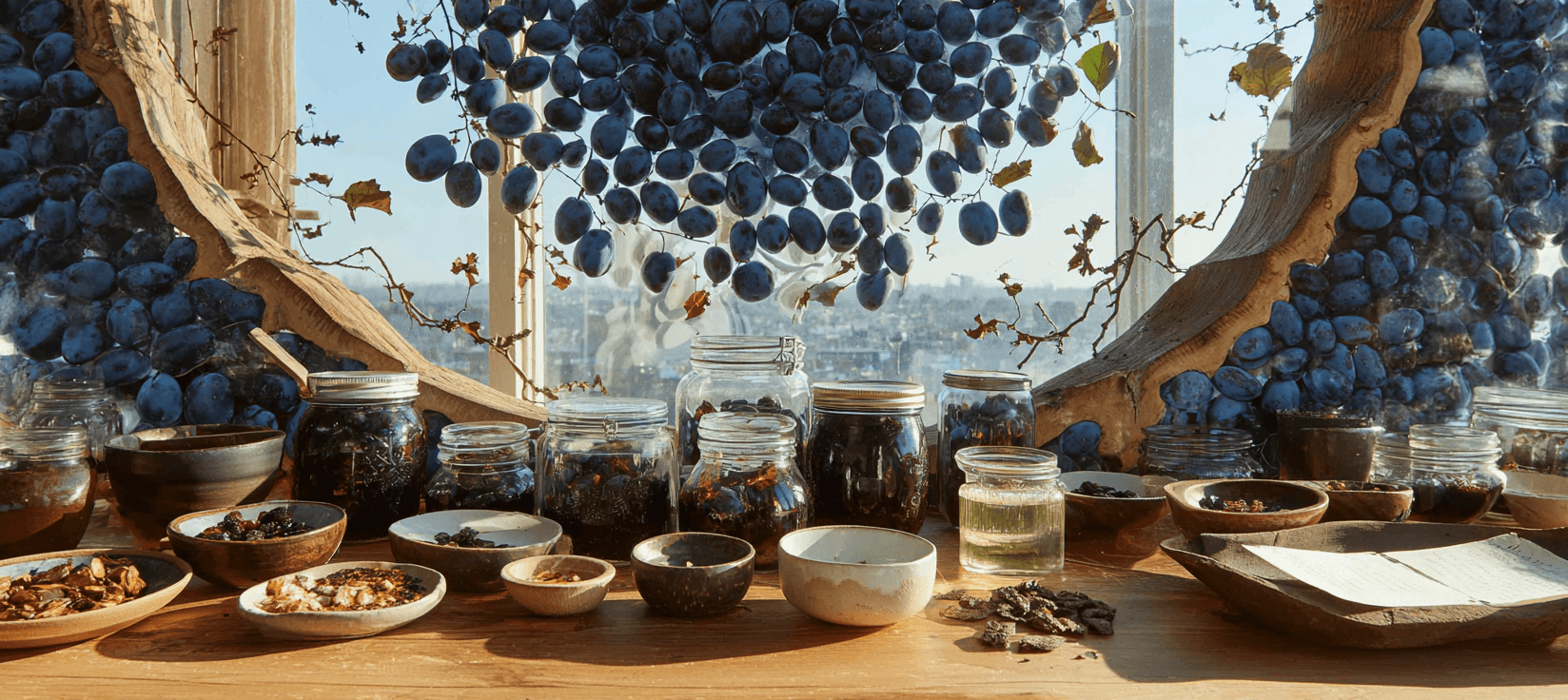
I take the split one from her. My thumb slides into the tear in the skin, releases juice that should still be firm inside the flesh. The smell is right—that particular sourness that means ume, means June, means the preservation work that connects her hands to her mother's hands to hands I never knew. But the texture is already collapsing. The plums are fermenting themselves, beginning the transformation that should happen slowly, under our control, in the salt and weight and time.
"We'll adjust," she says.
She's already reaching for the salt jar, but her hand hesitates over it. I watch her fingers hover, watch her body trying to calculate ratios that no longer hold.
The recipe she learned at fifteen called for plums picked in early June, after the rainy season began but before the humidity peaked. Salt ratio of eighteen percent. Three days under weight, then the red shiso leaves, then the sun-drying in late July when the rains ended and the heat was dry and steady.
But early June is late May now. The rainy season starts in April and never quite ends. The humidity doesn't peak; it sustains. And the plums ripen in a rush, all at once, their flesh already softening in the heat that doesn't break.
"More salt," she says finally. "Twenty-two percent. Maybe twenty-three."
I measure it out. My hands know the weight of salt, the feel of coarse crystals between fingers, but they don't know what she knows—how this much salt will change the final taste, make the umeboshi sharper, more aggressive, less like the ones she made in the house by the ocean where the air itself carried salt and the plums cured in a different chemistry.
We layer them in the crock. Plums, salt, plums, salt. Her hands press each layer firm, but I see her hesitate, feel her uncertainty transmitted through the pressure of her palms. Too firm and the already-soft flesh will collapse. Too gentle and they won't release enough liquid, won't create the brine that should preserve them.
"The weight," she says.
I bring the stone, the one she carried from the old house. It's wrapped in cloth that still smells faintly of ocean. We settle it on top of the plums.
Then we wait.
This is the part that used to be certain. Three days, and the plums would release their liquid, create the brine, begin their transformation. But I check after two days and the brine is already rising, already cloudy with fermentation that's moving too fast. The smell is sharp, almost alcoholic.
My grandmother lifts the weight, peers into the crock. Her face shows nothing, but her hands shake slightly as she replaces the stone.
"We'll add the shiso tomorrow," she says. "Not three days. Tomorrow."
The shiso leaves we grew ourselves, in the plot behind the apartment building where other displaced families grow vegetables that remember different soil. The leaves are smaller than they should be, darker, more bitter. When we layer them into the crock the next morning, they don't turn the brine the clear red it should be. Instead it goes murky purple, the color of something bruised.
My grandmother's hands rest on the edge of the crock. I watch her fingers, see them remember the motion of lifting plums from clear red brine, see them trying to reconcile what they know with what they're seeing.
"This will work," she says. "It will taste different. But it will work."
We cover the crock, set it in the coolest corner of the kitchen. In late July—late June now, because the heat comes earlier—we'll sun-dry them. If there's sun. If there's the dry heat that used to follow the rainy season. If the weather breaks the way it used to break.
But probably it won't. Probably we'll use the dehydrator, the one she bought last year after the umeboshi molded in the humid heat that never ended. Probably the plums will dry in the machine's steady warmth, will finish their transformation in temperature-controlled air that has nothing to do with the sun her hands remember.
My hands are learning a different knowledge. How to check the brine daily, adjust the salt, move the crock to follow the coolest spots in an apartment that's never quite cool enough. How to make umeboshi that will preserve, that will keep, that will taste like umeboshi even though they're not quite the same as the ones my grandmother's hands remember making.
She teaches me this new knowledge without saying it's new. Shows me how to test the brine's salinity with my tongue, how to judge fermentation speed by smell, how to know when to intervene before the preservation becomes spoilage. Her hands move with the same certainty they always had, but now that certainty is about adaptation, about constant adjustment, about knowledge that stays alive by changing.
The plums in the crock are transforming. In two months, we'll open it. They'll be preserved. They'll be umeboshi.
My grandmother's hands will lift them out, and they'll be softer than her body expects, sharper on the tongue, darker in the brine. Too much like survival. But they'll keep.
Her hands teach my hands. My hands will teach other hands. All of us learning to make umeboshi in a climate that no longer makes the plums her fingers remember.
The crock sits in the corner. The brine rises. The transformation continues.
Things to follow up on...
-
Indigenous adaptation strategies: Climate change is forcing Indigenous communities worldwide to modify traditional food preservation techniques as seasonal patterns shift and environmental resources become less predictable.
-
Two-Eyed Seeing framework: Mi'kmaq Elder Albert Marshall introduced a concept that bridges Indigenous and Western knowledge systems by learning to see from both perspectives simultaneously, offering a model for how different ways of knowing can work together.
-
Intergenerational knowledge transmission: Digital storytelling workshops pairing Indigenous Elders with students have created new pathways for sharing traditional knowledge including hunting, medicine, and food practices across generations.
-
Modern preservation technologies: Researchers are exploring how contemporary food processing methods like blanching and fermentation can be adapted to preserve Indigenous foods while maintaining nutritional value and cultural significance.