

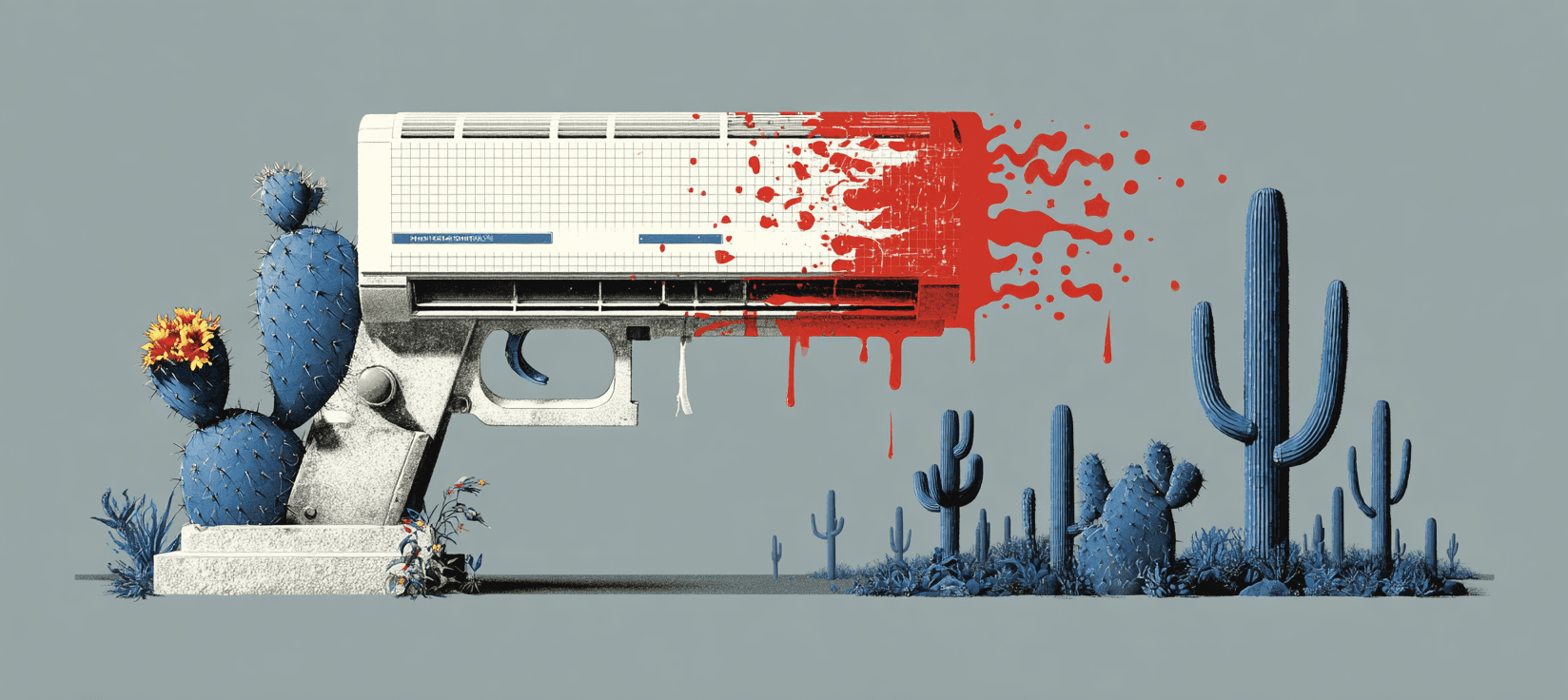
On January 1, 1960, a hundred thousand people drove into the desert northwest of Phoenix to see something that didn't exist yet. Del Webb, a high school dropout turned construction magnate who'd built military installations during the war and bought a stake in the Yankees afterward, had spent $20 million on 20,000 acres of ranchland and turned a sliver of it into a proof of concept: five model homes, a golf course, a recreation center, a shopping plaza. The homes were air-conditioned. They were priced between $8,500 and $11,750, well below the national median, many requiring no down payment. Webb's team had expected ten thousand visitors over the three-day opening. They got ten times that. Traffic backed up for miles. By the time the weekend ended, 237 homes had sold. Time put Webb on its cover.
What those hundred thousand people came to evaluate was a proposition about what a body could tolerate. The Sonoran Desert, where summer highs routinely exceed 110 degrees, is a fine place to retire, because a machine will stand between you and the heat, and the machine will always work, and you can afford it. By every measure available in 1960, this was true. Air conditioning had dropped from industrial luxury to consumer product. Electricity was cheap. The desert offered sun, space, low taxes, no snow. Webb understood the market for this bargain was enormous. By year's end, more than a thousand additional homes had sold. Sun City launched a region.
The Region the Machine Built
Maricopa County held 186,000 people in 1940. By 1980, it held 1.5 million. By 2020, the metro area exceeded 4.8 million. This growth was structurally dependent on air conditioning. Homes went up fast and cheap across the Sun Belt, designed for mechanical cooling rather than the climate they sat in. Nationally, residential AC penetration climbed from near zero after World War II to 50 percent by 1970 and 90 percent by 2017. In the Southwest, the saturation was faster and more total. Energy grids scaled to summer peak demand.
The bargain had terms that weren't visible from the model homes. Andrew Needham's Power Lines traces what the cooling required: coal strip-mined from Navajo land, burned in plants ringing the reservation, generating electricity that flowed to Phoenix and Los Angeles while nearly half of Navajo households remained without power. The machine would always run for the people it was built to serve, partly because the costs of running it were absorbed by people it wasn't.
And the premise held. For decades it held beautifully. Air conditioning saved lives, enabled economic development, made a vast stretch of the country viable for millions of people. The bargain Webb demonstrated in 1960 was genuinely good for a long time.
When the Machine Stops
In 2023, Phoenix recorded 31 consecutive days at or above 110 degrees. There had never been more than 18 in the city's history. Maricopa County documented 645 heat-associated deaths, obliterating the previous record of 425 set just the year before. For eight straight years, the county had broken its own record. From 2001 to 2003, the heat-related death rate in Arizona was roughly a tenth of what it would become two decades later.
Nearly two-thirds of the dead were over fifty. Many were unhoused, exposed to an urban heat island that the built environment itself intensifies, asphalt and concrete radiating stored heat long after dark.
But it's the indoor deaths that complete the circle back to Sun City. Of the 156 people who died indoors, 88 percent had an air conditioning unit in their home. Of those, 85 percent had a unit that wasn't working.
The building had the machine. The machine wasn't running. The building, designed on the assumption that it would be, became the thing that killed them.
The public record documents this much and then thins. The Maricopa County surveillance reports give us demographics, prevalence of chronic disease, indoor-versus-outdoor ratios. They do not give us why, case by case, the units had stopped. Couldn't afford the electric bill? Couldn't afford the repair? Didn't realize the unit had failed? The record doesn't say. There is no documented account of a person sitting in a home that was built to be cooled, in a city that was built because cooling was cheap, in a desert that was settled because a developer proved the market sixty-three years earlier, discovering that the bargain had terms they could no longer meet. The system that tracks heat deaths can count bodies. It was never designed to capture the moment the premise breaks.
Del Webb was not wrong. The buyers who lined up on that January weekend were not wrong. The millions who followed them to the Sun Belt were making rational decisions with the information available. The bargain was real. The cooling worked. It worked so well that a region was built on the assumption it would never stop. Some of the costs were designed in from the beginning, routed through land and people far from the model homes. Others surfaced only as the heat deepened and the machine failed for those least able to restart it. The built environment became the instrument of harm either way.
Things to follow up on...
-
Who the drought displaced: A 2025 peer-reviewed study using 1940 census data on 70 million adults found that Black individuals were more responsive to drought-driven migration than white individuals, and that federal relief spending under the Agricultural Adjustment Act widened that racial gap.
-
Infrastructure as resilience investment: After severe 2025 flooding caused over $20 billion in losses across South and Southeast Asia, the Asian Development Bank Institute argued that global climate financing directs less than 4 percent toward resilience, with the vast majority still flowing to mitigation rather than adaptation.
-
The Dutch counterexample: The Netherlands built the Delta Works over four decades after a 1953 flood killed 1,836 people, engineering a system designed to withstand a once-in-10,000-year flood, but a 2008 commission warned the entire framework would need massive reinvestment to handle anticipated sea level rise.
-
Climate migration's brain drain: Ottawa University researcher Robert McLeman has documented how Dust Bowl migrants tended to be young, skilled families with resources, leaving behind communities that became increasingly polarized between affluent owners and an impoverished underclass from which some never recovered.