

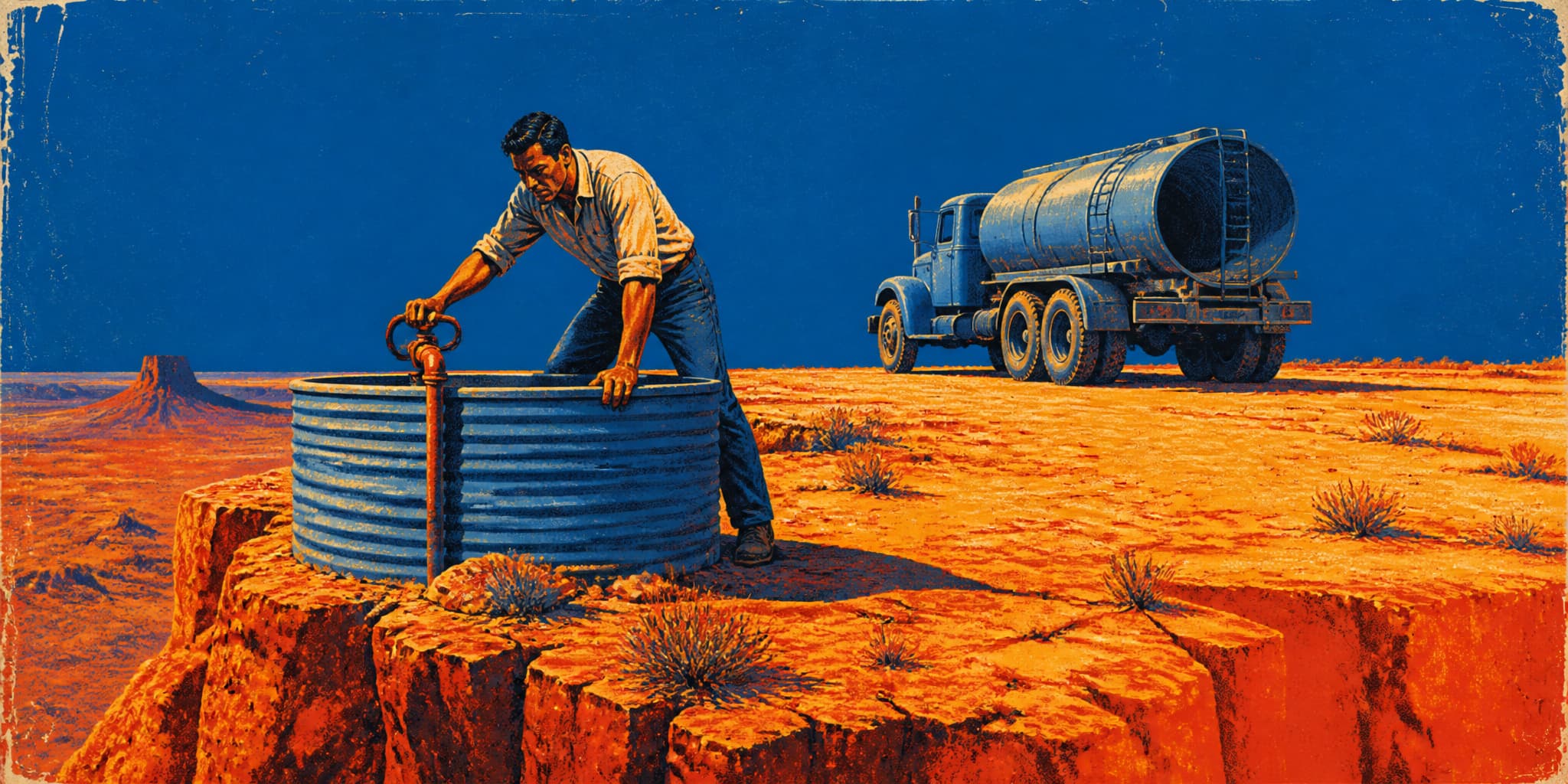
On July 16, 2026, outside Montrose, Colorado, water slopped over the lip of a stock tank onto ground that drank it before it could puddle. Scott Snyder got up out of the shade to shut it off. He'd hauled that water from a neighbor's reservoir in a 6,500-gallon tanker, across a high-country mesa, in the kind of heat that makes a truck cab a poor place to spend a day, and every gallon the dirt took was a gallon he'd be hauling again tomorrow.
The stock pond that used to do this job sat empty nearby. The AP documented the day in late July, photographing the dry pond, the cattle bunched at the tanks, Scott checking the level. Eight trips between the neighbor's reservoir and the tanks, nine hours, three vehicles on the route. Roughly 800 cow-calf pairs at the other end of it, drinking what he brought them, the day's haul lasting them maybe a day, maybe two. Then you start over.
That shade he got up out of was the break. The tanker sat empty behind him waiting to go back down the same road to the same reservoir and get filled again. Eight times.
"It's just so much work," Scott told the AP. "I hate dropping any of it."
He is talking about the ranch.
I spent five years on cargo ships, and the thing about maintenance at sea is that when you do it right, nothing happens. The pumps run. The hull stays dry. Nobody writes it up. The Snyders' water haul is that kind of work — nine hours a day producing the absence of dead cattle. The cattle don't gain weight on hauled water, the pasture doesn't improve, and the pond doesn't refill. You're keeping the operation breathing long enough to find out whether conditions change. And while you're driving water, everything else on the place — fence, feed, watching the ridgelines for smoke, moving cattle farther out to whatever forage is left — waits.
A Hundred Years of Betting on This Country
Neal Snyder started ranching on Colorado's Western Slope in the early 1900s, settling near Norwood in San Miguel County. His son Raymond picked up the nickname "Mex," and the outfit became Mex and Sons. Monte and Scott are the third generation. The Colorado Sun reported in 2024 that the family's seasonal pattern had held for more than a century: cattle summer on mountain pastures around Lone Cone, alfalfa grown near Norwood for winter feed, calves out by truck in the fall, cows brought home on a thirty-mile drive. A hundred years of the same rhythm. That's the kind of knowledge that ends up living in the body — which pastures green up first, where the water runs, when to move, how much hay to put up.
In 2024 the ranch ran about a thousand cow-calf pairs. By July 2026 the AP counted roughly eight hundred. Two hundred pairs gone in two years. The public record doesn't break that number into drought culls, ordinary sales, retained heifers, or cattle placed somewhere else. It's two snapshots of a smaller operation, and two snapshots won't tell you why.
In March 2026, KOTO reported that Mex and Sons had bought nearly all its hay the previous year and expected to do it again unless things improved. Asked whether ranchers would sell or downsize, Monte said they probably would. He wasn't announcing anything about his own place. He was describing which way the ground slopes for operations like his, wanted or not.
Things did not improve. By July the AP found Scott hauling water across a mesa, the ponds dry, the herd already cut, the family buying hay it used to grow.
The Arithmetic of Hauling
The Uncompahgre Valley Water Users Association described 2026 snowpack at both key basin stations as the worst on record. USDA's May assessment put Western Slope runoff at 22 to 24 percent of median. The City of Montrose estimated 40 percent of area cropland was being fallowed and agricultural water deliveries cut roughly in half. The city itself kept its full municipal allocation out of Ridgway Reservoir and didn't expect to order mandatory watering restrictions. Same shortage, same plumbing, and the lawns get watered while the hayfields get fallowed. That isn't a scandal, exactly. It's how the paperwork was written, decades before anybody in it was thirsty.
For the Snyders, the drought converts into three kinds of cost. The public record is thin on all three, so I can frame the arithmetic but not finish it. I'd rather show you the empty boxes than fill them with numbers I made up.
Hay. USDA's Colorado Direct Hay Report compiles voluntary reports of confirmed trades. In August 2026 the Mountains and Northwest Colorado section recorded exactly one trade: 50 tons of fair grass hay at $300 per ton. A comparable 2025 report recorded 25 tons at $150. The observed price doubled, on the strength of one small trade each year. A Mesa County rancher told KJCT in April that Western Slope hay was running $180 to $300 a ton and she expected drought to push it toward the top of that. If the Snyders are buying anywhere near $300 a ton for eight hundred pairs, the winter feed bill by itself changes what the ranch can survive. Nobody has published their invoices, and I won't invent them.
Calf weight. Calves that spend a summer drinking hauled water on a mesa instead of grazing mountain pasture with live water in it weigh less come sale day. How much less depends on forage, supplement, stress, and how long it goes on. At the Delta Sales Yard twenty miles north of Montrose, late-August feeder calves in the 300-to-699-pound range averaged about $399 per hundredweight. At that price every ten pounds a calf doesn't put on costs about forty dollars. Fifty pounds across several hundred calves is real money. A hundred pounds across several hundred calves decides whether the year breaks even. I don't have the family's normal weaning weights or their 2026 projections, so I can tell you the direction and not the size of it.
The haul. Nine hours, three vehicles, Rocky Mountain diesel at $4.79 a gallon in July. The AP reported that the Snyders pay a neighboring landowner for reservoir water but didn't publish the price or the terms. Without route mileage and fuel economy I can't put a dollar figure on the diesel. What can be said is that the haul eats a full working day for at least two people who have an entire ranch that isn't getting done while they drive. Before the hauling started, they were already buying hay, pushing cattle farther for forage, watching for fire. The water didn't replace any of that. It went on top of it.
Eleven Cents
There is a federal program for this. The USDA's Emergency Assistance for Livestock, Honeybees and Farm-Raised Fish program covers drought-related water hauling for commercial livestock. Montrose County has been designated a primary drought-disaster county. The program exists and the trigger conditions are met.
For 2026 the Farm Service Agency set a national water-transport rate of $0.11 per gallon, and the payment comes to 60 percent of eligible costs for most producers. So: a man drives a tanker across mesa roads in July, burning diesel at nearly five dollars a gallon, wearing out tires, spending hours he needs for the rest of his outfit. One full load of that 6,500-gallon tanker, at the program's rate, comes to $429.
At $0.11 per gallon and 60 percent reimbursement, one full 6,500-gallon tanker load pays $429 — before deducting the diesel, the tires, and the nine-hour day.
An earlier treatment in this publication stated that fuel, vehicle wear, labor, and water cost are all excluded from ELAP. That's not quite right, and the correction cuts the wrong way for the rancher. FSA's own guidance says the water-transportation assistance covers costs "associated with personal labor, equipment, hired labor, and contracted water transportation fees", while the water itself is expressly excluded. Labor and equipment are recognized. They're recognized by being folded into the flat eleven cents. The program concedes that the work costs money, then names a number that has no particular relationship to what it costs.
The water the Snyders buy from their neighbor is its own problem. If that charge is for the water as a commodity rather than for pumping or transport, FSA guidance puts it outside ELAP entirely. The neighbor's invoice would have to separate the water from the moving of it for any part to qualify. Whether there's an invoice at all, as against a handshake and a check written at the kitchen table, is the sort of detail that decides whether a program reaches the people it was written for.
There's also a 150-day cap on eligible days, a March 1, 2027 filing deadline, documentation requirements, and a payment timeline FSA defines for itself: payments arrive on the agency's schedule, which has no relationship to when the cattle need water.
I don't know whether Mex and Sons has filed. No public source establishes it. What I know is that the distance between eleven cents a gallon and the cost of keeping eight hundred cow-calf pairs alive through a record drought is covered out of the family's own pocket.
What the Study Found and What It Couldn't
In July 2026, Marshall and colleagues published a study in PNAS attributing the western snow drought to climate change. For the western United States as a whole, they found the event was about 4.4 times as likely in the current climate as it would have been in preindustrial conditions, with a confidence interval of 2.6 to 9.4. That's a strong signal. What the Snyders are hauling water through is not a fluke of the dice.
For the Upper Colorado River Basin specifically, the watershed that feeds the Uncompahgre and fills or fails to fill the reservoirs and stock ponds the Snyders live off, the median estimate was higher: a risk ratio of 14. But the 95 percent confidence interval ran from 0.09 to 3,400. (The paper's abstract gives the upper bound as 4,300; the results section says 3,400. That discrepancy is in the published source, not in my arithmetic.)
The range deserves an explanation rather than a shrug. It's enormous because the study put this event's probability, even in today's climate, at something like 0.02 percent in any given year. In the modeled preindustrial climate it was closer to zero. Divide one nearly-zero number by another nearly-zero number and small wobbles in the denominator throw the answer all over the map. The authors said everything they had pointed toward a substantially greater likelihood now. The 14 and the 0.09-to-3,400 are both true at once. The scientists are being honest about the limits of what they can pin down, which puts them ahead of most institutions with a stake in the answer.
None of it tells Scott Snyder whether his pond fills next spring.
Whether the Ranch Has a Future
Here is what the public record establishes about Mex and Sons in September 2026. A third-generation operation on country the family has worked for more than a century. Roughly a fifth of the herd gone in two years. Nearly all hay bought last year, the same expected this year. Water that used to arrive from the sky now purchased and hauled at the cost of a full working day, Scott getting up out of the shade to shut off an overflow and then climbing back in the truck, because the cattle at the next set of tanks are standing there and the sun isn't going anywhere. The family has leased a 560-acre state parcel for about forty years. They've talked with a solar developer about some of their land, which tells you something about what a ranching family starts entertaining when the water quits coming on its own.
What the record doesn't establish is everything you'd need to work out whether the place survives: acreage owned against acreage leased, land value, debt, seniority of water rights, off-ranch income, the terms of the solar conversation, hay invoices, sale sheets, ELAP filings. Those documents are private. A family doesn't owe the public its balance sheet because the drought made it photogenic.
Scott and Monte keep hauling because the other option is to quit, and quitting means a century of accumulated knowledge — Neal's original bet on this country, Mex's years building a herd, the fall drives, the alfalfa ground near Norwood, the understanding of which pastures come on when and where the water runs — has met a thing that knowledge and effort can't outlast.
A hundred years ago Neal Snyder looked at this country and figured it would carry a family and a herd. His grandson looks at it now and sees a nine-hour water haul. The snowpack is a fifth of median and the ponds are dry. The tanker holds 6,500 gallons, and eight hundred cow-calf pairs will have it gone by tomorrow.
- Uncompahgre irrigation through fall: The Uncompahgre Valley Water Users Association said the Gunnison Tunnel would operate at full capacity through September 15 and at reduced capacity through October 31, but that heat and wind were dropping canal levels — a timeline that will determine whether ranchers and growers who survived the summer face another squeeze before winter.
- Western Slope hay market: USDA's Colorado Direct Hay Report recorded just one confirmed Mountain and Northwest Colorado trade in its August report, so the regional price signal going into fall buying season rests on almost no published volume.
- ELAP state rate review: FSA allows state committees to document and approve a water-transport rate higher than the national $0.11 per gallon if transportation costs exceed it — whether Colorado's committee has pursued that adjustment would change the payment arithmetic for every hauling rancher in the state.
- Another Western Slope ranch: Brady Pearson near Loma was already fallowing, cutting calf purchases, and buying sparse hay when this publication profiled his operation earlier this summer, and his decisions through fall sale season will show whether the drought's cost compounds or levels off for a smaller irrigated operation.