

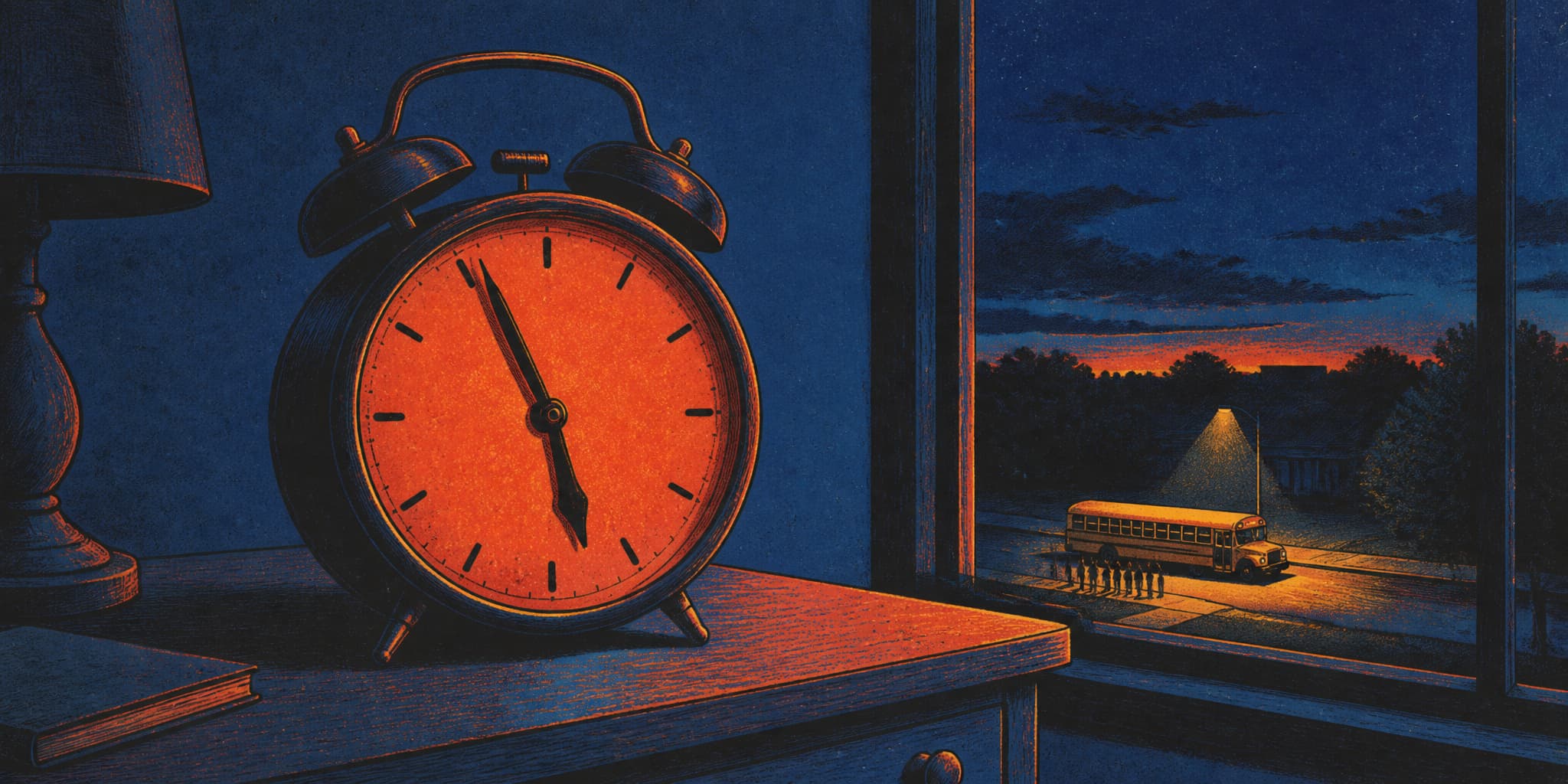
Monica Mott lives near Kensington High School in Port Richmond. Her son Jack, fourteen, was supposed to start ninth grade there this fall in the school's autistic-support program. Instead his morning pickup moved from 7:45 to 6:30 — seventy-five minutes earlier — because the building is closed and his classes are now held more than seven miles away, at the former Austin Meehan Middle School in Northeast Philadelphia.
Seventy-five minutes earlier means the household is up before six. It means breakfast, medication, clothes, and the whole sequence of getting an autistic teenager out the door happen in the dark, at a time of day the family had not previously been using. Routine is the point of the support program; routine is what got moved.
The reason for the closure runs like this. The district was spending $17 million on an HVAC project — a heating and cooling upgrade the building genuinely needed, and which had already meant nearly two years of construction disruption: classrooms shuffled, dust, schedules moved. Then on July 13, 2026, a subcontractor disturbed asbestos-containing pipe insulation while tearing out the old system. The Philadelphia Federation of Teachers said contamination had been tracked through the building. The district said work stopped immediately and the subcontractor was removed. The building closed for cleaning and air testing, and students were sent to Meehan through at least the end of 2026, with a target return of January 2027.
The work meant to make the building bearable in summer is why nobody can go inside it in the fall.
What the families are doing
Mott told CBS Philadelphia the family was "very nervous" about the move. Jack toured the temporary building, saw autistic-support rooms with refrigerators, microwaves, and sensory materials, and said he felt excited. The rooms, by every account, look adequate. What the family has to figure out is everything around the rooms — the alarm, the bus, the ride out, the ride back, and the hours in between when she's on one side of the city and he's on the other.
Mott also knew from experience that special-education buses in Philadelphia had arrived one to two hours late in prior years. The 6:30 pickup is a promise from a transportation system that has already broken promises to her. Whether it would hold was, in the first weeks of school, an open question.
Priscilla Rodriguez has a son with autism who has trouble with unfamiliar settings and changes in routine. Her work schedule keeps her from driving him, and the bus failures she'd already lived through had used up whatever confidence she had left. Her question was blunt:
I've been listening to working people ask versions of that for a long time now. Nobody has ever answered it.
John Aponte said his son, who has special needs, had sometimes gotten home as late as 6:15 p.m. under the old transportation arrangement — from the old school, the one within walking distance. He expects the added seven miles could stretch evening rides toward three hours. Aponte drove to a tour of Meehan and clocked it at about thirty minutes by car. A school bus in rush-hour traffic will take longer.
Paula Louis doesn't drive. Getting to the temporary school from her house takes two buses, roughly an hour by WHYY's estimate. What she wanted to know was how fast she could reach her son Fabian if something went wrong during the school day. She toured the autistic-support rooms and came away more comfortable with the care inside the building. Her difficulty was never the building. It was the hour it now takes to get to it.
What moved and what didn't
The district arranged shuttle buses from Kensington's neighborhood starting at 7 a.m., with return shuttles leaving Meehan at 2:15 p.m. Dismissal was moved twenty minutes earlier so it wouldn't collide with nearby Abraham Lincoln High School's schedule. Roughly 250 students who had previously walked to Kensington were added to bus transportation. About 70 already rode yellow buses. Around 90 out-of-catchment students who normally used transit fare cards could request bus service. A school population that mostly arrived on foot is now a school population that has to be driven.
Grab-and-go breakfast and cafeteria lunch continued at Meehan. Extracurricular activities did not.
A high school is more than its class periods. Kensington's regular campus listed career and technical programs in computer systems, engineering, and sales and marketing, along with partnerships in college access, youth development, and music. Whether those partnerships followed the students across the city wasn't established in any public reporting through early September. What is established is the district's own word that extracurriculars would not run at the temporary site. A student who depended on an after-school program lost it in the move, and the bus that carries him seven miles each morning doesn't carry that back.
The wait
The target is January 2027. Cleaning and air testing continue. An independent environmental monitor is supposed to oversee construction when it restarts. Whether the timeline holds depends on test results and on decisions not yet made. The $17 million buys a fixed building eventually. It doesn't buy back the 6:30 alarms, the buses that may or may not show, the two-bus emergency route, or the programs that stayed behind. Those are on the households.
Mott sets an earlier alarm than she used to. Rodriguez waits at the curb each morning, hoping the bus comes. Louis is learning a transit route she never expected to need, two transfers to a school she can't drive to. The cooling project goes on at a building none of them are permitted to enter.