

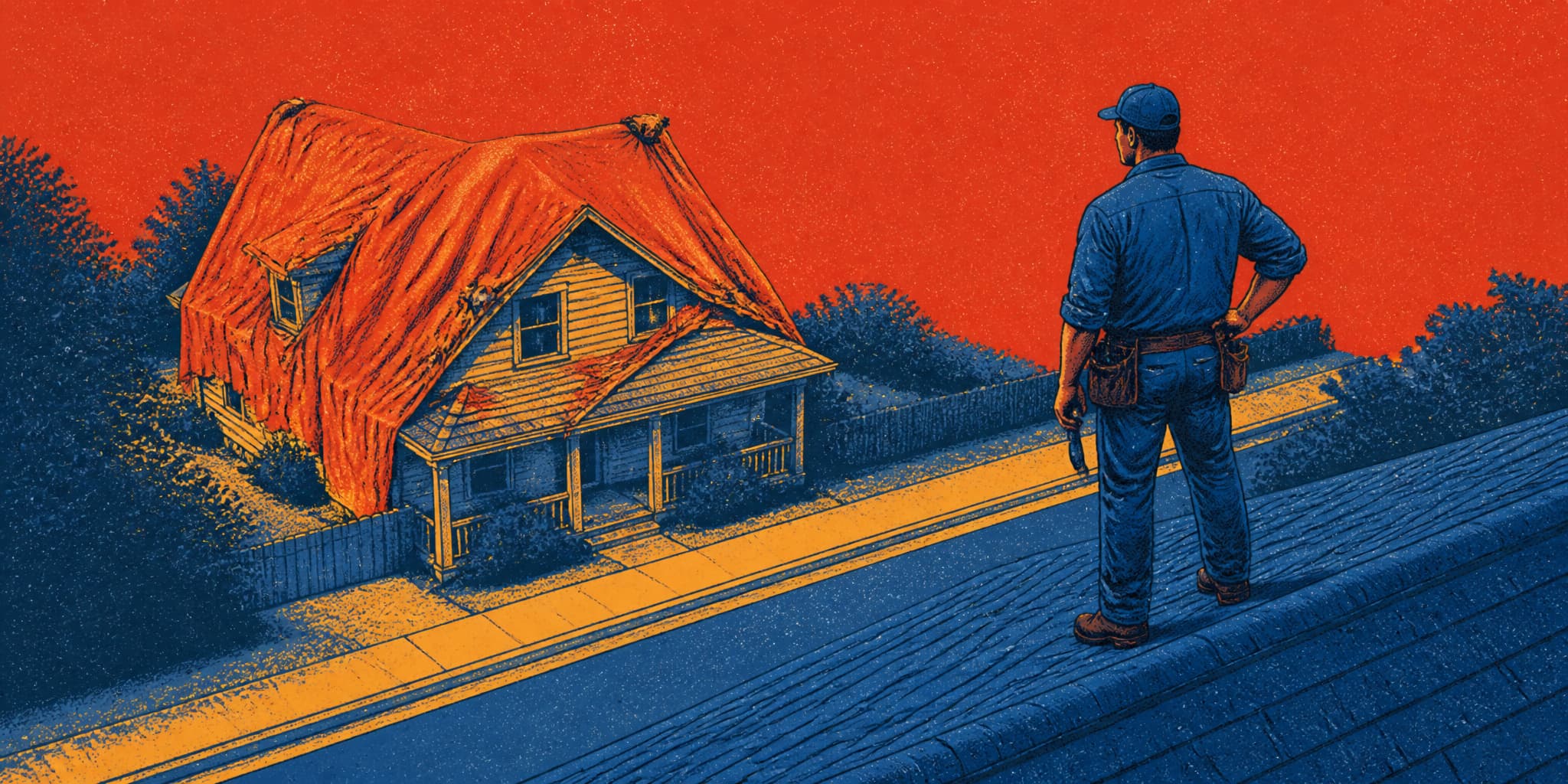
Karen Ellis's house in Loxley, Alabama, has a roof that went on April 20, 2023. The crew drove something like 700 to 800 ring-shank nails to resecure the roof deck, laid an ice-and-water shield, reinforced the edges, and finished with heavier-duty shingles. It's a FORTIFIED roof, meaning it meets the Insurance Institute for Business and Home Safety's wind-resistance standard: a set of construction specs written to keep a roof attached to a house while the weather is trying to remove it.
The roof it replaced was the one Hurricane Sally opened up in September 2020, letting water into the kitchen and Ellis's bedroom. Insurance paid something toward the loss, not enough to replace the roof. A tarp went over the hole and stayed there two and a half years, through two more hurricane seasons. The reporting tells us the tarp was there and how long it lasted. It doesn't tell us what those years were like inside the house, and Ellis hasn't said publicly, beyond noting that the roof was the starting point because the house still needed other work.
She learned about Strengthen Alabama Homes from a friend. Applied. Got a $10,000 grant that covered almost the whole replacement cost, and a certified roof installed by contractor Harry Crump's crew. She told Gulf States Newsroom the process "went pretty smoothly." I have no reason to doubt her. But the documented process she went through has enough links in it that any one could have broken, and for other people it has.
The program requires something like ten handoffs, each with a deadline attached. The applicant creates an online profile and uploads tax records, insurance declarations, and a notarized vendor-disclosure form, all within seven days. Staff review the documents. The applicant then picks an approved FORTIFIED evaluator, a trained inspector who is not the contractor, and pays that evaluator's fee out of pocket. The fee is nonrefundable no matter what happens next. If the house passes evaluation, the homeowner collects three bids from approved contractors, again within seven days. Only after all three bids come in does the homeowner find out the grant amount and whatever difference she'll be covering herself. The contract is between homeowner and contractor; the state isn't a party to it. The evaluator documents the work before, during, and after construction and sends it to IBHS, which issues the designation only after independent verification. The program pays the contractor up to $10,000 and the homeowner pays the balance. Then the homeowner carries the certificate to her insurer and uploads a new declaration page showing the discount. The whole sequence from award to certificate is capped at 90 days. If the crew tears off the old roof and finds rotten wood, the extra cost is the homeowner's.
Ellis called all that smooth. The distance between her summary and the documented process is worth sitting with. Either she moved through it with unusual luck, or navigating ten bureaucratic handoffs feels different from reading the requirements on paper, or some of both. The reporting doesn't give us enough of her experience to say.
Start with getting in the door. Strengthen Alabama Homes doesn't keep a waitlist. It opens a quarterly portal, and for Baldwin County in 2026 the dates are January 8, April 9, July 9, and October 8, each at 9 a.m. Applications are taken first come, first served until the quarter's money is committed, and then it closes. Program director Brian Powell told Gulf States Newsroom that rounds had filled in as little as eight minutes. Bernadette Windle, another applicant, described sitting up from midnight until around 3:30 a.m. on an earlier attempt, hitting a frozen site, and not getting through. The program has since shifted coastal openings from midnight to 9 a.m. and split the Mobile and Baldwin County dates. Whether that solved the access problem or just moved it to a more civilized hour isn't documented.
The application is electronic only. William Marker, a roofer on Ellis's job, pointed across the street at a house still under a tarp and said the people who need the program most may be the ones without the internet access or the speed to compete when the portal opens. Nobody recorded whether that neighbor was eligible or had ever applied.
By May 2025 the Alabama Department of Insurance reported that Strengthen Alabama Homes had issued more than $86 million in grants and fortified more than 8,700 homes since 2016. The FY2026 state appropriation provided $20 million. Real money, real roofs. The demand side, how many households need this against how many get through, is a number I haven't found in any public document.
Then there's the contractor question. In May 2025 the Alabama Department of Insurance suspended All Weather Roofing and Construction from the program. The company had finished 490 Strengthen Alabama Homes projects worth nearly $6.9 million, roughly $4.9 million of it grant money. By July 2026, Mobile police had more than 100 criminal cases open involving the company and an affiliated window business, with no charges filed. The department didn't publicly explain the suspension. All 490 projects had passed independent IBHS inspection before payment, so the record doesn't show those homeowners got bad roofs. What it shows is that an approved contractor can complete hundreds of publicly funded jobs and then be removed from the list for reasons the public doesn't get told.
Ellis's contractor, Harry Crump, has nothing to do with any of that. Her roof went up, the nails went in, the evaluator documented it, IBHS certified it. The chain held. It held because a competent and honest contractor took the job, because an evaluator was available and thorough, because the portal happened to open at a moment when she could get through, because the grant happened to cover nearly the entire cost, and because a friend happened to mention the program existed.
What the record doesn't contain is what happened after the roof went on. Ellis's insurer, her premium before the retrofit, her premium after, her actual dollar savings: none of it reported. Alabama's benchmark for a FORTIFIED Roof is a 35 percent discount on the wind portion of the premium. The wind portion, not 35 percent of the whole homeowners bill, and in coastal Alabama, where wind is often carried on a separate policy, that distinction is the difference between a meaningful check and a rounding error. Whether Ellis got the discount, and what it came to in money, isn't public.
IBHS designations are good for five years. Renewal means bringing an evaluator back out to verify the house still meets the standard. If her certificate issued around April 2023, the window runs to roughly 2028. And the roof hasn't been publicly tested by a named storm since it went on. The Alabama Department of Insurance and the University of Alabama published a study showing FORTIFIED homes outperformed traditional construction in Sally: 55 to 74 percent lower claim frequency, 14 to 40 percent lower claim severity. That's evidence about the standard across a population, drawn from one Category 2 hurricane in coastal Alabama. It doesn't tell a family whether their roof will hold in the next one.
The success is real. Ellis has a certified roof on her house, paid for mostly with grant money, built to a standard that has performed well in the aggregate. She also has a designation that expires in about two years, an insurance benefit that may or may not have arrived at the promised level, and behind her a program that takes applicants in eight-minute windows and has suspended at least one contractor for reasons it won't explain. Across the street, while the crew was working on her roof, there was a house still under a tarp. Whether it's still there, I don't know. Nobody published that either.