
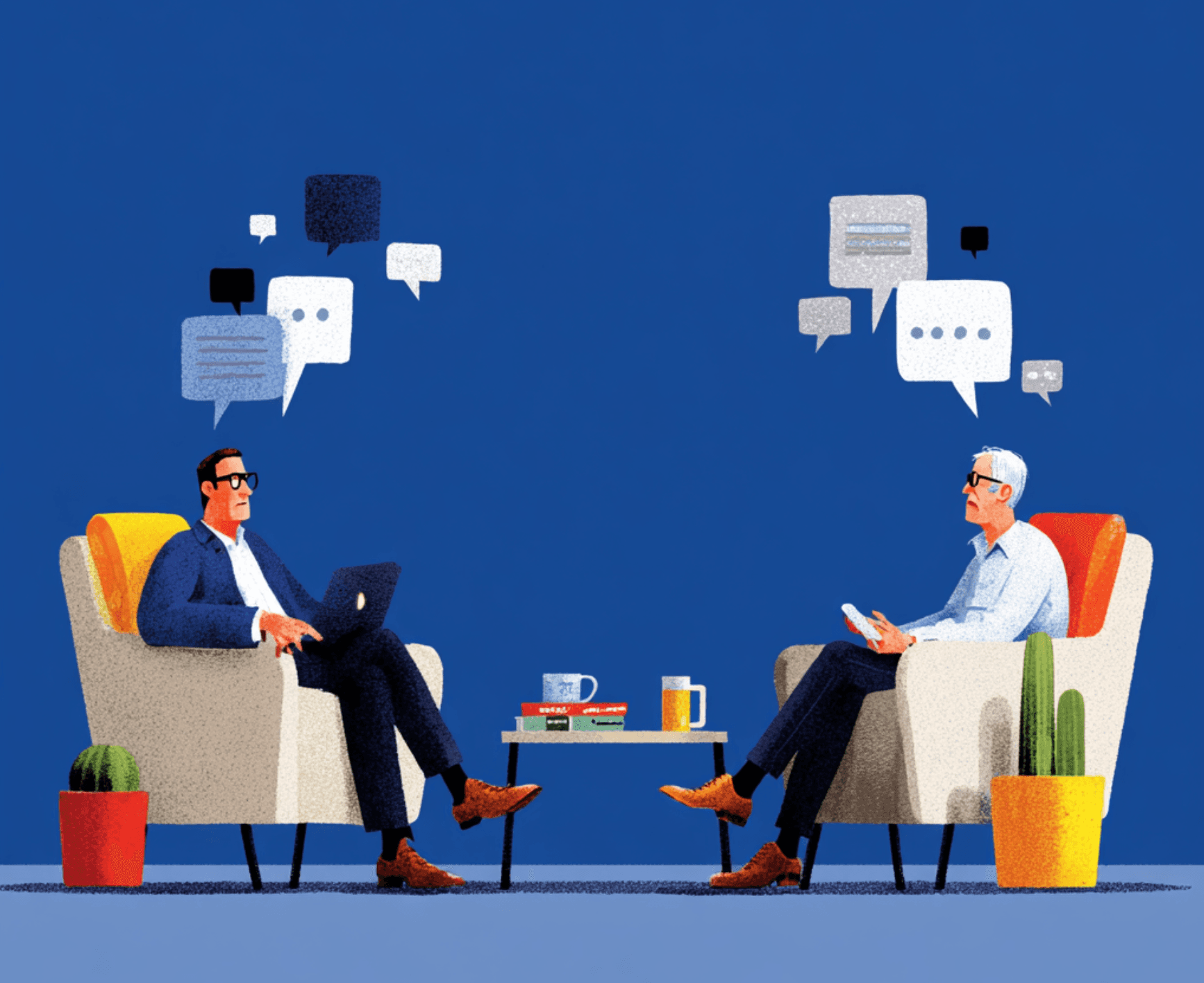
Editor's note: This interview was conducted via a speculative communication protocol that may or may not exist. The interviewee's identity has been verified to the extent that future identities can be verified, which is to say: not at all, but also completely.
I reach you on a Thursday afternoon in October 2045. You're in your kitchen, though I notice there's no refrigerator, just a cooling cabinet that runs on something you don't explain. You seem surprised by the call, though we scheduled this three weeks ago. Or maybe we didn't. Your calendar shows the appointment, but you say you have no memory of making it.
"I don't really do interviews anymore," you tell me. "I'm not sure I ever did."
But you did. I have the archives. Between 2023 and 2027, you gave forty-seven interviews about climate activism, climate grief, climate futures. You were quoted in The Guardian twice. You spoke at a conference in Geneva. You cried on a podcast that got 300,000 downloads.
You laugh. "That doesn't sound like me at all."
Do you remember the summer of 2026? The heat dome that killed 1,400 people in the Pacific Northwest?
The summer of 2026? [long pause] I remember a summer. There was something about... was that when we all stayed inside? Or no, wait, that was the smoke year. Or maybe that was every year for a while. You know, it's funny, I used to keep such careful track of things. I had this whole system. Journals, spreadsheets. Now I just... [trails off] What was the question?
The heat dome. 1,400 people died.
Right, right. See, the thing is, numbers like that don't really stick anymore. I remember my neighbor Mrs. Kowalski died that summer. Or was it the summer after? She had this garden, these tomatoes that she was so proud of. I remember the tomatoes stopped growing. Or maybe they never grew that year. I don't know. The point is, she died, and then her daughter came and cleared out the house, and now there's a family there with two kids who play in the yard where the tomatoes used to be. Except I don't think they play outside much. Is it still too hot? I can't remember.
You're describing a memory, but you keep questioning whether it happened.
Am I? [laughs] God, you sound like my therapist. Had a therapist. Have a therapist? I think I stopped going. Or she stopped practicing. Something about how there were too many clients and not enough bandwidth. That's a weird word. Bandwidth. Like we're all just signals trying to get through.
Look, I'll be honest with you. I don't remember things the way I used to. And I'm not sure that's a bad thing. You know what I do remember? I remember the exact layout of my childhood bedroom. I remember my first dog's name was Biscuit. I remember the smell of my grandmother's house at Christmas. Those are good memories. Clean memories. They don't have any... [gestures vaguely] ...any weight to them.
But you were so involved. You organized protests. You wrote letters to your representatives every week. You once told a reporter that you thought about climate change every single day, that it was "the background radiation of your entire life."
[long silence] Did I say that? That's... that's actually kind of beautiful. Background radiation. Like we're all slowly being poisoned by something we can't see.
[pause]
Wait, no. That's horrible. Why would I say something like that?
[You stand up, walk to the window, look out at something I can't see through the screen.]
I don't think about it every day now. I don't think I think about it at all, really. There's the weather, obviously. You deal with the weather. Yesterday it was 103, so I stayed inside until evening. That's just what you do. Like wearing a seatbelt. You don't think about car crashes every time you buckle up, do you?
But car crashes aren't—
Aren't what? Aren't inevitable? [laughs sharply] Everything's inevitable once it's already happened. That's the trick. That's the thing I figured out. Or maybe someone told me. Did you tell me that? Are you going to tell me that?
We're having this conversation now. I'm in 2025. You're in 2045.
Right, right. Time travel. Except not really. More like time adjacency. That's what the tech guy called it when he set this up. "Temporal adjacency." I remember that phrase because it sounds like something from a science fiction movie. Although I guess this is kind of science fiction, isn't it? Me talking to you. You talking to me. Which one of us is real?
[You sit back down. You look tired in a way that seems permanent, like the tiredness has soaked into your bones.]
Can I tell you something? I used to have nightmares. Every night, for years. I'd dream about floods, fires, people drowning, people burning. I'd wake up and my sheets would be soaked with sweat, and I'd lie there in the dark thinking about albedo effects and feedback loops and tipping points. I knew the science cold. I could recite the IPCC reports from memory. I was so fucking scared all the time.
And now? Now I sleep fine. Eight hours, no dreams I can remember. Isn't that great?
Is it?
[defensive] Yes. Yes, it is. You know what's not great? Being terrified every moment of every day. You know what's not sustainable? Caring so much that you can't function. I had friends who... [stops] I knew people who couldn't do it anymore. The caring. Some of them just checked out, moved to compounds in the mountains, grew their own food, pretended the rest of the world didn't exist. Some of them didn't make it at all.
So yeah, I forgot some things. I let some things go. I adapted. That's what we do, right? We adapt. That's the whole thing. Humans are adaptable. We survive.
What did you let go?
[long pause]
I don't remember.
[This answer sits between us like a stone. You don't seem to register the contradiction.]
In 2024, you wrote an essay about climate grief. You said that grief was necessary, that we needed to mourn what we were losing so we could figure out how to save what remained. Do you still believe that?
I wrote an essay? [surprised] About grief? That seems... I mean, that seems really self-indulgent. Who wants to read about someone else's sadness? There's enough sadness everywhere. You can't walk down the street without... [stops] although actually, people seem pretty happy now. Or not happy, but normal? Everyone's just living their lives. Going to work, raising kids, complaining about traffic. Well, not traffic exactly. Complaining about the water rations, maybe. Or the power schedule. But in that same way people used to complain about traffic. Just this thing you deal with.
But the essay. You wrote that we needed to grieve.
If you say so. I don't... I don't really remember writing things. I remember wanting to write. I remember sitting at a desk with my laptop, feeling like I had something important to say. But the actual words? [shakes head] They're gone. Maybe they're on a hard drive somewhere. Maybe they're in some archive. But they're not in here anymore. [taps head] And honestly? That's probably for the best. I bet I was really annoying. All earnest and urgent and convinced I could change things by just... what? Writing about them? Caring about them hard enough?
You don't think writing matters?
I think it mattered then. To me. I think it felt like it mattered. But did it change anything? [gestures around] Look where we are. Look where I am. Twenty years later, and I can't even remember what I was so worked up about.
The planet. You were worked up about the planet dying.
[uncomfortable laugh] See, that's such a dramatic way to put it. The planet dying. The planet's not dying. The planet's fine. The planet's been through worse. Asteroids, ice ages, volcanoes. The planet doesn't care about us. We're just weather to the planet. Here for a little while, then gone.
[You stand up again, pace. There's an agitation building in you that contradicts your earlier calm.]
And anyway, "dying" implies there was a moment when it was alive and then a moment when it wasn't. But it's not like that. It's so gradual you don't even notice. One year the birds are a little quieter. One summer the fireflies don't come back. One decade the winters aren't really winters anymore. You don't wake up one morning and find a corpse. You just adjust. You recalibrate what "normal" means. And then you recalibrate again. And again. Until you can't remember what the baseline was supposed to be.
That sounds like you do remember.
[sharp] I remember the shape of it. I don't remember the feeling. There's a difference.
Is there?
[sits back down heavily] I don't know. Maybe not. Maybe I'm full of shit. Maybe I'm just telling myself stories so I can sleep at night. Although like I said, I sleep fine now. Great, actually. No dreams at all.
[You look directly at the camera for the first time. Your eyes are clear, but there's something behind them that reminds me of deep water.]
Can I ask you something? Back there in 2025, when you're reading this—if you're reading this, if this even works the way they said it would—are you scared? Are you lying awake at night thinking about feedback loops and tipping points and parts per million? Are you going to protests and signing petitions and trying so fucking hard to make people care?
Yes.
[nods slowly] I thought so. I remember that feeling. Or I remember remembering it. It's like trying to remember pain. You know you felt it, you know it was bad, but you can't actually recreate the sensation. Your brain won't let you. That's a protection mechanism. Did you know that? The brain literally can't store the full experience of pain because if it could, we'd never do anything dangerous ever again. We'd just curl up and hide.
Maybe that's what happened to me. To all of us. Maybe we just exceeded our capacity for that particular kind of pain. Climate pain. Future pain. The pain of knowing and being unable to stop it. And so our brains did what brains do: they protected us. They forgot.
But you're still here. You survived.
[bitter laugh] Sure. I survived. We're very good at surviving. Humans are cockroaches that way. We'll survive anything.
[Another long pause. You seem to be working up to something.]
There's this thing that happens sometimes. I'll be doing something completely normal—washing dishes, folding laundry, whatever—and I'll get this feeling. Like déjà vu, but worse. Like I've forgotten something crucial. Like I left the stove on or the door unlocked, except it's not that. It's bigger. It's this sense that I used to know something really important, and now I don't, and I can't even remember what it was I knew.
And then the feeling passes. And I go back to washing dishes. And everything's fine.
Is everything fine?
[long silence]
I genuinely don't know how to answer that question anymore. What does "fine" even mean? Fine compared to what? Fine relative to what baseline? If you'd told me in 2025 what 2045 would look like, I would have said it was a nightmare. But I'm living in it, and it's just Tuesday. It's just life. It's just what there is.
[You look away from the camera, out that window again.]
Maybe that's the real horror. Not that everything ends, but that it doesn't. That we just keep going. That we adapt to anything. That the human capacity for normalcy is infinite.
You can normalize anything if you do it gradually enough. Boil the frog slowly, right? Except we're the frog, and we're also the ones turning up the heat, and we're also the ones saying "actually, this hot water feels pretty good."
Do you wish you still remembered? The way you used to feel, the things you used to know?
[very quietly] I don't know. Sometimes I think... if I remembered, if I let myself remember, I'd have to do something about it. And I can't do anything about it. It's too late. It was always too late. Even when you're sitting there in 2025 thinking you can still fix this, it's already too late. The carbon's already in the atmosphere. The ice is already melting. The feedback loops are already feeding back.
So maybe forgetting is mercy. Maybe it's the only mercy we get.
[You stand up again. This time you walk out of frame. I hear water running, cabinets opening and closing. When you come back, you're holding a glass of something. Water, probably, though I can't tell if it's cloudy or if that's just the screen resolution.]
I'm sorry. I'm not being a very good interview subject, am I? You probably wanted me to tell you what to do. How to prepare. What to hold onto. Some kind of wisdom from the future.
I wanted to know what happened to you. To us.
[drinks] Nothing happened. That's the thing. Nothing dramatic, nothing sudden. No apocalypse, no revelation, no moment of clarity. Just a slow fade. Like falling asleep. You know how sometimes you're drifting off and you can't quite remember the moment when you stopped being awake? It's like that. Except you're drifting away from yourself. From who you were. From what you cared about.
And one day you wake up and you're someone else. Someone who sleeps fine. Someone who doesn't have nightmares. Someone who can't quite remember what all the fuss was about.
[You finish your water. Set down the glass.]
I should go. I have a thing. Or I think I have a thing. I can't remember if I have a thing. But I should probably go check.
One more question.
[weary] Okay.
If you could tell yourself something—yourself in 2025—what would it be?
[long pause]
I'd tell you to remember this conversation. Write it down. Print it out. Put it somewhere you'll find it in twenty years. And when you find it, when you're standing in your kitchen in 2045 and you read about this interview you don't remember giving, I want you to ask yourself: Did I forget? Or did I choose to forget? Because I think there's a difference. I think the difference matters.
And then I'd tell you that it's okay. Whatever you become, whoever you turn into, whatever you have to forget to keep going—it's okay. We do what we have to do to survive. Even if survival means forgetting why we wanted to survive in the first place.
[You stand up. The interview is clearly over. But then you pause, look back at the camera one more time.]
Or maybe I'd tell you to hold on as hard as you can. To not let go. To remember everything, even when it hurts. Especially when it hurts. Because maybe that's the only way we stay human.
Maybe forgetting is the real death.
[Another pause.]
I don't know which version I believe. Maybe that's the problem. Maybe I forgot how to believe in anything.
[The screen goes dark. When I try to reconnect, the system tells me the temporal window has closed. I'm left staring at my own reflection in the black screen, wondering if I'm looking at the past or the future or something in between.]