

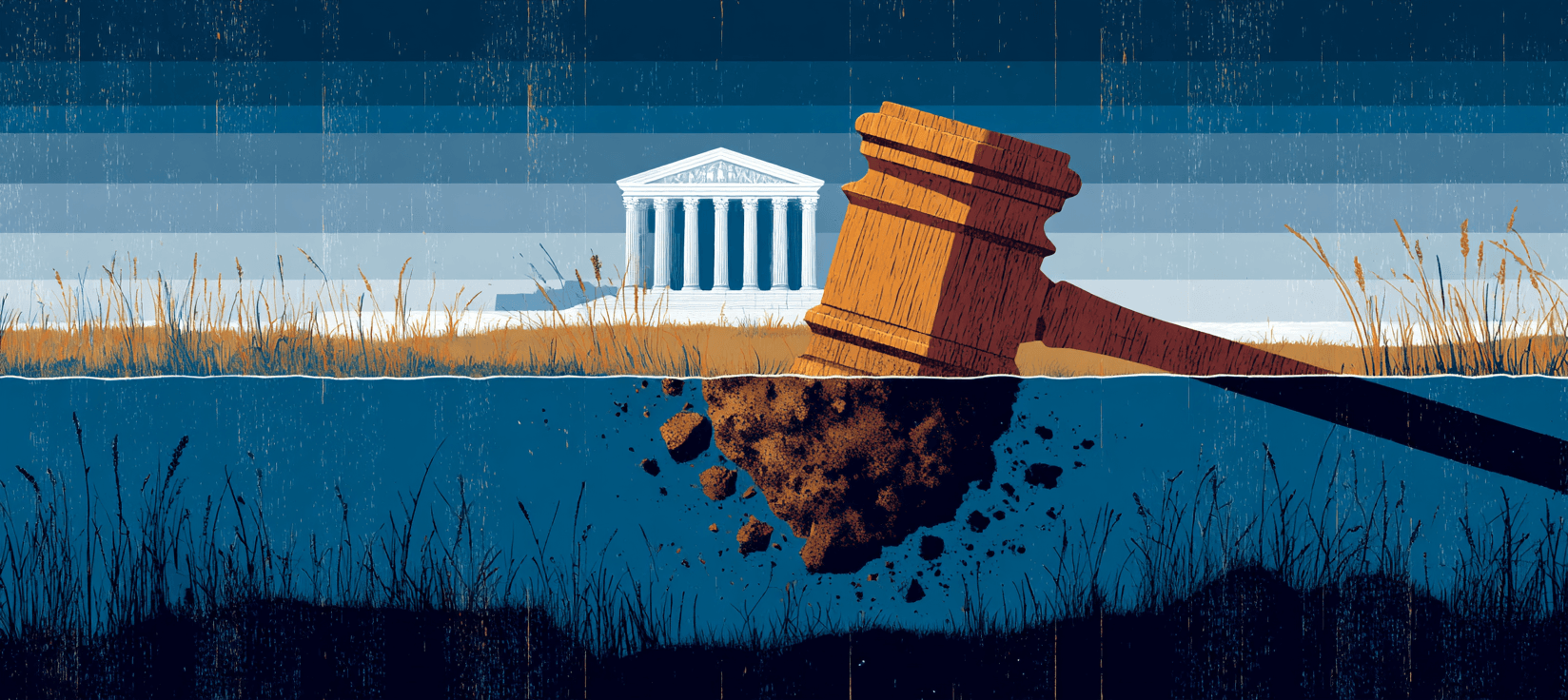
Drive south on Highway 23 through Plaquemines Parish and you can see it, or rather, you can see where it used to be. Levees rise on either side. The Mississippi to the east. To the west, Bay Vacherie, where open water sits in the footprint of marsh that stood within living memory, canals cut straight through the wetlands widening year by year into channels the Gulf pours through. The parish has lost roughly half its land area in a century. "After Katrina, the state did wake up and say 'Oh shit, we used to have 90 miles of land mass between us and the Gulf of Mexico,'" Scott Eustis, a lifelong Louisiana wetland researcher whose grandfather worked for the oil companies, told The Lens. "'Now, we have a bunch of swiss cheese.'"
A 1989 study commissioned by the industry's own trade group found:
"Canal development tend to be the overwhelming cause of wetland losses."
The industry knew. The marsh kept going.
Last April, in a courthouse in Pointe à la Hache, a jury of Plaquemines Parish residents sat through a month-long trial and returned a $745 million verdict against Chevron. $575 million for land loss. $161 million for contamination. $8.6 million for abandoned equipment. They found that Texaco, which Chevron acquired in 2001, had violated Louisiana's coastal management laws for decades: no permits, contaminated wastewater dumped into the marsh, no restoration. It was the first of dozens of pending coastal lawsuits to reach trial. Some of those jurors fish those waters.
Four days ago, the Supreme Court moved the case to federal court.
The Paradox the Jury Understood
Plaquemines Parish didn't sue the oil industry from a distance. Energy companies employ over 1,550 workers in the parish at an average salary of $111,274, more than double the local median income. When oil prices collapsed in 2015, the parish cut 300 of its 800 employees. A massive Venture Global LNG plant is under construction in Port Sulphur right now.
This is a community that sued the industry it depends on. The lawsuit survived four parish councils and five parish presidents, with pressure to drop it right up to trial. Attorney General Liz Murrill called the jury "one of the most conservative, pro-oil communities in the country." They found Chevron liable anyway.
The $745 million is the cost of damage the industry externalized for decades. Canals dredged without permits, wastewater dumped without cleanup, land lost without restoration. Louisiana's $50 billion coastal master plan is running dry as Deepwater Horizon settlement money expires. The coastal lawsuits were supposed to help close that gap. The verdict was a community trying to recover the price of its own land from the companies that took it.
What Moved
The 8-0 decision in Chevron USA Inc. v. Plaquemines Parish turned on World War II. Texaco produced crude oil in the parish during wartime, some refined into aviation gasoline for the military. Chevron argued this federal connection meant the case belonged in federal court under the federal officer removal statute. The Fifth Circuit had rejected that argument. The Supreme Court, in an opinion by Justice Thomas, reversed.
The standard is broad: challenged conduct need only bear "a close relationship" with federal duties. Texaco dug canals instead of building roads to save wartime materials. It used earthen pits to comply with a directive to conserve steel. That was enough. Lead plaintiff attorney John Carmouche has said 11 of the 42 pending coastal lawsuits are directly affected by the wartime removal argument. The other 31, which lack that World War II nexus, remain in state court.
The $745 million verdict will likely be vacated. The case starts over in federal court with a different judge, different procedural rules, and a jury drawn from well beyond the parish.
Federal courts are broadly considered more favorable to corporate defendants, particularly when national defense dimensions are in play. The Court ruled on where the question gets asked. Whether Chevron owes the money remains unanswered.
What Distance Changes
Pointe à la Hache sits on the east bank of the Mississippi, accessible by ferry. The courthouse is in a parish where the community of Delacroix watched dredging and toxic dumping eat the land around it, where a Shell manager's own 1980 internal report documented "flagrant violations of the law" including oil drained directly into the wetlands and never cleaned up.
Federal court will be somewhere else. The judge will have no relationship to the vanishing marsh. The jury will include people who have never watched a canal widen into open Gulf over the course of a lifetime. The marsh does not pause for procedural questions.
Murrill says she's confident the outcome will hold. Carmouche says his team will fight just as hard. The facts are the same. The contamination is documented. The land loss is measurable. The industry's own studies acknowledged the cause decades ago. But the distance between the people rendering judgment and the people living with the consequences just got wider. The cost the parish tried to recover stays the same. It has further to travel.
The jury that already answered the question won't be the one that answers it again. People who understood the paradox because they live inside it, who weighed the paychecks against the land and found the land was owed back. They've been replaced by a process measuring the same facts from somewhere farther away.
The marsh was right there. The courtroom won't be.
Things to follow up on...
-
California cases now frozen: San Francisco Judge Ethan Schulman stayed California's climate lawsuits while the Supreme Court decides Boulder v. Suncor, expected for oral arguments in October 2026, meaning dozens of state-level climate cases nationwide are effectively suspended in the interim.
-
Oklahoma shields fossil fuels: Legislation protecting the fossil fuel industry from climate-related lawsuits is headed to Oklahoma's governor this week, signaling a parallel legislative strategy to complement the judicial forum shift.
-
The endangerment finding wrinkle: EPA's February 2026 rescission of the greenhouse gas endangerment finding may have inadvertently weakened the federal preemption argument that industry defendants rely on, a potential irony tracked by the Columbia Sabin Center that hasn't been fully tested in court.
-
Race and insurance costs compound: New Brookings research finds that insurance market instability hits low-income Black and Latino communities hardest, layering financial extraction on top of the same environmental damage patterns at issue in the Louisiana coastal cases.