

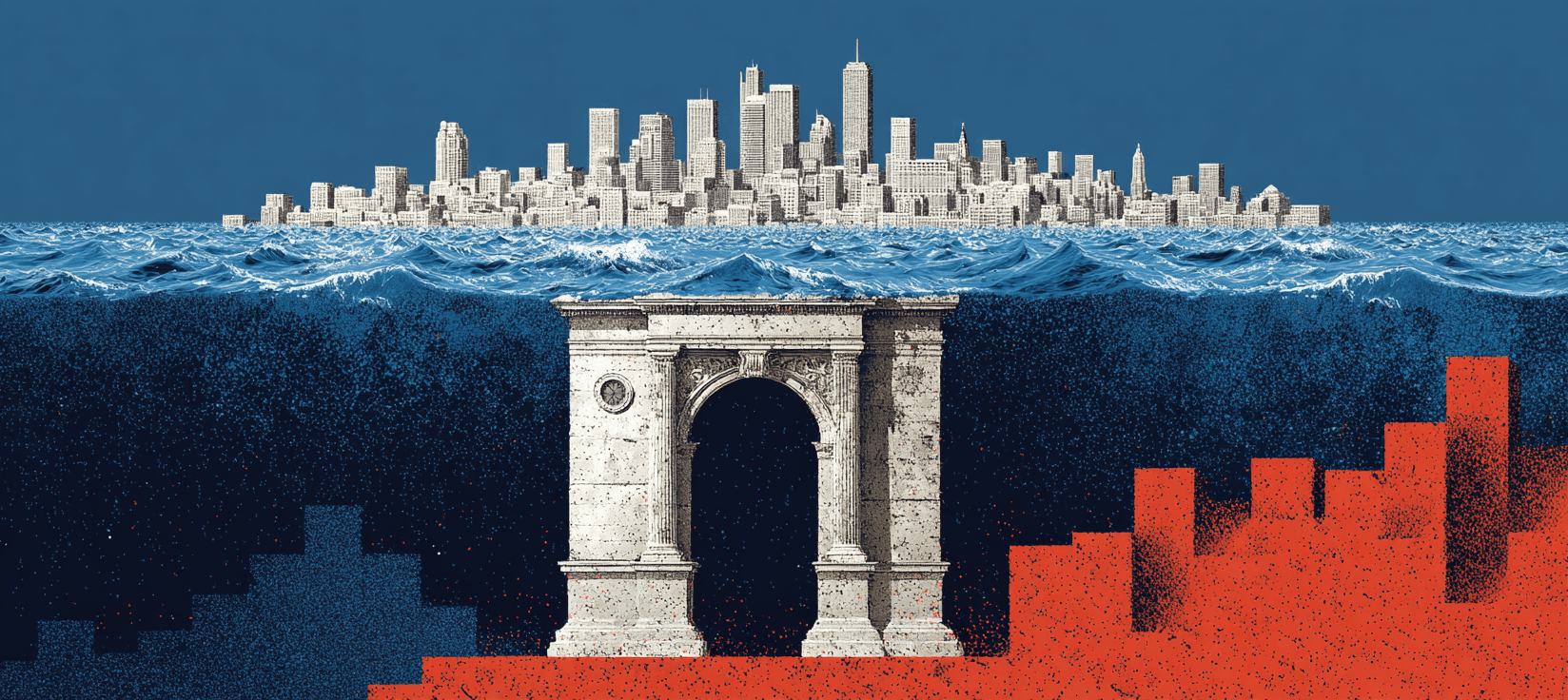
In December 2025, the Gulf Coast Protection District awarded contracts to design the largest flood gate system in the world. Two miles across the mouth of Galveston Bay. Gate crest elevation: 21.5 feet. Budget: roughly $34 billion. Construction through 2043, then fifty years of operation after that.
21.5 feet. That's the number. Specific, engineered, load-bearing. Everything downstream follows from it.
Four months after the contracts were signed, a study moved the science beneath that number.
On April 15, Portmann et al. published a correction in Science Advances to a salinity bias that had been distorting climate models of the Atlantic Meridional Overturning Circulation. The AMOC moves heat north through the Atlantic. The Gulf Stream is part of it. When it slows, sea levels rise along the US East Coast. The correction revised projected weakening by 2100 from 32% to 51%, with 90% probability. That number is contested. Fabien Roquet at the University of Gothenburg cautioned that another team using a similar method reached opposite conclusions last year. "One paper does not settle a scientific debate," said Frédéric Sévellec.
But the uncertainty range tightened.
| Previous projection | Revised projection | |
|---|---|---|
| AMOC weakening by 2100 | 32% | 51% |
| Transport estimate | 12.0 ± 6.5 Sv | 8.1 ± 1.4 Sv |
| Uncertainty range | Wide enough to design to the optimistic end | Narrowed by 79% |
The comfortable end of the range moved much closer to the uncomfortable end. The models got more confident about a worse outcome.
What Weakening Looks Like at the Waterline
When the AMOC weakens, the Gulf Stream slows. Less water gets pulled offshore. Levels rise along the coast. Stefan Rahmstorf at the Potsdam Institute estimates this dynamic effect alone at six to eight inches by 2100, layered on top of global mean rise from thermal expansion and ice melt.
"Unfortunately the realistic ones." — Stefan Rahmstorf, on the pessimistic models
That estimate predates the revision. No published study translates the gap between a 32% and 51% weakening into additional inches at the waterline. The relationship isn't linear, and the science hasn't caught up to the new number. But the direction is plain enough. A stronger weakening means more water stays inshore.
We have a recent example of what partial weakening does. In 2009–2010, a 30% AMOC downturn produced a five-inch spike in coastal sea levels north of New York City over two years. A 1-in-850-year event based on the full tide gauge record. Between 2015 and 2020, AMOC-driven heat redistribution accounted for 30–50% of flood days along the Southeast Coast. And between 2004 and 2023, ocean moorings documented a 10% weakening already underway at four key latitudes.
Five inches in two years from a temporary fluctuation. The Portmann study describes something permanent.
Norfolk and Galveston
Norfolk, Virginia has the fastest relative sea-level rise on the East Coast. Phase 1A of its $399 million coastal storm risk management project was authorized in 2020 and funded through the Bipartisan Infrastructure Law. Flood walls, pump stations, tide gates. Designs were built to scenarios from a 2018 feasibility study using USACE's standard three-scenario framework for sea-level rise, and were expected to be finalized by early 2025.
In Galveston, a 2025 study in Risk Analysis found the Ike Dike's future effectiveness unresolved under multiple sea-level rise scenarios. The project describes itself as "adaptable to future conditions, including sea level rise." What that means in engineering terms isn't specified in public documents.
Two of the largest coastal protection investments in American history. Both in active design. Both built to projections the Portmann study just moved past. And the room that planners had to design toward the lower end of the range, the room that made those projections feel workable, is the room that just closed.
Roquet may be right that one paper doesn't settle it. But the disagreement is the condition these projects are being designed inside. The science is actively diverging on trajectory while the decision windows close. The chain from a published paper to a revised crest elevation runs through peer review, federal guidance updates, state adoption, local permitting. By the time it propagates, the concrete is curing.
What's Not in the Number
The 51% figure does not include meltwater from the Greenland ice sheet.
The AMOC depends on dense, salty water sinking in the North Atlantic. Fresh water is lighter. It sits on top. It disrupts the density-driven sinking that powers the whole system. Greenland is adding that fresh water right now, through surface melt and calving that has accelerated over the past two decades. The corrected models still don't represent this mechanism.
"That is one additional factor that means the reality is probably still worse." — Stefan Rahmstorf, on Greenland melt absent from the revised projections
The 51% weakening projection already exceeds what current infrastructure projects were designed to handle, and it still doesn't account for Greenland's accelerating meltwater contributions.
The Margin Question
Nobody is going to stop building. Norfolk can't wait for scientific consensus while neighborhoods flood today. Galveston Bay needs a gate whether the AMOC weakens by 32% or 51% or something worse.
So the questions are specific. How much margin sits in the current designs, and against which scenarios. Whether "adaptable" means a gate crest can actually be raised after construction, and at what cost. When federal sea-level guidance gets updated to reflect this study, what happens to projects already past design review. Whether there's any point in the chain short enough to intervene before the specs lock.
The projection moved. The projects, so far, haven't. 21.5 feet is still the number. Whether it's the right number is something the water will answer, on its own schedule.
Things to follow up on...
-
The companion observational study: University of Miami researchers documented a 10% AMOC weakening between 2004 and 2023 using direct measurements from four ocean moorings along the western boundary of the North Atlantic, providing real-world validation that the modeled decline is already underway.
-
New York's coastal megaproject stalls: The $52.7 billion NY/NJ Harbor and Tributaries study, which proposes 41 miles of coastal barriers and 12 storm surge gates, will not meet the timeline for inclusion in a 2026 Chief of Engineer's Report, while the Regional Plan Association has publicly criticized its sea-level rise assumptions as insufficiently aggressive.
-
Colorado River forecasts systematically wrong: A University of Washington study found that warmer, drier springs explain nearly 70% of the gap between predicted and actual Colorado River flows, because plants are consuming snowmelt before it reaches rivers — meaning the primary forecasting tool water managers rely on has been overstating supply for over two decades.
-
Ocean methane not in models: University of Rochester scientists discovered in PNAS that microbes produce methane in open ocean under nutrient-poor conditions that warming intensifies, a feedback loop not currently included in major climate projection models — another mechanism, like Greenland melt, absent from the numbers we're building to.