

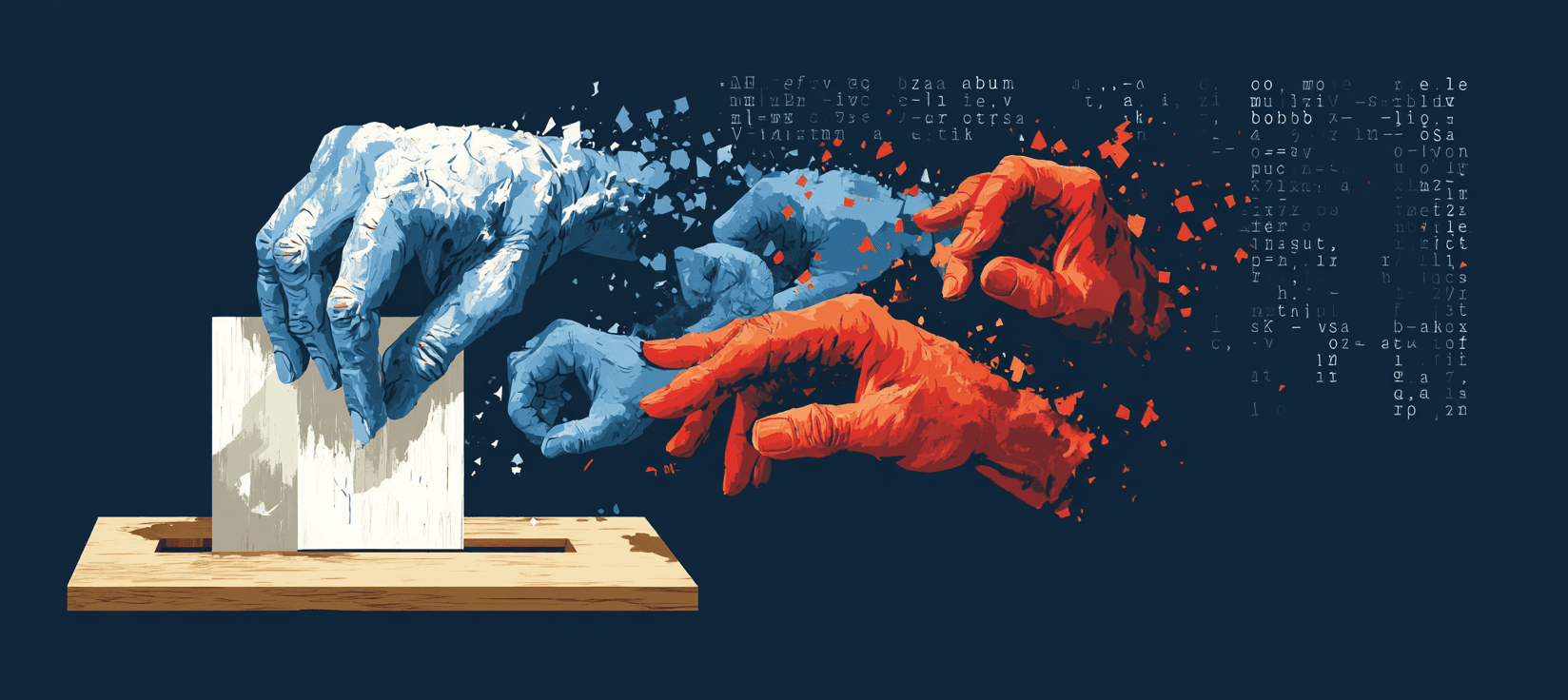
The moderator's hands had sorted ballots for forty-three years. School board elections, zoning amendments, the referendum on whether to rename the elementary school after someone who wasn't a slaveholder. Her fingers knew the weight of paper, the texture of pencil marks, the rhythm of counting that made democracy feel like arithmetic.
Tonight the ballots felt wrong.
She'd expected the weight difference, had even practiced with the weighted stock the state required for refugee voting. Triple-weight paper for recent arrivals, standard stock for everyone else. The printer had apologized about the color difference: cream for triple-weight, white for single. "Constitutional requirement," he'd said.
The wrong part was how her hands kept trying to make the piles equal.
She'd started counting at 8:47 PM. Forty-six people had voted, which meant forty-six pieces of paper but not forty-six votes. Her right hand held the cream stack—fourteen ballots. Her left held the white, thirty-two. The math was simple: fourteen times three plus thirty-two times one. Seventy-four total votes from forty-six people.
Her hands wanted to split the stacks evenly. Forty years of muscle memory insisted that democracy meant one person, one ballot, one pile.
The gymnasium had emptied except for the six people required to witness the count. Three sat in the front row: the woman who'd talked about her grandmother, the man with scarred fishing hands pressing his palms flat against his thighs, the town clerk who'd held this job before her. Three more stood by the exits, legally mandated observers.
"Problem?" The former clerk's voice carried across the basketball court.
"No." She picked up the first cream ballot. YES printed in block letters, pencil pressed hard enough to dent the paper. She set it in the YES pile, then added two phantom ballots beside it. Her fingers mimed the motion: one real, two imaginary, three total votes.
The man's scarred hands tightened against his legs.
Second cream ballot: NO. She placed it in the NO pile, added two phantoms. By the seventh cream ballot, her fingers had stopped reaching for imaginary papers. The physical motion had changed: she now placed each cream ballot with more force, a small impact that represented its triple weight.
The white ballots felt insubstantial after that. She had to remind herself they still counted, that thirty-two single votes still mattered even though fourteen triple votes outweighed them.
The woman who'd talked about her grandmother was crying silently, tears running down her face while she sat perfectly still, that spreadsheet folded in her lap like a prayer she'd forgotten the words to.
Halfway through the white stack, the moderator's hands started shaking. Not from age or exhaustion.
From counting votes that didn't count equally, from performing democracy that had given up on the pretense of equivalence.
Earlier that day, she'd marked her own white ballot and dropped it in the box with everyone else's. Single weight. Standard stock. Her vote counted once because her family had lived here for four generations, because she'd never been forced to move, because climate change had been something that happened to other people until suddenly it wasn't and those other people needed somewhere to go.
The white stack finished at twenty-one YES, eleven NO. Thirty-two votes from thirty-two people.
The cream stack: nine YES, five NO. Forty-two votes from fourteen people.
Total: sixty-three YES, sixteen NO. The five hundred people from Louisiana's disappeared coast would be accepted. The town's infrastructure would strain. The schools would split into shifts. The water treatment plant would fail and be rebuilt and fail again.
Her hands rested on the two piles. Unequal heights pressing against each other.
"Sixty-three to sixteen," she announced. Her voice sounded normal, professional, like she'd just counted a school board election instead of arithmetic that made people into fractions and multiples of themselves.
The woman stood up. So did the man with scarred hands. They didn't look at each other. The moderator watched them walk toward separate exits, their bodies moving through the gymnasium like they were already practicing the distance they'd maintain for the next decade while living in the same town, shopping at the same grocery store, their children attending the same overcrowded schools.
The former clerk approached the table. Looked at the two piles of ballots, cream and white.
"You did it right," he said.
The moderator's hands were still shaking. She'd counted thousands of votes in forty-three years. She'd never had to count by threes before.
"I know," she said.
Cream stack on top of white stack, triple-weight pressing down on single-weight. She gathered the ballots and carried them toward the archive room where they'd sit next to every other election going back to 1883.
Things to follow up on...
-
Houston's Katrina reception: When Houston absorbed 100,000-300,000 Hurricane Katrina evacuees in 2005, public opinion shifted dramatically from 97% community support to 70% viewing evacuees negatively by 2008, revealing how receiving communities' attitudes can deteriorate even when integration succeeds.
-
Historical weighted voting systems: Multiple democracies including Sweden, Belgium, and Southern Rhodesia used weighted voting systems based on property, education, or race until the mid-20th century, when they were abolished as discriminatory—though philosopher John Stuart Mill defended plural voting "in the cause of competence and participation."
-
U.S. climate displacement scale: According to Census Bureau data, 3.2 million U.S. adults were displaced by natural disasters in 2022, with over 500,000 still unable to return home by 2023, suggesting internal climate migration is already reshaping American communities at significant scale.
-
Migration projection uncertainty: Climate migration forecasts differ by about two orders of magnitude for international movement, while even the direction of internal migration remains uncertain, with no models yet proven to explain historical migration patterns—limiting confidence in any specific projection.